HRD analysis of the ABS Labour Force data reveals a hidden workforce opportunity that most employers are overlooking

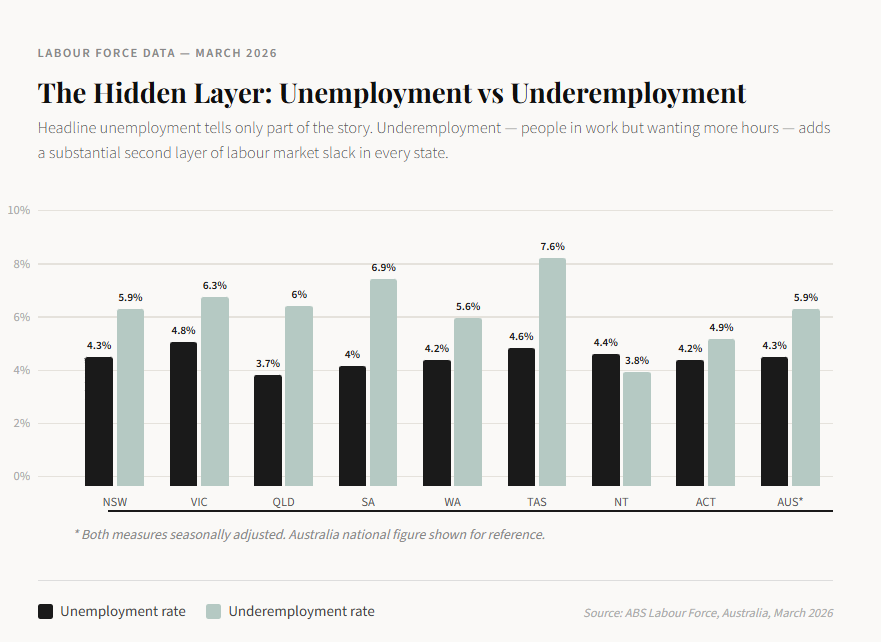
Australia's headline unemployment rate of 4.3% tells an orderly story: a stable, near-full-employment economy in which labour demand and supply are broadly matched. The March 2026 figures from the Australian Bureau of Statisticsconfirm this reading. But headline unemployment has never been the whole story - and for HR professionals seeking workforce capacity, a second figure buried deeper in the same release deserves considerably more attention.
The national underemployment rate sits at 5.9%. That is, nearly one in seventeen members of the Australian labour force is currently employed but actively wants, and is available for, more hours of work than they are presently receiving. In absolute terms, the ABS's new u-series analysis puts 450,000 employed people in the underemployed category - those who prefer more hours, are available for them, and have actively looked. Broaden the definition to include those who simply prefer more hours without having recently searched, and the figure rises to 7.8% of all employed Australians.
Taken together with the unemployed, total labour underutilisation stood at approximately 1.43 million people in March 2026. That is a substantial pool of working-age Australians whose productive capacity the economy is not fully deploying - and whose availability represents a meaningful opportunity for employers prepared to think creatively about workforce planning.
The strategic blind spot
The conventional response to a labour shortage is external recruitment. Yet in a market where job vacancies recently climbed to their highest level since November 2024 - reaching 337,900 nationally in February 2026 - that approach is neither swift nor inexpensive. Advertising costs, agency fees, induction time, and the inevitable productivity lag of a new hire all extract a toll that is rarely reflected in a job requisition.
The underemployment data suggests a different question deserves priority: before posting a vacancy, have you examined whether the capacity already exists within your existing workforce or within your sector's part-time cohort?
This is not a novel concept, but it is one that tends to fall out of focus when labour markets appear stable. An employee contracted for 24 hours per week who could productively work 32 represents an eight-hour weekly increment that requires no induction, no background check, and no cultural integration. For roles in which experience and institutional knowledge carry value - which is to say, most roles - that arithmetic is compelling.
The regional picture: Where underemployment concentrates
The state-level data from the March report sharpens the picture considerably, and the variation across jurisdictions is material for any organisation operating in multiple markets.
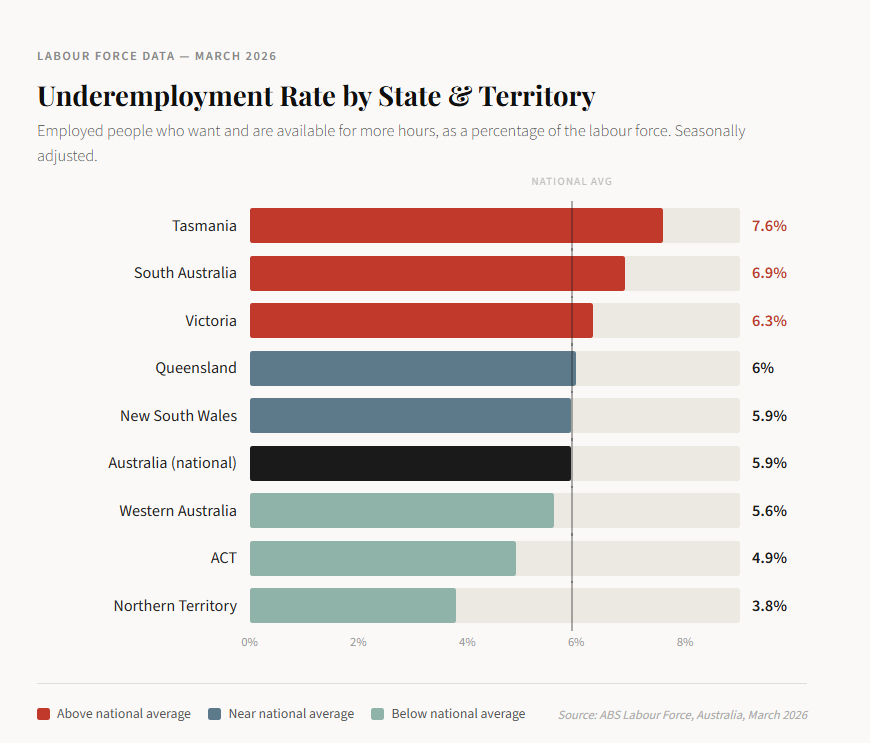
Tasmania records the highest underemployment rate of any state at 7.6%, followed by South Australia at 6.9%. Both figures are meaningfully above the national average and signal that employers in those states are operating in an environment where available hours significantly exceed contracted supply. For businesses with operations in Hobart, Launceston, Adelaide, or regional centres in those states, the case for proactive internal hour-expansion conversations is particularly strong.
Western Australia, by contrast, presents a markedly different environment. An underemployment rate of just 5.6% and an employment-to-population ratio of 65.9% - the highest of any mainland state - indicate a tight labour market with limited latent capacity. Employers in the resources, construction, and professional services sectors that dominate Perth and the regions should not expect to draw on a deep underemployed reserve; competitive external hiring and retention investment remain the primary levers.
Victoria and New South Wales sit close to the national average at 6.3% and 5.9% respectively, though their labour markets are evolving in divergent directions - a point addressed in the companion analysis below.
The part-time dynamic
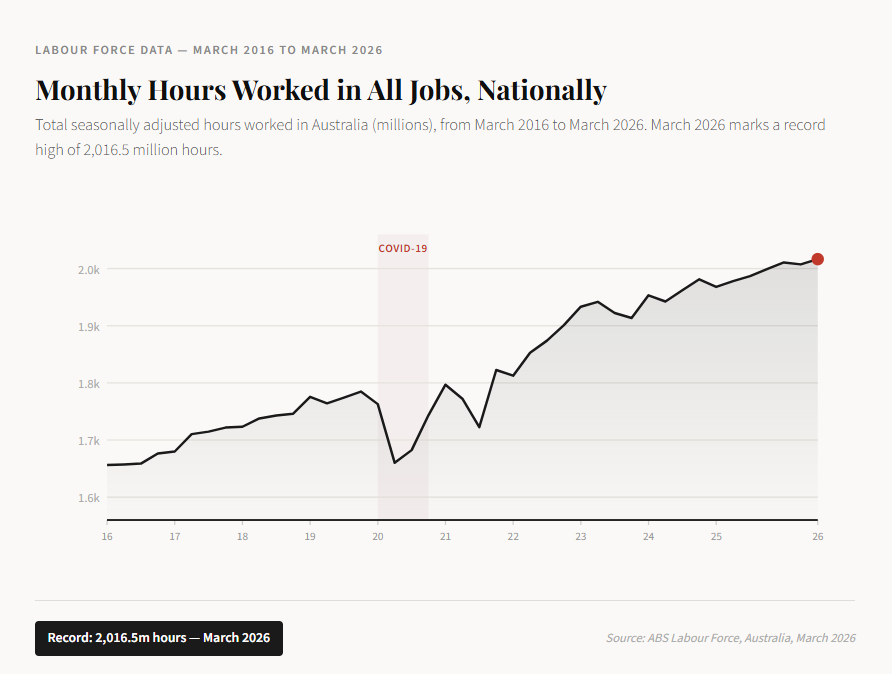
A notable feature of the March figures is the composition of employment growth. Nationally, full-time employment rose by 52,500 people in March, while part-time employment fell by 34,600. That shift towards full-time work is consistent with employers responding to capacity pressures by converting existing part-time arrangements - and it is precisely the mechanism that underemployment data would predict.
For HR leaders, this dynamic has a practical implication: the pipeline for full-time conversion already exists within the part-time workforce. Many part-time employees are in that arrangement not by preference but by the terms originally offered to them. Research from the Centre for Future Work has documented that 44% of Australian workers report dissatisfaction with their current hours, with a sizeable proportion working unpaid overtime simply to manage workloads that exceed their contracted time. That is not a workforce in equilibrium; it is a workforce sending signals that contracted arrangements and actual demand for labour are misaligned.
A note on legal and contractual obligations
Any expansion of an employee's hours requires careful handling. The Fair Work Act governs reasonable additional hours, and individual employment agreements and enterprise agreements may contain specific minimum and maximum hour provisions. As HRD Australia has reported, the Fair Work Commission has ruled against employers who substituted overtime rates for minimum ordinary hours guaranteed under Individual Flexibility Agreements - a reminder that any re-structuring of hours must be conducted within the terms of existing instruments and, where appropriate, through formal variation processes.
HR teams should also be alert to the distinction between an employee who genuinely seeks additional hours and one whose contracted arrangement reflects a deliberate work-life balance choice. A proactive conversation differs from an imposition; handled well, the former strengthens engagement. Handled carelessly, it produces the very attrition that the approach is designed to avoid.
The practical recommendation
For employers seeking to respond to skills and capacity pressures without the costs and risks of external hiring, the March 2026 data makes a straightforward case. Conduct a structured audit of your existing part-time and casual workforce: who is contracted for fewer hours than they prefer, and which roles have capacity for expansion? In states with elevated underemployment - Tasmania, South Australia, Queensland - there is an external supply of experienced workers already attached to the labour market and available at relatively short notice.
With more than 82% of Australian employers planning to recruit in 2026, competition for external talent will remain intense. The underemployed workforce is not a complete answer to that pressure, but it is an underutilised one - and the data suggests it is larger than most workforce plans currently acknowledge.