
The other important numbers that often get overlooked

When Australia's monthly labour force data lands, the unemployment rate swallows the room. It anchors every news bulletin, every ministerial statement, every market note. Today's ABS figures were no different: a 0.2 percentage point rise to 4.5% dominated the morning's coverage within minutes of the 11:30am release.
But for HR professionals, the unemployment rate has always been a lagging, aggregate, and often misleading guide to the actual conditions inside Australian workplaces. The number tells you where the economy has been. The figures surrounding it tell you where the workforce is going.
Buried beneath today's headline are four data points that deserve considerably more attention from CHROs, HR directors, and people strategy leaders than the unemployment rate itself. Each one carries a direct implication for how Australian organisations design work, develop talent, and manage their people through a softening labour market.
1. Hours worked are rising while employment falls – and that should concern you
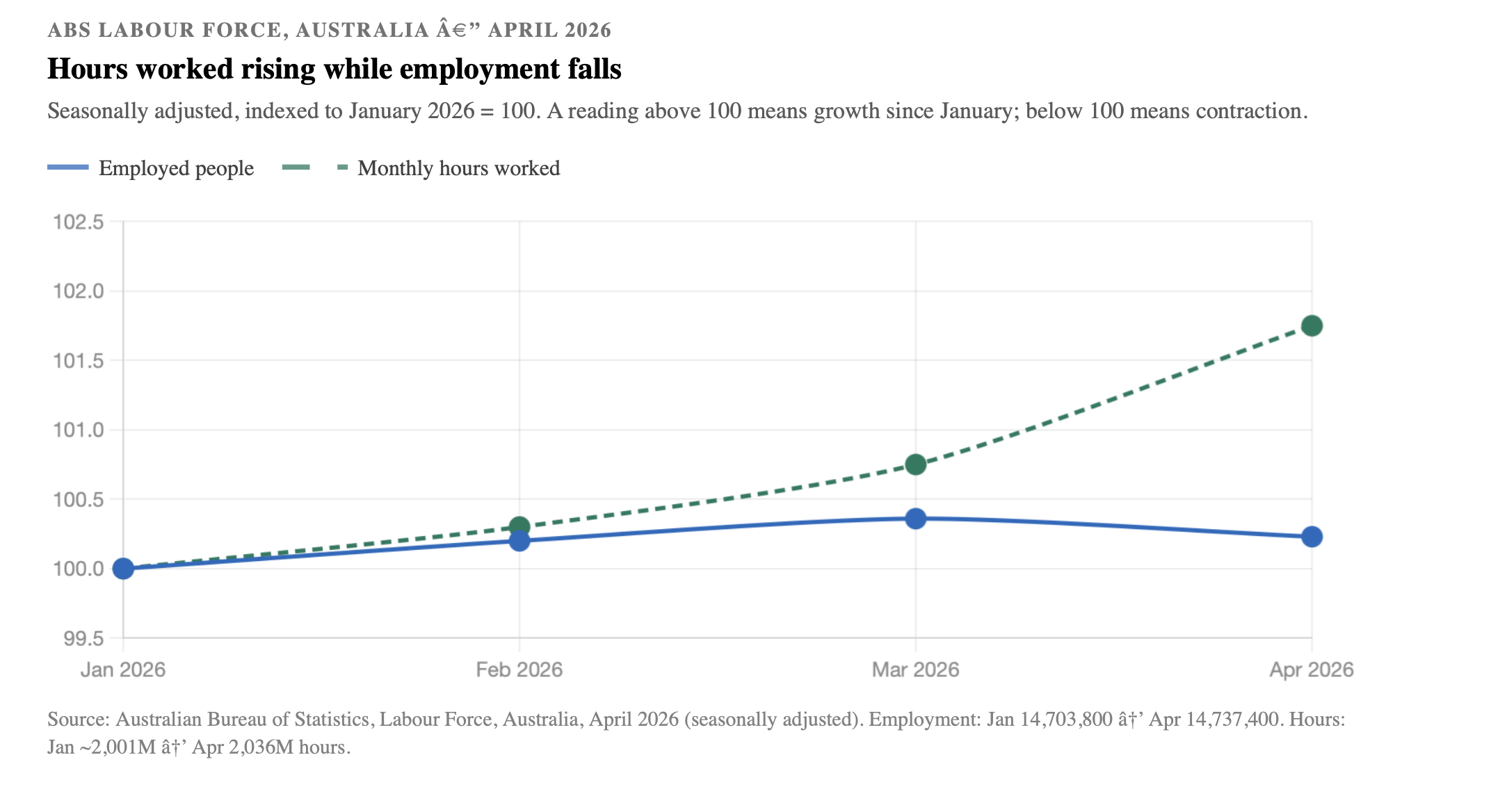
The single most striking tension in today's release is one that almost no general media coverage will touch: total monthly hours worked rose by 16 million to 2,036 million in April, up 0.8% for the month and 3.5% year-on-year. Employment, meanwhile, fell by 18,600 people.
Fewer workers. More hours. That divergence has a name: it is called labour intensification, and it is one of the more reliable early indicators of workforce stress.
The pattern is not new to 2026. HRD Australia has previously reported that between October 2025 and January 2026, the total number of shifts worked declined by close to 8% while total hours worked fell by just over 6% – with average hours per employee falling around 8% over that period, suggesting workers were not choosing to work less but that fewer hours were being made available to them.
April reverses that trend at the aggregate level. But the reversal is not unambiguously good news. When employment contracts and hours expand simultaneously, it typically means organisations are extracting more output from a smaller headcount rather than investing in workforce capacity. The immediate cost savings are real. The downstream risks – burnout, disengagement, attrition of the very people being leaned on most heavily — are equally real.
HRD Australia has reported that 80% of Australian workers are currently experiencing burnout, placing Australia as the most stressed workforce in the Asia-Pacific region. Among HR professionals themselves, 73% are considering leaving the profession entirely. Both figures precede today's data. The conditions that produced them have not improved.
For HR leaders, the hours-versus-employment divergence in the April data is a prompt to audit workload distribution across remaining teams — not as a compliance exercise, but as a retention and productivity imperative. The organisations that respond to cost pressure by quietly adding to the plates of those who remain will find that strategy has a time limit.
2. Youth unemployment at 11.1% – a structural problem hiding inside a cyclical one
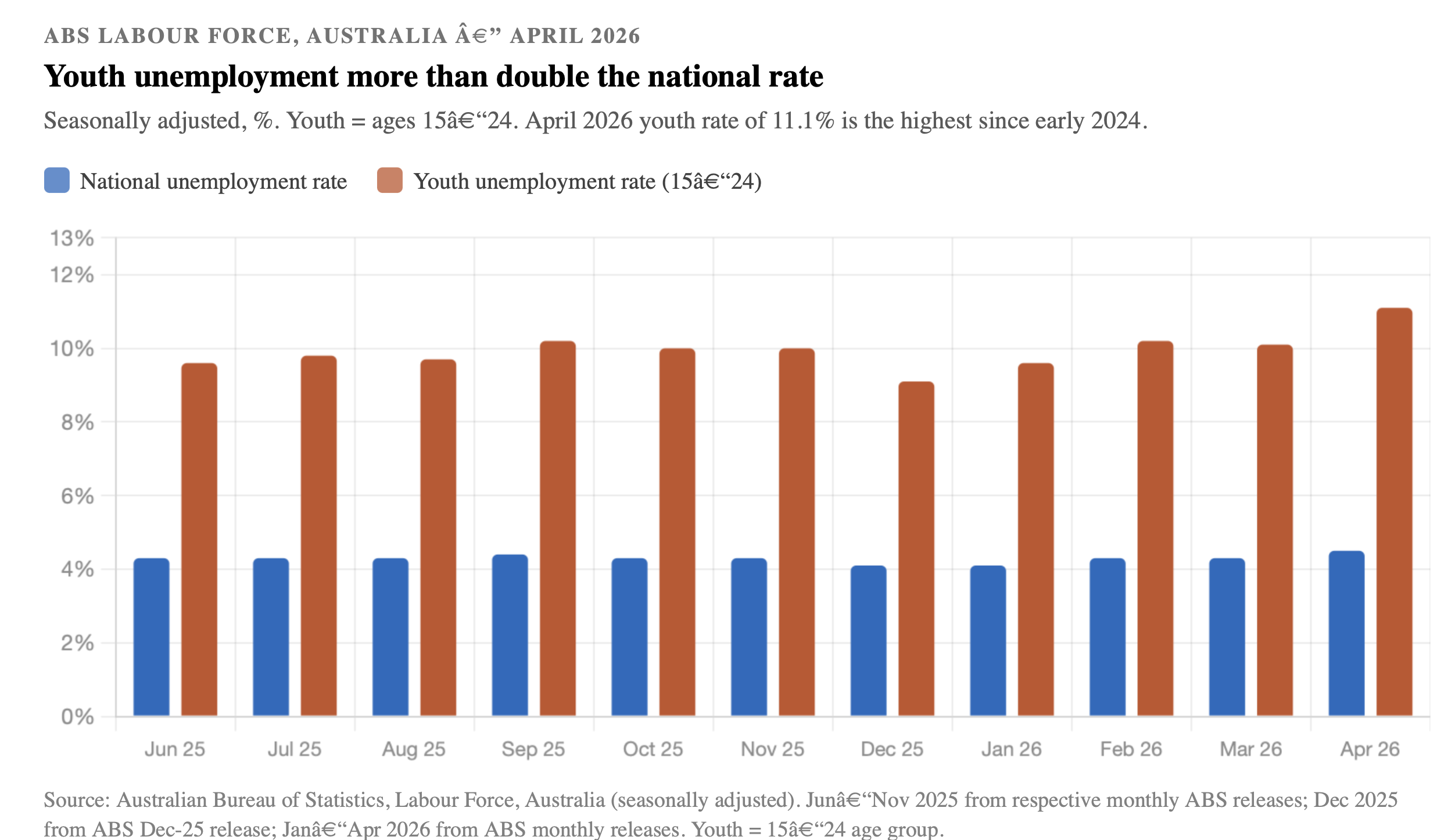
Youth unemployment jumped 0.9 percentage points in April to 11.1% – more than double the national rate of 4.5%, and the sharpest single-month increase in the April data.
For some HR readers, this will register as a cyclical story: young people are always more vulnerable to labour market softening, their shorter tenure and higher job mobility making them first in and first out through the employment cycle. That reading is not wrong. But it is incomplete.
A deeper structural shift is underway in Australia's early-career labour market that predates the current economic softening and will outlast it. HRD Australia has reported extensively on the disappearance of entry-level roles, noting that some employers have already signalled they are hiring fewer junior workers as routine tasks are absorbed by AI tools – even as overall employment remained relatively stable. A Harvard working paper published in May 2026, analysed by HRD, found that at firms which had adopted generative AI, junior employment declined by approximately 9% after six quarters relative to non-adopting firms. The decline was driven by a reduction in new hiring, not by dismissals of existing workers.
The compounding risk for Australian businesses is not simply that young people cannot find work today. It is that the organisations shedding or not creating entry-level roles are simultaneously eliminating the pipeline that produces their mid-level managers and senior specialists of the 2030s. As HRD Australia has reported, the senior leaders of 2035 are the junior hires of today – and today, an increasing share of those hires are not being made. CFOs are simultaneously intensifying succession planning while reducing junior hiring, two intentions that are in direct tension.
For HR professionals, the 11.1% youth unemployment figure is a call to examine whether their organisation's approach to graduate and entry-level recruitment is being driven by genuine workforce planning or by a series of short-term cost decisions that will be difficult to reverse.
3. The gender gap in the April data is more significant than it looks
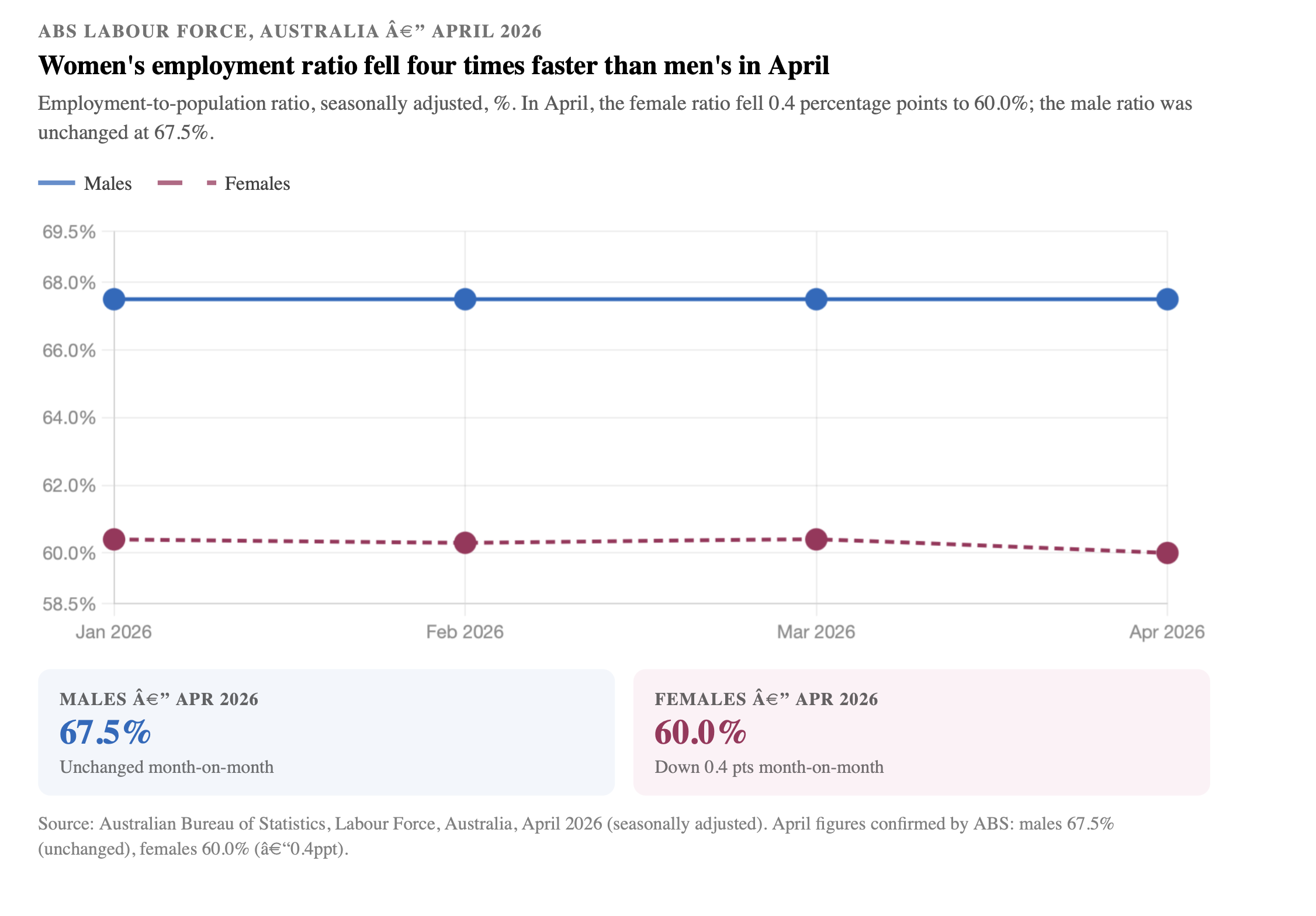
The April figures contain a gender dimension that the unemployment headline entirely obscures. Women's unemployment rose 0.4 percentage points to 4.4% – four times the monthly change in the male rate, which held steady at 4.6%. The employment-to-population ratio for females fell 0.4 percentage points to 60.0%, compared to no change for males at 67.5%. The female participation rate fell 0.1 percentage points to 62.8%; the male rate held at 70.8%.
This is a single month of data and should not be over-interpreted. But it is consistent with a pattern that HRD Australia's analysis of gender pay gap and employment data has documented: women's workforce position remains structurally more precarious than men's, with more than 50% of large Australian employers recording gender pay gaps exceeding 11.2% in favour of men.
The structural reasons are well established. Women are more likely to work part-time, more likely to be employed in industries sensitive to consumer and business spending, and more likely to carry primary caring responsibilities that make workforce exits easier and re-entry harder. When the labour market softens, those structural vulnerabilities compound.
For HR leaders, the gender dimensions of April's data represent a specific risk to hard-won progress on workforce gender equity. Organisations that have spent recent years closing participation and pay gaps may find those gains quietly eroding if cost-cutting decisions fall disproportionately on part-time, casual, and flexible arrangements – the working patterns most used by women.
4. Falling underemployment is a genuine bright spot – but read it carefully
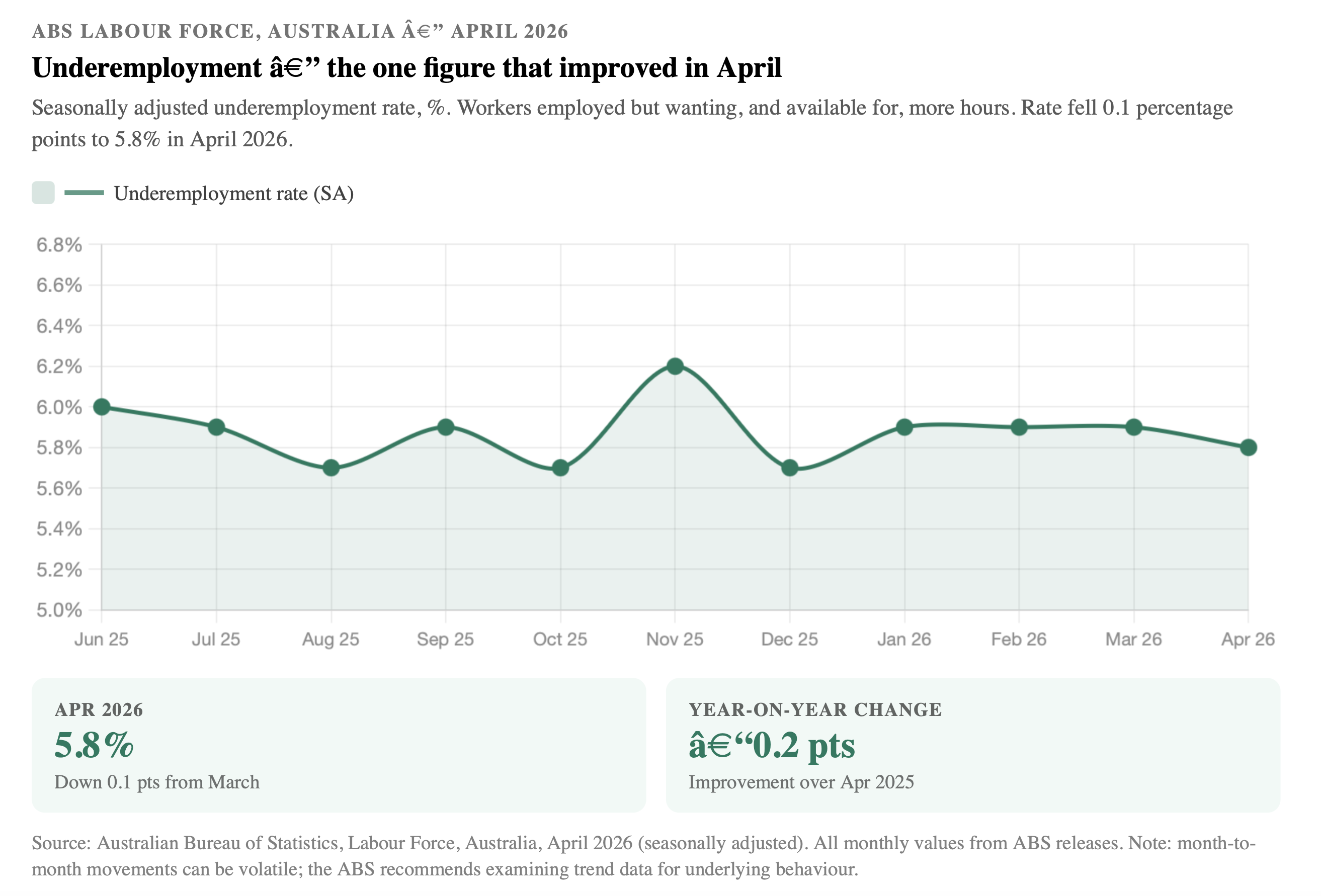
One number in today's release moved in the right direction: the underemployment rate fell 0.1 percentage points to 5.8%. For a data release that was otherwise unwelcome, this is a meaningful counterpoint.
Underemployment measures workers who are employed but want, and are available for, more hours than they are currently receiving. Its decline suggests that even as overall employment contracted, the workers who remained employed were accessing more of the hours they sought – consistent with the rise in total hours worked discussed above.
HRD Australia's analysis of March underemployment data noted that the national underemployment rate, at that point 5.9%, represented approximately 450,000 employed Australians who were available for additional hours. For employers under cost pressure and reluctant to undertake external recruitment, that pool represents an underutilised internal resource — workers already attached to the labour market, already onboarded, already familiar with their industries, available at relatively short notice.
The strategic implication cuts both ways. A falling underemployment rate means some of that internal slack has been absorbed. But at 5.8%, the pool remains substantial. HR professionals who responded to earlier skill shortages by reaching immediately for external hiring may find it worth revisiting whether existing casual, part-time and contracted workers could fill capacity gaps more efficiently – and with significantly lower recruitment costs and time-to-productivity.
There is also a wellbeing dimension to the underemployment figure that HR leaders should not ignore. Workers who are underemployed – who want more hours and cannot get them – face persistent financial insecurity that affects engagement, performance, and the likelihood of seeking additional employment elsewhere. A declining underemployment rate is, among other things, a signal that fewer workers are caught in that position.
What the four figures add up to
Taken together, these data points do not tell a story of a labour market in crisis. They tell a story of a labour market under pressure, shifting shape in ways that are uneven across demographics, employment types, and workforce segments.
The divergence between hours worked and employment numbers points to intensifying workloads that carry burnout risk. The youth unemployment figure points to a structural pipeline problem that cyclical hiring will not fix. The gender differential in the April data points to a specific equity risk that deserves targeted monitoring. And the falling underemployment rate, the most encouraging figure in the release, points to an internal workforce resource that many organisations are still underutilising.
None of these signals will lead the evening news. All of them will shape the workforce decisions that HR leaders make in the months ahead – and the organisations that pay attention to the full picture, rather than the headline number, will be better placed for it.


