A record Fair Work undertaking makes NAB’s people and culture executive answerable for making sure the bank’s next pay deal works from day one

For the first time, the Fair Work Ombudsman has put a company’s most senior HR executive in charge of making sure a new enterprise agreement can be paid correctly before it takes effect.
The company is National Australia Bank. Under an Enforceable Undertaking announced on Thursday, NAB is completing payments of $127 million in underpaid wages and entitlements, plus $34 million in interest and $8 million in superannuation, to 65,999 current and former staff. It will also make a $2 million contrition payment to the Commonwealth, the largest the regulator has ever included in an undertaking. HRD’s news report on the undertaking covers the full list of entitlements involved.
What is an enforceable undertaking? It’s a written agreement under section 715 of the Fair Work Act. The employer admits breaches and commits to fixing them, and the Fair Work Ombudsman accepts it instead of going to court. If the employer doesn’t keep its promises, the regulator can ask a court to enforce them. The contrition payment goes to the Commonwealth, not to workers.
The ABC’s markets blog described NAB as “penalised”, but strictly speaking it hasn’t been. Fair Work Ombudsman Anna Booth said an undertaking was appropriate because NAB had cooperated with the investigation, would fully fix the underpayments, and had committed to stronger compliance and governance. Workers NAB can’t locate will have their money paid to the Commonwealth’s unclaimed monies account, which former staff can search online.
Read next: ‘Disappointing’: NAB reveals it underpaid employees
How it went wrong
NAB first self-reported to the Fair Work Ombudsman in late 2019 after finding significant errors in implementing its then enterprise agreement. Years later, when rolling out a new agreement in 2024, it discovered it had not properly found and fixed the earlier problems, and it was still underpaying staff. The underpayments ran from 2012 to 2026.
The regulator’s list of root causes was; weak governance and compliance oversight, poor record-keeping, legacy payroll technology and limited investment in specialist payroll capability. NAB also failed to run the reconciliation checks its own agreement required, comparing what staff were paid against what they would have received under the Banking, Finance and Insurance Award 2010.
In other words, the bank negotiated a safeguard into its own agreement and then didn’t use it.
That history explains the new requirement. NAB must set up a steering committee, chaired by Sarah White, its Melbourne-based Group Executive People and Culture, to plan and put into operation any new enterprise agreement. Its job is to make sure the bank’s systems and processes can deliver every requirement of the agreement before it starts.
Complaints as an early warning
The undertaking also treats staff grievances as compliance data. NAB must improve the systems it uses to spot trends in employee complaints and to track each complaint from receipt to resolution, and it must report those improvements to the FWO. Booth said the aim was to pick up emerging problems in complaint channels “before they become systemic”.
Other commitments include an independent audit of a new payroll platform with findings reported to the FWO, regular staff forums, regular compliance reporting to the board, and mandatory training on recording additional hours worked.
That last item has some history behind it. The Finance Sector Union (FSU) took NAB to the Federal Court in 2023 over members on annualised salaries who said they were being required to work unreasonable additional hours. The case settled through court-directed mediation, announced in April 2026, with a framework that treats additional hours as a physical and mental health risk and new rest and recovery leave provisions. The union’s argument was that “a packaged salary does not mean unlimited hours”.
Banks raise the bar
NAB isn’t the first big four bank to sign an undertaking for a long-running underpayment. In November 2025, Westpac signed one after back-paying nearly 47,000 staff more than $50 million for underpayments over 11 years, with an $800,000 contrition payment. Westpac’s average back-payment was about $1,000. At NAB, the average is about $1,934, and individual payments run from under $5 to more than $87,000.
Westpac’s undertaking already pointed to worker voice as it required a dedicated channel for staff to raise pay concerns and regular consultation with employees and the FSU. At the time, Booth said: “We cannot overstate the importance of sound governance and proper board oversight”. NAB’s deal goes further, putting a named executive role in charge of agreement readiness.
Read next: Westpac back-pays over $50 million in underpayments
Not just banks
Universities have produced most of the other large undertakings. In December 2024, the University of Melbourne agreed to pay more than $72 million, including interest and super, to more than 25,000 staff, with a $600,000 contrition payment. In July this year, UNSW agreed to pay $32.7 million to 33,069 current and former employees, plus $500,000.
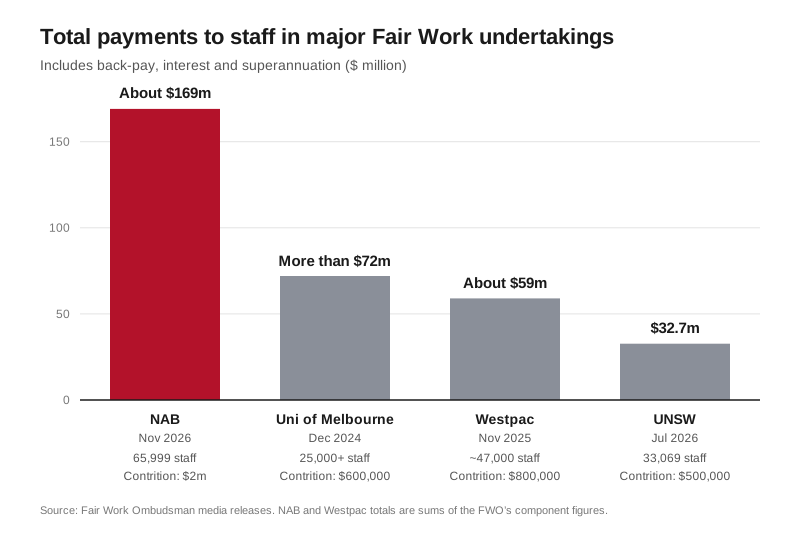
NAB’s total is more than double the next-largest undertaking in this group, and its $2 million contrition payment is more than double Westpac’s.
The FWO says improving compliance among large corporates is a priority, and that it has helped recover more than $1.2 billion for workers from large corporates over the past five financial years.
Read next: UNSW signs $32m enforceable undertaking over staff underpayments
What HR should take from it
NAB told the market in August 2025 it expected about $130 million in FY25 costs to fix payroll issues, and the FSU says that was on top of $128 million in earlier repayments and program costs.
The practical lesson is about timing with this decision. Payroll configuration usually starts after an agreement has been voted up. NAB is now required to work the other way round, testing system capability while the agreement is still being planned. HR directors heading into bargaining rounds may find their boards asking for the same thing.
Context matters too. Intentional underpayment became a criminal offence under the Fair Work Act on 1 January 2025. Nothing in the FWO’s release suggests NAB’s underpayments were deliberate. Still, the stakes for large employers that leave known problems unfixed are higher than when NAB first self-reported in 2019.
The timing is awkward for the bank. Big four chief executives are appearing before the House of Representatives economics committee this week, with NAB scheduled for Friday, according to the ABC.
Before your next enterprise agreement goes live
These steps draw on what the FWO required of NAB:
-
Test payroll against every new clause before the agreement is voted up, not after it starts.
-
Put a senior executive in charge of agreement readiness, with payroll, industrial relations, technology, risk, audit and legal all involved.
-
Run any reconciliation checks the agreement requires, such as comparing salaries with award entitlements, on schedule and on the record.
-
Make sure time and attendance data captures additional hours, including for salaried staff.
-
Look for patterns in pay complaints, not just one-off fixes.
-
Report pay compliance to the board regularly.
-
If you find a problem, use the FWO’s Payroll Remediation Program guide to plan the fix.
Read next: University of Queensland backpays about $11m to underpaid staff