This R U OK? Day, HR leaders are told genuine support means embedding check-ins into daily workplace culture, not one annual gesture
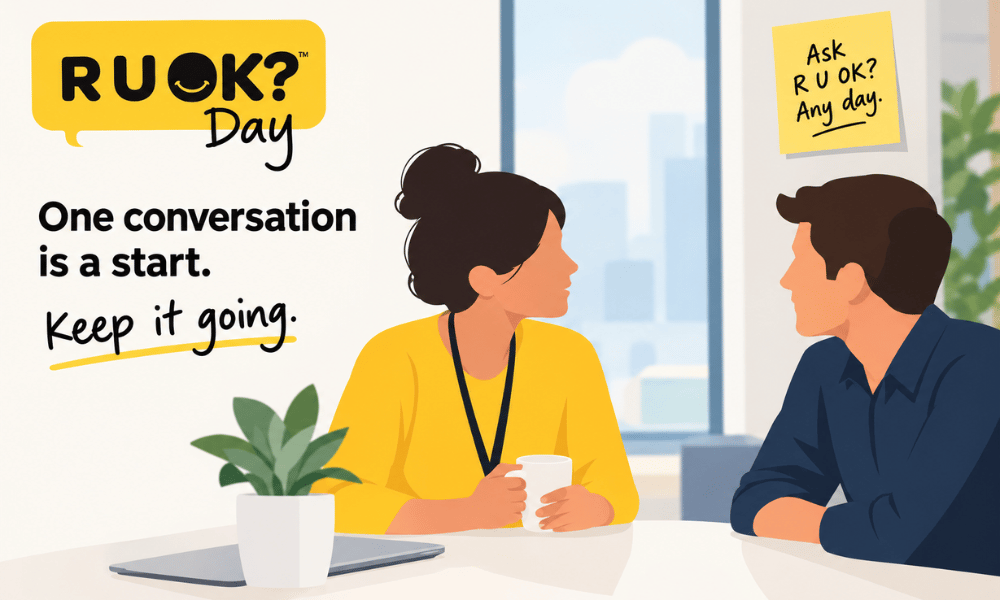
As Australia marks R U OK? Day (10 September), new research is pushing HR leaders to confront an uncomfortable gap: most people underestimate how much a single question can matter, and most organisations are still treating the day as a once-a-year event rather than a habit.
New research from R U OK?, the national suicide prevention charity behind the day, has found that one in three Australians underestimate the difference they can make by asking someone if they are okay, even though the vast majority of people who have been asked say they felt supported and positive about the experience. The findings land as the charity leans into this year's secondary message: "If you're thinking it, ask R U OK? Any Day."
Julie-Anne Whitfield, workplace program manager at R U OK?, works with organisations of all sizes throughout the year to help build what she calls an ongoing culture of care, rather than a single day of activation.
"My role is to build the confidence of people within workplaces at all levels of an organisation," Whitfield said, "because it should be an all-organisational approach to culture and wellbeing, not just potentially the HR manager or the WHS manager or peer support workers or mental health first aiders. It's actually an entire organisational approach on an ongoing basis."
Whitfield said a day of activation still has value, but it is only the opening move. "Year-round support is built through trust, good work design, capable leaders, building the leaders' confidence to have these difficult conversations, understanding what support networks and pathways are available within the organisation, and basically just having regular human check-ins," she said.
"It's not necessarily that I'm against performative wellbeing in any way, shape, or form. But I suppose the difference between performative wellbeing and genuine support is where the care is embedded into everyday work."
Ingrid Jenkins, chief people officer at workplace wellbeing platform Sonder, said the format of a check-in matters as much as the intent behind it. "There's no one-size-fits-all way to check in on someone. Sometimes it'll work best as a direct, one-to-one conversation. Other times speaking shoulder-to-shoulder, walking, driving, or working alongside someone, which can feel far less confronting than sitting across a table, is a better fit," Jenkins said.
"That's also why R U OK? Day can't be the whole strategy. A morning tea or a staff-wide email once a year can feel like a tokenistic gesture, and tokenistic gestures can actually erode trust rather than build it."
The scale of the problem behind the question
The case for moving beyond a single day is backed by data Jenkins cited from Sonder's own research: 77 per cent of employees experience poor mental health symptoms, yet 78 per cent don't identify as having a mental health condition, meaning most people struggling at work do not think of themselves as someone with "a problem."
Nearly half have experienced stress in the past 12 months, but only 13 per cent sought professional support. R U OK?'s own research, Jenkins said, shows 90 per cent of people who are regularly asked if they're okay feel more supported, connected and cared about.
"That's exactly why initiatives like R U OK? Day matter," Jenkins said. "It's not the one conversation that changes things, it's having regular check-ins that enable you to deepen connections."
Whitfield pointed to a related pressure point: roughly one in two people in Australia report feeling lonely, and much of that plays out inside workplaces, particularly amid the shift to hybrid arrangements. "When you're not having that day-to-day interaction with people, it's very difficult to know how somebody is traveling," she said, adding that leaders need to be "constantly thinking about what's going on in my employees' world."
What this means for HR leaders under WHS law
For HR and people leaders, the stakes are no longer just cultural. Jenkins said the shift to proactive checking-in is reinforced by law: under Work Health and Safety (WHS) legislation, employers carry a positive duty to identify and manage psychosocial hazards at work, such as unreasonable job demands or poorly managed change, rather than waiting for harm to occur, a shift HRD has tracked in its earlier reporting on workplace psychological injury moving onto safety regulators' radar.
That legal backdrop, combined with separate findings that workplace loneliness is quietly eroding productivity and retention, is why both Whitfield and Jenkins argue leaders should treat R U OK? Day as a prompt rather than a program. As HRD reported when discussing mental wellbeing at work around a previous R U OK? Day, the charity has long urged employers to embed its material into ongoing routines rather than a single annual push.
Whitfield's message for the day itself is simple: notice, and act on it. "If you're thinking about someone's wellbeing, that's reason enough to check in," she said, quoting R U OK?'s principal psychologist, Rachel Clements. "A simple conversation can help someone feel seen, heard and supported."
Jenkins agreed the follow-through is what separates genuine care from a gesture. "The first conversation opens the door, but it's the follow-up that shows someone the door is still open, even something as simple as asking 'how's things been since we spoke?' in your next one-on-one," she said. "That consistency is what turns one good conversation into real, ongoing support."