As mental health claims soar, HR leaders say prevention starts with how work is designed, led and managed
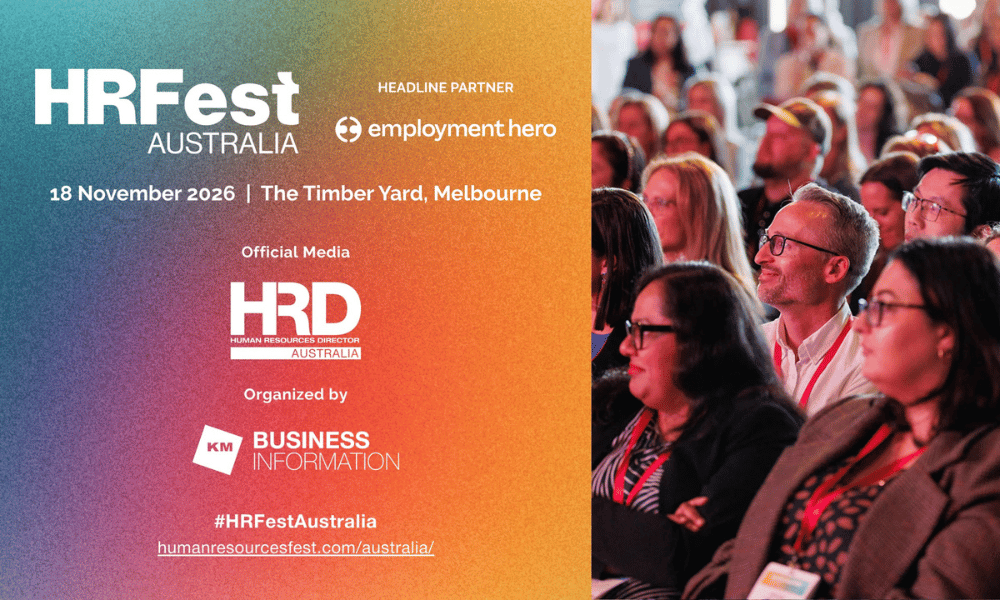
Australian employers will not curb psychosocial risk with more first aid and resilience training – they need to change the work itself, according to HR and wellbeing leaders who spoke at HRFest Australia 2026 in Melbourne last week.
Across two wellbeing panels, executives from L'Oréal, MUFG, TELUS Health, AGL, TAL and Australian Red Cross Lifeblood argued that psychosocial hazards – aspects of how work is designed, managed and experienced that can cause psychological harm – must be controlled at the source, not managed after someone is hurt.
The stakes are rising. Safe Work Australia's Key Work Health and Safety Statistics Australia 2026 report recorded 17,900 serious workers' compensation claims for mental health conditions. That is 12.2 per cent of all serious claims and a 169 per cent increase over the past decade, as shown in Safe Work Australia's latest national work health and safety figures.
Tim Nelson, senior director, APAC business development at TELUS Health, said organisations too often focus on how individuals cope rather than on the hazard itself.
"You get to the office tomorrow... and there are a pack of lions roaming the workplace. The first thing we want to do is conduct first aid training to make sure when people get bitten by a lion, we can stem the bleeding," he said. "Have we actually taken a step back and tried to remove the lions from the workplace?"
"It's absolutely critical that we look at removing the risks themselves, controlling the hazards, and fundamentally changing the risk profile rather than focusing on the individual staff responsibility," he said.
Nelson said job design is one of the key issues coming out of TELUS Health's psychosocial risk assessments. He described a consulting firm where staff routinely worked 60 to 90 hours a week. Projects there were priced and scoped to win the work, not to be delivered in normal hours.
"To say to a manager, your staff are working too much, fix it, but not give them the how, why, makes it almost an impossible job for them to achieve," he said.
Nicki Tan, manager psychosocial safety at AGL, said bullying complaints often have their roots in work design. One example is friction between sales teams chasing targets and operations teams left with the rework.
"We always say incivility is a gateway behaviour," Tan said. "If we can solve the friction points from a work design perspective, it will actually eliminate the behaviour itself."
What mental health claims reveal about work
David Savio, director – wellbeing, inclusion and safety at Australian Red Cross Lifeblood, described claims data as a lag indicator: it signals harm long after the warning signs were missed.
Glenn Baird, head of mental health at TAL, said mental health has been the insurer's leading cause of claim for five years. He said about half of TAL's income protection and total and permanent disability (TPD) claims where mental health is the primary condition trace back to work.
"About half of those are triggered by workplace bullying, workplace stress, workplace abuse, burnout. That's what we see on the claim forms, in the psych notes," Baird said.
He pointed to Council of Australian Life Insurers (CALI) research showing that TPD claims for mental health among people in their 30s rose 732 per cent over a decade. What often makes the difference in recovery, he said, is staying connected: "When you see claims where there's continual engagement... that's when we see great outcomes."
Tan added that how employees experience the claims process can shape their final outcome as much as the original incident. "Perception of organisational support and perceptions of organisational justice actually plays a really big role in moderating the final harm outcome," she said.
Why well-intentioned managers are a hidden risk
Karen Crew, head of people at MUFG, said the biggest leadership risk is not low capability.
"It's the people leaders who are well-intentioned. They're the great people leaders who are just under so much pressure that they don't realise their leadership style shifted from that human-centred leadership to the transactional surface-level leadership," she said.
Paul Steer, chief HR officer ANZ at L'Oréal, said the most common pitfall he sees is avoidance. One new senior executive told him they weren't confident having these conversations and expected HR to train them. "It's like, no, you're a well-paid executive. It's time to lean in," he said.
L'Oréal's traffic-light workload check-in showed what does work. Only about 5 per cent of staff used the formal scorecard, but the green, amber and red language caught on in everyday conversations. "The process doesn't always have to be documented and formal, but the conversation must occur," Steer said.
How to win executive buy-in
Nelson said hard numbers cut through for leaders who need a business case. In one assessment for a multinational with 70,000 employees, TELUS Health found psychosocial hazards were costing the equivalent of 700 full-time employees' worth of lost productivity.
"You tell an executive that you've got 700 people that you're paying to do nothing, it's amazing how quickly they start listening," he said.
Nelson said most directors now understand they can be personally liable under work health and safety laws. That pressure has grown as HR leaders now carry personal liability for psychosocial risk failures.
Crew urged HR leaders to stop treating psychosocial safety as a standalone program and to build it into what managers already do. "It's about thinking critically around how do I embed this in the things that our people leaders already do, like our employee listening strategy or our leadership development tools," she said.