Researchers calls for Fair Work Act amendment so any monitoring of employees must be fair and reasonable

Australia's laws governing workplace surveillance are "dangerously out of date," leaving workers exposed to increasingly intrusive AI-powered monitoring and employers uncertain about what is lawful, according to a new report from the University of Technology Sydney's Human Technology Institute (HTI).
The report, Drawing the line: Tech-enabled surveillance of Australian workers, calls on the federal government to amend the Fair Work Act 2009 so that any monitoring of workers must be "fair and reasonable."
"Whether driving a truck, sitting at a desk or sorting supermarket shelves, workers are being subjected to more invasive forms of surveillance. Often workers simply don't know that the computers, mobile phones and other tech they rely on can also be used to monitor and surveil them," said Professor Edward Santow, Co-Director of HTI in Sydney.
"Yet our laws are dangerously out of date. They don't protect workers from harmful forms of surveillance, and nor do they give clarity to employers about what forms of monitoring are acceptable," Santow said.
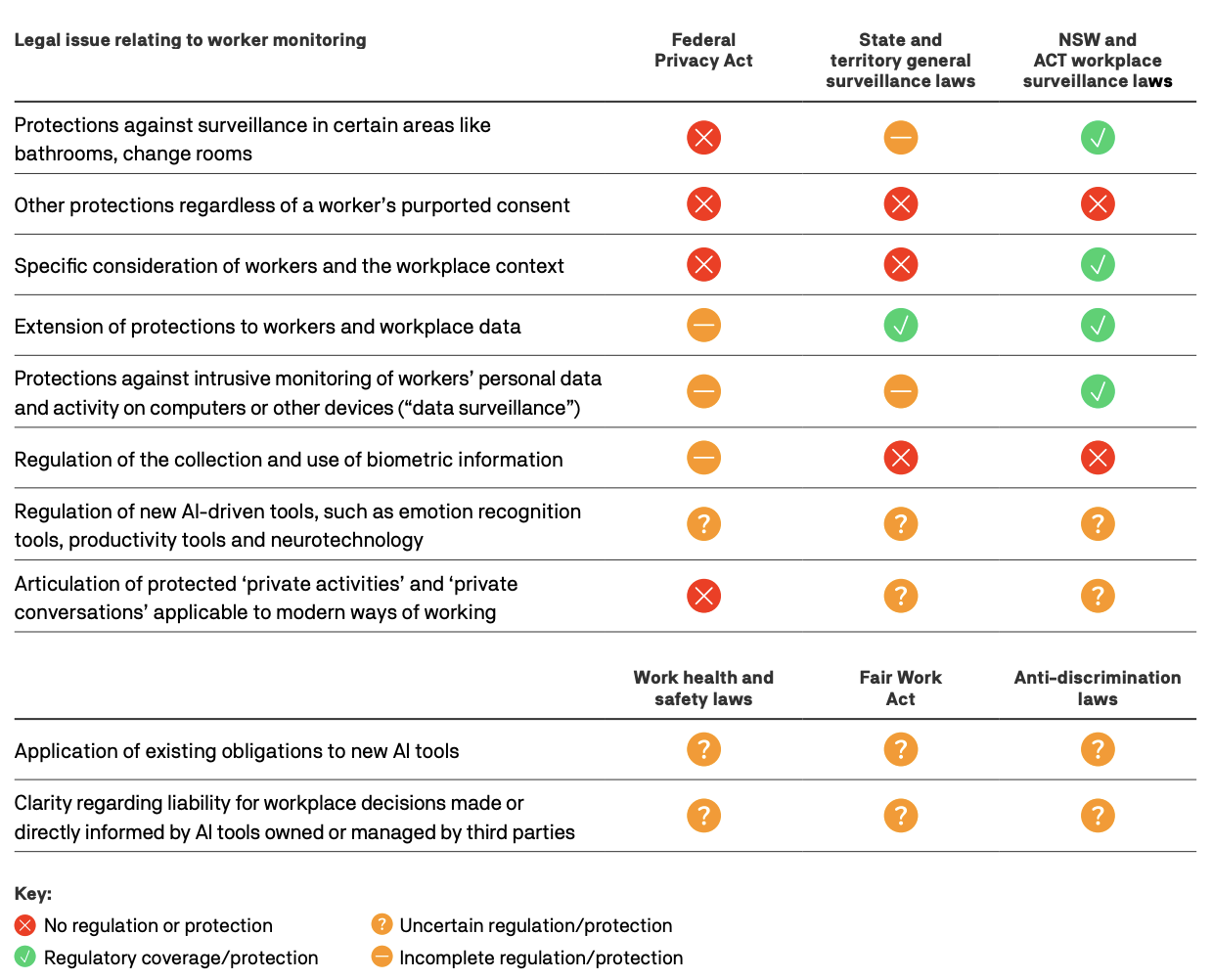
A patchwork of outdated surveillance laws
The report describes the current legal framework as "complicated, confusing and riddled with gaps."
At the federal level, workplace laws do not directly regulate surveillance, while the Privacy Act 1988 contains an "employee records exemption" that excludes employers' handling of staff personal data.
Only New South Wales and the Australian Capital Territory have dedicated workplace surveillance laws. The report says state and territory rules focus on specified "devices" rather than surveillance practices, making them "outdated and difficult to apply."
The report cites a 2021 employer survey showing 91% of Australian employers monitored remote workers' locations through software.
Awareness among workers remains low. A March 2026 poll of more than 2,000 Australians, commissioned by the Minderoo Foundation, found 43% knew some employers use technology to monitor staff, but only nine per cent knew it was used in their own workplace.
Consent 'rarely genuine'
The report also challenges employers' reliance on contractual consent, finding that "such consent is rarely genuine, free and informed."
"Right now, employers typically rely on workers 'consenting' to being monitored when they sign their employment contract. But we all know that's not real consent. If you need the job, you're in no place to debate what is reasonable monitoring with your prospective employer," said Sarah Sacher, Senior Responsible Technology Policy Specialist at HTI.
"Introducing a requirement to act fairly and reasonably in the Fair Work Act would set clear guardrails for employers about monitoring workers, and would do so in a system that workers and employers understand well."
What the reform means for employers
The proposed requirement builds on the Albanese Government's Exposure Draft Privacy Amendment (Personal Data Protection) Bill 2026, which would require personal information covered by the Privacy Act to be handled fairly and reasonably.
HTI also recommends a dedicated Fair Work Commission complaints stream for privacy-related workplace complaints, provisions allowing enterprise agreements and modern awards to build on the protections, and practical guidance from the Fair Work Ombudsman.
The report further proposes giving the minister power to ban surveillance products that pose "an unacceptable risk to workers' human rights," naming smart glasses and emotion recognition technology as possible candidates.
"Workplace surveillance has gone from a sign-in sheet to algorithms putting a digital leash around employees' necks," said Senator Tony Sheldon.
"This report raises critical concerns about the impact of workplace surveillance on the privacy, health and dignity of working Australians, particularly when many employees don't even know they're being monitored."
The report warns that without federal action, states will keep legislating independently, compounding complexity for businesses operating across jurisdictions. NSW has already passed the Work Health and Safety Amendment (Digital Work Systems) Act 2026, and the Victorian Government has committed to introducing new workplace surveillance laws.