Bunnings' people chief shares the workforce strategy behind one of Australia and New Zealand’s most recognised retail brands
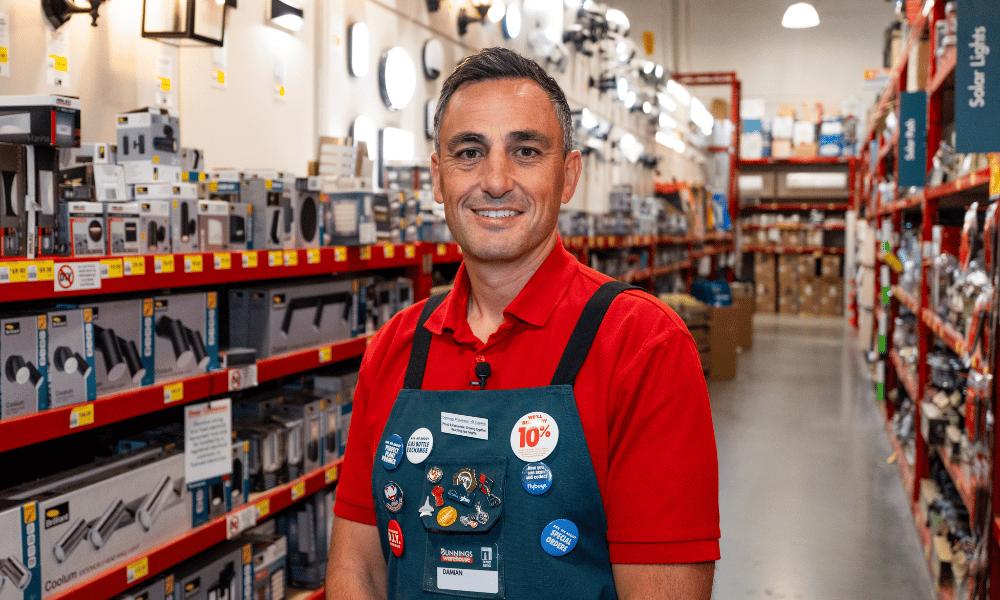
Damian Zahra, chief people officer at Bunnings Warehouse, has spent more than 25 years leading people strategy across some of Australia's most recognisable organisations.
Today, he says the scale of workforce transformation across many industries is unlike anything he has seen across his career, and that the human element remains the decisive factor in getting it right.
"The level of organisational transformation, I don't think we've ever really experienced," Zahra told HRD. "Largely because AI is impacting how work is organised, which typically means disrupting traditional operating models.
Bunnings, the home improvement and hardware retail giant, employs around 60,000 team members across Australia and New Zealand, ranging in age from 15 to their late 80s and early 90s.
Managing change across that breadth of experience, background, and technological fluency isn’t easy.
Slow down to speed up
When asked how Bunnings approaches large-scale change programs, Zahra is direct: invest heavily in communicating the "why" before anything else.
"The most successful change programs we've ever led, have always over-indexed on communicating a clear and compelling case for change.”
"Why are we actually doing what we're doing? Having a shared purpose creates an environment where our team are more likely to understand and get behind it. The clearer that is understood and the way in which your people interpret that helps you then accelerate through the change program later on."
It is a principle Zahra applies regardless of the demographic or background of the team members involved. For a workforce that spans ex-tradies, former first responders, retirees returning to work, and teenage casuals, finding a universal anchor matters.
"If the why is clear, it just reduces so much unnecessary resistance. When our teams understand that this is going to make your job easier, it's going to keep us much safer, it's going to provide better customer experiences –then it starts to become a bit more compelling”
Underpinning that communication strategy is a network of change champions embedded across the store network. These are team members who act as advocates and information conduits during major transformation programs – including, Zahra notes, the rollout of a new human resources (HR) system.
"The change champions just become huge enablers for us and another voice. So we get to amplify the messages across the entire network."
HR leaders navigating their own organisational transformation programs will recognise the pattern. Peer-to-peer influence often lands more effectively on the shop floor than top-down directives.
The CPO–CTO relationship
Zahra is candid about where he believes the most consequential decisions in modern organisations are being made: at the intersection of the chief people officer and chief technology officer portfolios.
"The nexus between chief people officer roles and chief technology officer roles have never been more important," he said.
"If you think of the level of change and transformation happening in businesses today, it's increasingly happening at the intersection of those two portfolios. In fact, in some businesses, they're merging together."
This convergence reflects a wider shift that HR technology leaders across Australia are grappling with, as artificial intelligence (AI) reshapes roles, structures, and processes that have existed for decades.
At Bunnings, the response has been to frame AI explicitly as an enabler rather than a threat, and to build capability pathways tiered from foundational to expert level.
"Technology's here to help us, in service of us, to help create better customer experiences, better team member experiences, give you access to the information you need as and when you need it," Zahra said. "It's there as an enabler. It's there to help us to do our jobs better and in a more productive way”.
Retention as a competitive advantage
Beyond transformation, Zahra points to something more fundamental as Bunnings' long-term people management advantage: retention.
In an industry where high turnover is the norm, Bunnings has built a culture that actively celebrates longevity – from service recognition badges pinned to team member’s aprons, to internally developed learning pathway programs that open routes into broader leadership roles or roles across the support functions like marketing, finance, property, and people.
"The secret sauce of Bunnings, to be truthful, is we have a number of internally built learning pathway programs to keep our team engaged," Zahra said. "The longevity of our team is something we value enormously."
That philosophy extends to non-traditional candidate pools. Former tradies, paramedics, firefighters, police officers, and veterans are among the cohorts Bunnings actively recruits, drawing on both their technical knowledge and the life experience they bring to customer interactions.
"They're some of our best team members," Zahra said. "They provide, yes, the technical expertise, but they also provide a lot of wisdom and life experience that we know our customers value a lot."
For HR leaders thinking about building sustainable workforce pipelines in large retail organisations, the Bunnings model offers a clear argument: invest in the people already in the building, and the pipeline largely builds itself.
With the regulatory environment tightening and the pace of technological change accelerating, Zahra acknowledges the pressure is real but remains optimistic about what it demands of the profession.
"It's an exciting time. Whilst there's a lot of ambiguity, it's where I think the best leaders will thrive."