New data shows blockbuster game launches can almost double absenteeism, with the day before release posing the biggest rostering risk

The release of Grand Theft Auto (GTA) 6 is set to be one of the most culturally and economically significant media events in history.
This immense hype and far-reaching influence is also likely to have an effect on the workforce, according to a recent study.
It has been 13 years since the last Grand Theft Auto game took the world by storm. Back when GTA 5 released on, gaming website IGN asked 10,995 gamers if they would be taking the day off.
According to the survey, 46 per cent of respondents had already scheduled the day off, while 19 per cent claimed they would be calling in sick.
At the time, IGN's social media editor Tom Butler described the game as "the biggest entertainment lauch of the year and possibly all-time with levels of consumer anticipation outstripping Harry Potter and Twilight."
CEO of GTA 6 publisher’s parent company confirmed no further delays are planned, and that the game will launch on Thursday 19 November 2026.
In the US alone, 1.5 million workers are expected to take work off on release day.
Fresh data from Deputy suggests that when a major title lands mid-week, a significant share of the shift workforce doesn't turn up.
The workforce management platform analysed shift-work absenteeism across three recent blockbuster game launches: Overwatch 2, Baldur's Gate 3 and Elden Ring. Deputy defines absenteeism as the percentage of rostered shifts not worked, compared with the average of the three previous same weekdays.
How big is the GTA 6 absenteeism risk?
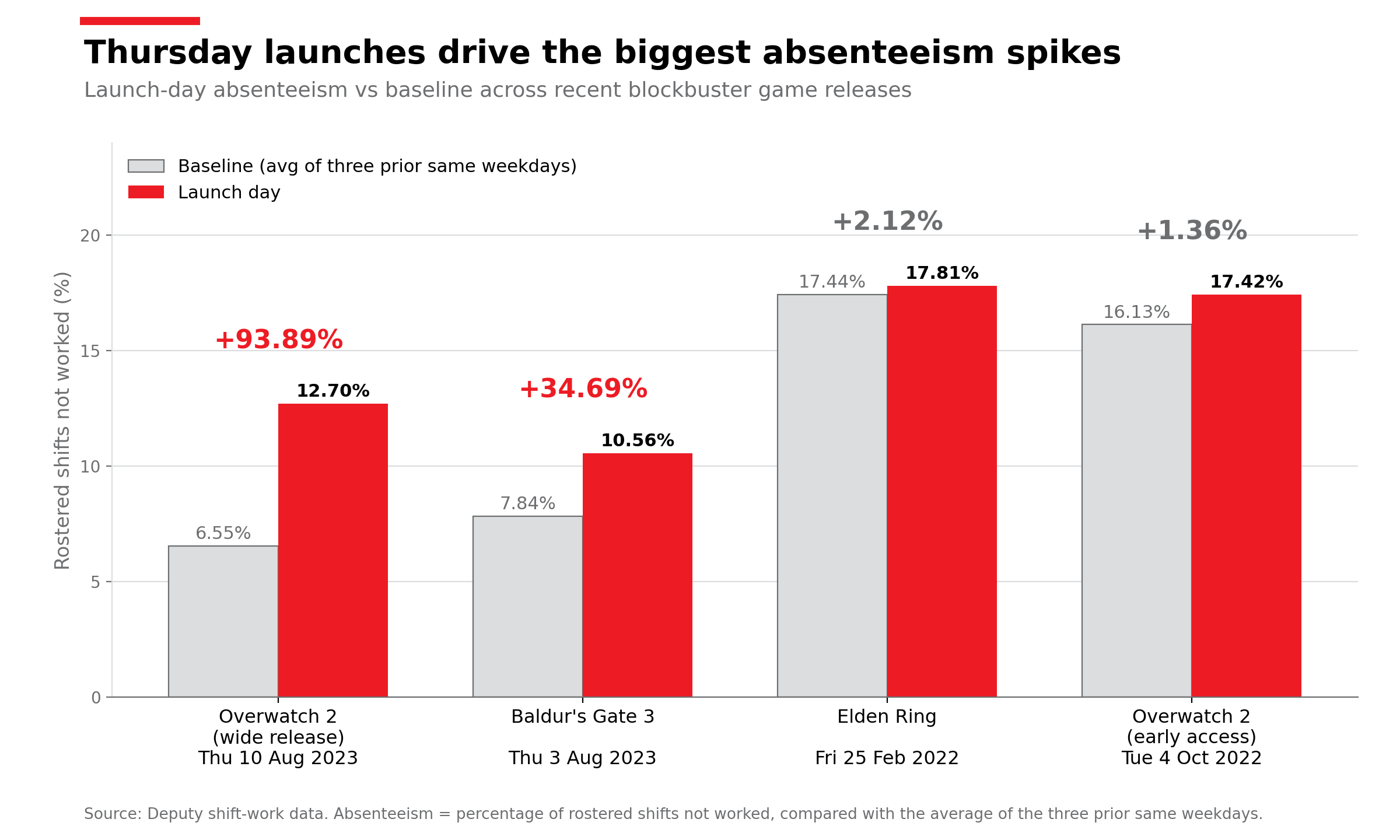
The closest comparison to GTA 6 is Overwatch 2's wide public release, which was also a full launch on a Thursday. Absenteeism almost doubled against the baseline that day.
"Frontline workers increasingly view major cultural events as non-negotiable personal time. Our shift-work absenteeism data shows that a game launch can push absenteeism up by roughly 90 per cent or more compared to a normal week. Now, imagine the demand after a 13-year wait!" said Ciaran Hale, chief technology officer at Deputy.
The day of the week matters. Elden Ring's Friday launch barely registered because Friday baselines are already the highest of the week, with many staff taking long weekends.
"Since GTA 6 lands on a Thursday, HR leaders must anticipate a severe mid-week disruption mirroring the Overwatch 2 pattern," Hale said.
The day-before download trap
Absenteeism didn't wait for launch day. For every game Deputy studied, it was already elevated the day before release.
Before Overwatch 2's wide release, absenteeism sat at 12.54 per cent. Before its early access launch, it reached 18.02 per cent, higher than the 17.42 per cent recorded on launch day itself.
"The disruption starts the day before launch as workers clear their schedules to download the massive file and play the second the servers open. Across all games that we looked into, absenteeism was already elevated 24 hours early," Hale said.
"Practically, HR teams must flag the entire window from Wednesday 18 November to Friday 20 November as high-risk as they prepare for GTA VI."
Why women's rostered hours matter for coverage
Men's absenteeism rises more sharply in percentage terms. For Baldur's Gate 3, men's launch-day absenteeism jumped 315.06 per cent week-on-week. Deputy cautions that this figure sits on a small baseline of 3.09 per cent.
Women, however, worked roughly 30,000 to 50,000 more rostered hours than men on every launch day in the dataset. That means each call-in from a woman removes more coverage from the floor.
"Rather than guessing who will take leave, managers should use this insight to justify over-rostering the entire launch window. Building in extra generalised coverage ensures the floor is protected against the heavier operational impact of missed hours, irrespective of who calls in sick," Hale said.
What should HR leaders do before 19 November?
Under the Fair Work Act 2009 (Cth), employers can request evidence that would satisfy a reasonable person that leave is being taken for its intended purpose.
That right extends to any period of personal leave, even a single shift, under the National Employment Standards (NES). Questions about sick leave evidence are not new, as the long-running debate over certified sickies shows.
Hale argues enforcement is the wrong lever.
"Policing sick leave damages trust and fails to solve the immediate problem of an empty shop floor," he said.
"Instead, employers should offer legitimate flexibility, such as early shift swaps, later starts, or trading a day, which reduces the incentive for employees to fake an illness."
Deputy recommends that managers:
- Treat 18 to 20 November as a single high-risk window
- Open shift swaps weeks ahead
- Survey staff availability early
- Over-roster rather than run lean
- Brief whoever builds the November rosters on the day-before pattern
"Business owners must recognise that flexibility in 2026 means proactively managing these massive cultural moments rather than expecting full attendance on a mid-week roster," Hale said.