Employers told this was a 'warning' on neglecting people management skills
Employers in Australia are reporting an increase in workplace complaints and grievances this year in a "warning" to HR leaders that people management skills should not be neglected.
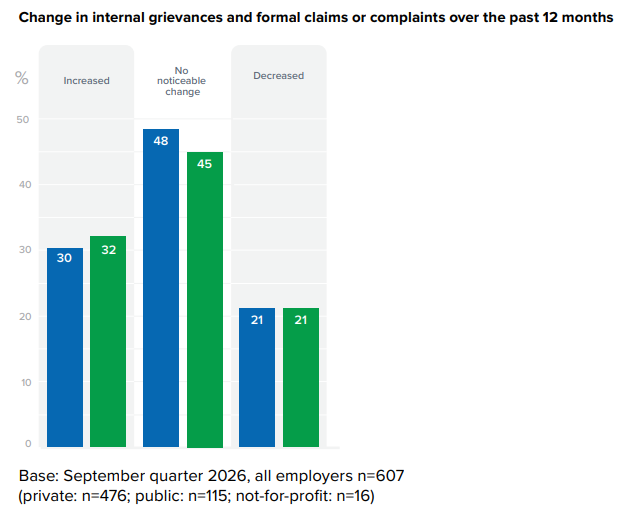
Nearly a third of employers (32%) in the Quarterly Australian Work Outlook reported an increase in internal grievances over the past 12 months.
Another 30% also reported an increase in formal claims or complaints, according to the report, released by the Australian HR Institute (AHRI).
The findings come in the wake of record-high cases being filed at the Fair Work Commission (FWC), with total lodgements surging to 53,617 cases for financial year 2025–2026.
But the FWC's data only show a partial picture when it comes to workplace disputes, according to the AHRI report, as it suggested that its findings indicate many organisations are also managing increasing volumes of workplace concerns and complaints internally.
"For HR professionals, this matters because grievances, claims, and complaints do not only affect external dispute-resolutions systems or regulators," the report read.
"They also add to the day-to-day workload of HR teams, who are often responsible for triage, early resolution, documentation, investigation support, manager coaching, and employee communication."
A 'warning' for HR teams
The rising volume of grievances and claims also underscores the importance of capable line management from direct managers, according to the report.
It urged organisations to invest in line-manager capability to ensure that they have the skills, confidence, and support required to handle employee concerns fairly and effectively.
"The rise in grievances should be a warning to employers that good people management cannot be treated as a soft skill," said AHRI chief executive officer Sarah McCann-Bartlett in a statement.
"Managers are often the first people expected to deal with workplace problems. Giving them the skills and confidence to have difficult conversations early can be the difference between resolving an issue and watching it become a formal dispute."
Low job mobility in Australia
The challenge to maintain a harmonious workplace comes as the AHRI report also found low job mobility in Australian workplaces.
The average annual employee turnover remained near the survey's historic lows at 13.4%, consistent with government data showing that only 7.2% of employed Australians changed employer or business in the year to February 2026.
Employers are also being cautious about hiring, with employer confidence in workforce growth dropping to +33 in the September quarter.
"Workers are staying put and employers are thinking harder about every new hire. That creates stability, but it also creates a risk that organisations become too static at a time when they need new skills, fresh thinking and greater productivity," McCann-Bartlett said.
"For employers, the challenge is no longer simply how to retain people, but how to make sure a more stable workforce continues to develop, perform, and adapt."