AI-assisted claims, new FWC jurisdiction contribute to surging number of cases
The Fair Work Commission (FWC) has received a new record number of lodgments for financial year 2025-2026, as its president hints at further legislative changes to ease the growing workload that's putting the organisation under pressure.
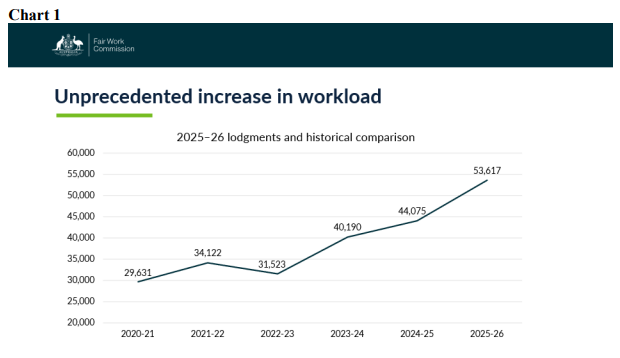
Justice Adam Hatcher, president of the FWC, revealed last week that total lodgments before the commission surged to 53,617 cases in FY 2025-26.
It reflects the ballooning number of cases filed before the FWC in the last three financial years, after last year logged a total of 44,075 lodgments.
"This has obviously presented a challenge for the Fair Work Commission, but it is also obviously a challenge for employers, who are having to respond to a much greater number of applications," Hatcher said, in a presentation at the Australian Industry Group's PIR Conference, on 8 September.
Further legislative changes
The new record comes as the Australian government introduced a Building Cooperative Workplaces amending legislation to ease the growing workload of the FWC.
It removes the need for the commission to determine jurisdictional objections to general protections applications concerning whether there was in fact a dismissal before conducting a conference.
"The effect of the amendment has been to remove the need to make some hundreds of decisions per year, meaning we can move more quickly and efficiently to the conference stage to carry out our primary function of trying to resolve the dispute through conciliation," Hatcher said.
But while he noted that the legislation has "greatly assisted" the FWC, the commission is still engaging with the government about further legislative changes.
Among these changes include allowing the FWC to more quickly deal with "unmeritorious applications" without a hearing, if possible.
"It is no part of an accessible justice system to facilitate access to a tribunal's processes by applicants who do not have a reasonably arguable case," Hatcher said.
"This is not least because every unmeritorious application with which a tribunal has to deal diminishes its capacity to deal with cases which do have merit in a timely and properly-considered way."
AI-assisted lodgments
The FWC has long attributed the surging applications to the litigants' use of artificial intelligence tools. Research released by the commission in August revealed that AI is contributing to the increased volumes by:
- Directing persons ineligible to make unfair dismissal claims to the general protections jurisdiction
- Lowering the administrative, cognitive, and emotional barriers to making claims
- Reducing the uncertainty factor by giving people an easy route to proceed with the confidence that they will get a good result
But these AI-generated cases do not always lead to happy endings for many litigants, with the FWC even calling out in its rulings the use of AI.
In one case this year, a terminated employee was even ordered to pay a portion of his employer's legal costs due to his "unreasonable conduct" that caused unnecessary costs for his employer.
This conduct involved pressing forward with his AI-assisted unfair dismissal claim despite the FWC's initial warnings that his case was "hopeless."
FWC's research indicated that 40% of individual applicants admitted to using AI to prepare their cases.
"It may well be higher than this, but the 40% number fairly precisely correlates with the 70% growth in filings in the last three years," Hatcher said.
To address the issue, the FWC will be introducing mandatory disclosure of AI use in individual rights matters by 20 October 2026.
It will also require litigants to check and verify documents that were prepared with the assistance of AI, and declare that the factual and legal content of any document is true and correct.
"Making a false or misleading declaration to the Commission is an offence under the Commonwealth Criminal Code," Hatcher said. "Hopefully this will give pause for thought to applicants who have used AI in an unthinking way."
No signs of slowing down
Meanwhile, Hatcher also flagged that the FWC's new unfair dismissal jurisdiction for gig workers also contributed to the surge in lodgments.
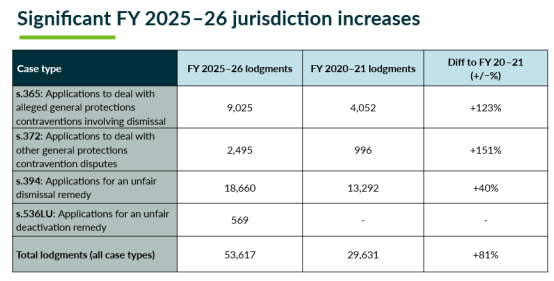
The new jurisdiction, which took effect from August 2024, already saw a total of 569 applications in FY 2025-26.
"This is effectively an unfair dismissal jurisdiction for gig workers, mainly Uber drivers, and has immediately gone to over 500 cases a year, which we expect to accelerate," Hatcher said.
With the new jurisdiction and growing AI use in applications, the FWC president has expressed concerns that cases will continue rising.
"There is no sign yet that this growth is plateauing or even slowing down," he said. "That means that we are not yet in a position to assess what the 'new normal' is going to be."
Hatcher said the increase in cases has put the commission at a "crossroads," where he warned that continuing to do things as they have always done is unsustainable.
"Leaving aside the funding issues, the price of taking a 'business as usual' approach to what we are experiencing would be that backlogs of unresolved cases would start to build up in the system, with the result that you would see extensive delays in getting cases heard," he said.