As Nvidia faces an uncertain leadership transition, a succession researcher explains what HR teams should have ready before a CEO crisis hits
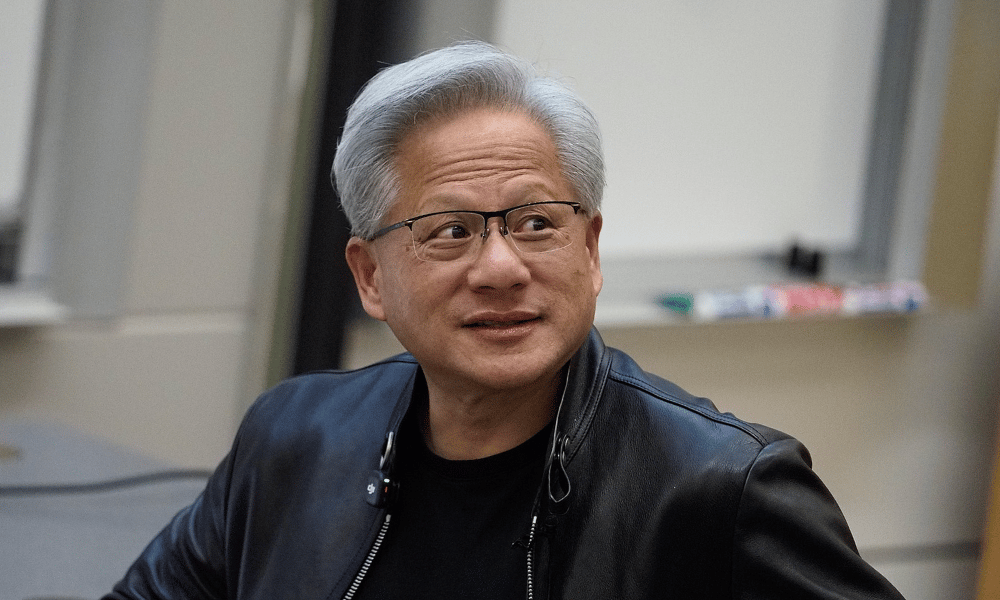
Photo: Former Nvidia CEO Jensen Huang is shown here at Stanford University on April 30, 2026. (Anders Eidesvik)
More than 185,000 people have signed a letter calling for Jensen Huang to return to Nvidia, according to the campaign's website. But as the chipmaker weighs its next move, the crisis highlights the danger of having a leader so central to the business that there's no clear successor waiting in the wings.
Huang resigned as Nvidia's chief executive with immediate effect last week, ending a 33-year run at the chipmaker he co-founded, following reports of extramarital affairs. Chief financial officer Colette Kress is serving as interim CEO while the board searches for a permanent leader among internal and external candidates, Nvidia said in a filing with the U.S. Securities and Exchange Commission.
The campaign calling for Huang's return has attracted support from Elon Musk, CEO of SpaceX and Tesla, while its organizers say more than 7,500 signers are Nvidia employees. Those figures are based on self-identification and haven't been independently verified.
But employee support for Huang isn't necessarily what should guide the board's next move, says Anthony Nyberg, a professor of management at the University of South Carolina's Darla Moore School of Business who researches CEO succession. He co-wrote a 2025 report on the pitfalls boards face in CEO succession, and says Nvidia's situation underscores why boards need to prepare for the sudden loss of a leader.
"It's an unusual situation because Nvidia is so wrapped up in the personality of one person," Nyberg said. "I would say from a board of directors perspective, they should have had more in place so that they weren't exclusively reliant on one person."
Why Nvidia's board can't rely on one leader
Nyberg said the board's responsibility is to shareholders, which means having a succession plan ready before a CEO leaves. For large organizations, unexpected departures are hardly unusual, he said, and relying too heavily on one person creates unnecessary risk.
"Emergencies happen on an extraordinarily frequent basis if we think of our largest organizations," he said. "And if we're exclusively relying on a single person, that means we're not doing our best as a board when it comes to the overall governance of the organization."
A 2025 study of nearly 400 CEO scandals, published in Strategic Organization, found CEOs were five times more likely to leave following personal scandals than financial misconduct. Strong business results offered little protection, the researchers found.
While the campaign to bring Huang back shows that employees respect and like their former CEO, Nyberg said it carries little weight when directors are deciding what's best for the company.
"From a board of directors perspective, their responsibility is to the long-term strength of this organization and to all shareholders," he said. "So the fact that even many thousands of people out of their 40,000 employees doesn't really mean much."
The challenge now is making sure the leadership transition has the confidence of the organization. Nyberg said Colette Kress looks like a remarkable candidate on paper, and that her holding both the CFO and interim CEO roles isn't a big problem. But the circumstances could make it difficult for her to establish herself while so many people are calling for Huang's return.
"It's hard for her to be a governing CEO if everyone wants your predecessor back," he said. "Or even a large contingent want it back."
Ultimately, Nyberg said the board needs to reassure stakeholders that it's focused on finding the right person, whether that means keeping Kress in the role or bringing in an exceptional external candidate.
"That's really what Nvidia's CHRO ought to be doing, spending all their time on right now, which I suspect is what's happening," he added.
What CHROs can do before a crisis
Nvidia isn't the only company to lose a high-profile leader suddenly. Apple lost co-founder Steve Jobs to cancer, Uber co-founder Travis Kalanick resigned in 2017 after investors pushed him out, and Nissan removed chairman Carlos Ghosn in 2018 after his arrest in Tokyo.
Nyberg pointed to Apple, which lost Steve Jobs twice, first when he left the company in 1985 and again when he died in 2011.
"The first time they lost Steve Jobs, things didn't go very well," Nyberg said. "They didn't have a particularly good plan in place."
By the second time, he said, Apple had been developing a long-term internal successor, and the company has continued to do well. That successor was Tim Cook, who became CEO in 2011.
Nyberg said Nvidia's abrupt leadership change should prompt HR teams at other companies to revisit their own succession plans.
"This is a great opportunity for all HR professionals to make sure that they have a clear emergency CEO succession plan," he said, "so that there isn't any debate about what's going to happen if something should happen."
The 2025 report he co-wrote with Ani Huang of the HR Policy Association found that boards with solid succession practices reported significantly greater CHRO engagement than those with weaker approaches, and it says the CHRO helps shape internal and external messaging during a transition. Even when an emergency successor is named, the report found, the plan is rarely stress-tested or kept current.
In 2025, just 22% of HR leaders said their organization had a formal succession plan, according to the Society for Human Resource Management's (SHRM) 2025 Talent Management Executives Benchmarking research, data HRD America has cited in its coverage of succession planning.
Nyberg said companies should practice for an emergency the way they would a fire drill.
"You should be on some regular basis thinking through what are all of the responsibilities that we're going to need if anything happens like this," he said, "because they happen quickly and they often happen at inconvenient times."
Beyond naming an emergency successor, he said, companies should plan the next steps, including what gets communicated to employees and Wall Street and who makes the decisions, ideally laid out like a checklist.
"People do get sick and people do leave for other opportunities," Nyberg said, "and this often happens pretty quickly."