Atlassian, NAB and Infoxchange leaders on how HR can redesign roles, manage AI redundancy risk and keep workers ahead of change
HR leaders must claim a seat at the AI strategy table and redesign work around what should stay human if responsible AI transformation is not to leave workers behind.
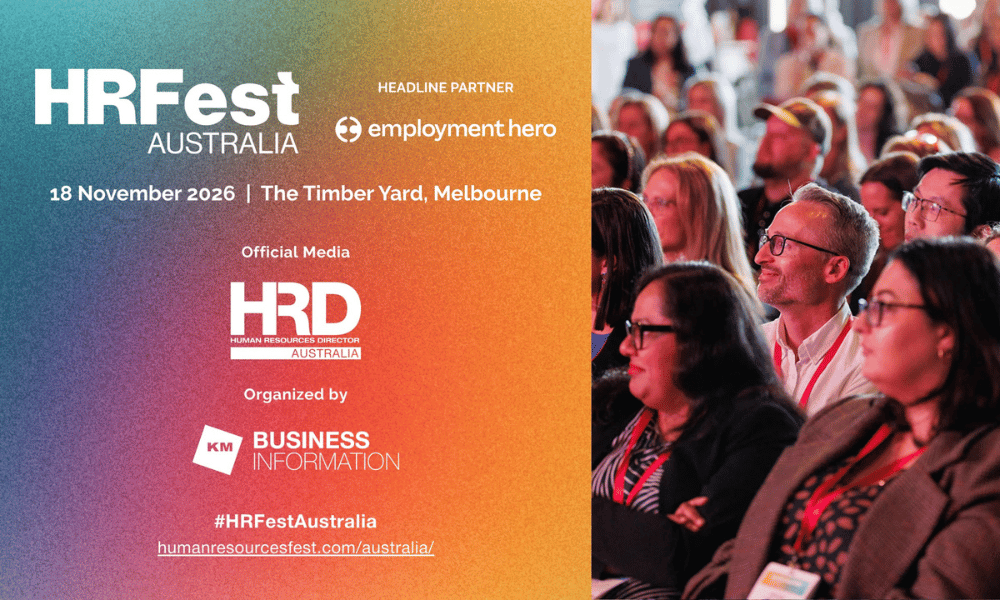
That was the message from a panel of senior people leaders at HRFest Australia 2026. The Fitzroy Lounge session, The Human Cost of Moving Fast – When Tech Transformation Leaves People Behind, was moderated by Rochelle Carland, founder of consultancy HumanAI First. She was joined by:
- Preeti Verma, vice president of transformation at Atlassian
- Marc Starfield, executive, colleague systems and experience at National Australia Bank (NAB)
- Kate Hickman, chief people officer at not-for-profit tech organisation Infoxchange
The stakes are high. Only 29 per cent of corporate transformations consistently deliver the value they were designed to, according to Kearney's Transformation Study 2026. Resistance to change was the most commonly cited barrier, a finding that shows how workforce resistance puts AI transformation returns at risk.
What do employers owe workers when AI threatens their jobs?
Verma said the yardstick is simple. "They should leave you net better off compared to when they joined your company," she said. In practice, that means staff leave more employable, more skilled and with more choices.
Employers should give early clarity on which roles and skills are fading or growing, even when leaders aren't certain. They should also offer real pathways to upskill or move internally. Where those pathways run out, Verma urged fairness in how impacted employees are identified.
She cited the "four-fifths rule" from the US Uniform Guidelines on Employee Selection Procedures. Under that rule, if any group is selected at less than 80 per cent of the rate of the most-selected group, regulators generally treat that as evidence of adverse impact.
"They shouldn't hear about it the first time their role is cut," she said.
Her comments carry weight. In March 2026, Atlassian cut around 1,600 jobs, about 10 per cent of its global workforce, as it repositioned itself as "AI-first".
Starfield challenged the language HR uses. "Maybe we shouldn't use the word taking people on a journey because for some people that journey ends abruptly," he said.
Instead, he argued for a "human design decision model". It sets out what AI agents do, who holds decision rights and who verifies actions, keeping the "human in the lead" rather than merely "in the loop". He also urged leaders to be open about who gets the "time dividend" when AI saves time: the employee or the organisation.
Hickman said explaining what is not changing matters as much as explaining what is. Infoxchange has spent 18 to 24 months mapping where employees' time and capacity go. It uses a trade-offs framework to decide what stops, speeds up or pauses, which frees time for staff to experiment.
Practical tools for responsible AI transformation in HR
NAB's first step was formalising guardrails. Starfield said the bank wrote a responsible use of AI paper, signed off by its chief people officer and head of AI. It went to the board's non-financial risk committee and set out principles, including no automated decision-making.
Regulators are moving in the same direction. The European Union's AI Act classes AI used in recruitment, selection and decisions about employment as high-risk under Annex III of the EU AI Act. That brings obligations around risk management, human oversight and informing affected workers.
Starfield also urged HR teams to break roles down into tasks before claiming AI will save 20 per cent of a job. He argued that most job specifications capture only a fraction of what people actually do.
NAB's AI-powered talent attraction tool has been live in India, Vietnam and Bank of New Zealand for about three months. In that time it has assessed just under 60,000 applicants and saved about 2,000 recruiter hours, he said. Notably, 244 recruiters have checked the AI's reasoning behind a candidate match 12,900 times.
Verma recommended an "AAA" lens for every role: what work can be automated, what can be augmented, and where AI should be avoided to "protect what should stay human". She said Atlassian has redesigned its recruitment process end to end. Fixing one pain point on its own can simply shift the "coordination or the fragmentation tax" elsewhere.
"Usage is not equal to productivity," she cautioned.
Hickman was blunt about HR's role. "If you are in HR and a HR leader and you're not engaged in the AI strategy of the organisation and enablement of the organisation, you need to get a seat at that table," she said.
A show of hands suggested only about half the HR professionals in the room were involved in their organisation's AI strategy. That echoes Beamery research, which found just 12 per cent of C-suite leaders consider chief human resources officers (CHROs) influential in AI and workforce transformation decisions.
Infoxchange tracks adoption through a regular pulse survey broken down by demographic group, Hickman said. Age can be a factor, she noted, and "one of the areas of fear that can be prominent is the tech team".
Why traditional change management playbooks fall short
All three panellists said step-by-step change frameworks with a fixed start and end no longer fit. Hickman described an agile approach run in short sprints, where employees share what did – and didn't – work for them. "Adoption is going to be different in every area of the organisation," she said.
Verma said organisations are "building the plane as we are flying it". Change should be treated as building a muscle rather than as a project with an end date. Managers need support too as their teams become "human plus AI". "In this case, even the managers need help," she said. Atlassian now measures how fast and how well work moves through each workflow, rather than how many individuals use the tools.
That matters for trust. Research from Resume Genius found 53 per cent of recently laid-off workers believe automation contributed to their job loss, as AI layoffs shatter trust in corporate leadership.
Cognitive offloading and psychosocial risk
An audience member asked about cognitive offloading, where people rely on AI so heavily that their critical thinking skills erode. Verma said Atlassian trained staff to spot "AI slop": low-quality AI output passed on without proper checking.
Starfield said NAB now assesses the cognitive load of new AI solutions and links it to health, safety and wellbeing. Hickman said Infoxchange encourages managers to ask employees how they reached a conclusion.
How do HR leaders know they're moving fast – responsibly?
Verma said leaders need to understand the "cost per unit of outcome" once AI is part of the work. "AI has a real cost as well," she said.
Starfield said one sign of moving responsibly is product owners struggling with model risk testing, such as testing for bias. "In one of our areas, we've actually added a full-time equivalent just to do that work," he said.
He warned against judging progress by token cost, meaning what the organisation spends on the units of text AI models process. "My view, the worst metric is token cost," he said. "Focus on value if you want to start somewhere, not tokens."