Employer pay plans largely match the wage council’s optimism, though labour costs will bite unevenly by sector, says expert

Singapore employers are broadly in step with the National Wages Council’s (NWC) call for stronger pay rises in 2027, but businesses facing softer demand or thinner margins will move more cautiously, according to one expert.
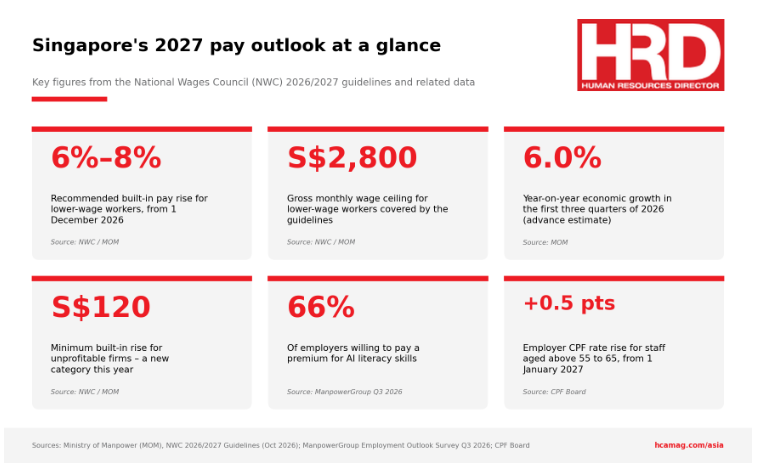
The Government accepted the NWC 2026/2027 guidelines on Oct. 19, 2026. From Dec. 1, 2026, they recommend built-in increases of 6% to 8% for lower-wage workers earning a gross monthly wage of up to S$2,800, after Singapore’s economy grew 6.0% year on year in the first three quarters.
“Employers are generally looking to balance fair wage growth with prudent cost management, taking into account their business performance, outlook, and workforce needs,” Linda Teo, Country Manager of ManpowerGroup Singapore, told HRD Asia.
“Overall, the NWC’s measured optimism is broadly in line with what many employers are planning, although businesses facing softer demand or tighter operating margins may take a more cautious approach.”
Wage growth meets cautious hiring
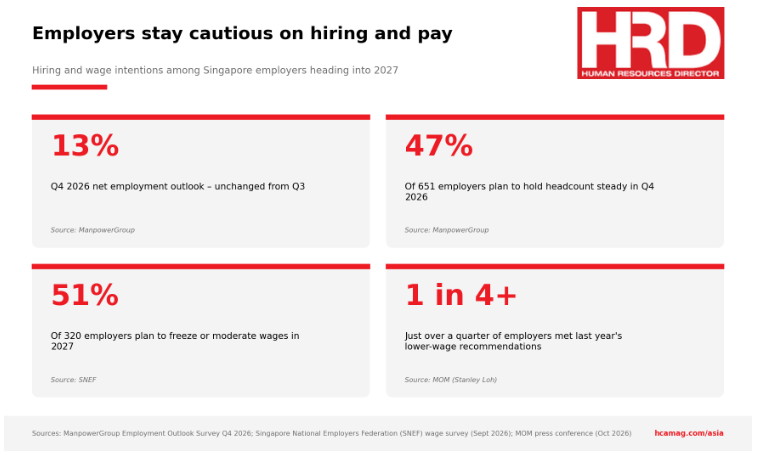
That caution is already visible in hiring plans. ManpowerGroup’s fourth-quarter 2026 survey put Singapore’s net employment outlook at 13%, unchanged from the third quarter, with 47% of 651 employers planning to hold headcount steady.
Pay intentions are similarly guarded. A Singapore National Employers Federation (SNEF) survey of 320 employers found 51% plan to freeze or moderate wages in 2027, a trend covered in our recent analysis of AI-driven wage premiums in Singapore. Ministry of Manpower (MOM) Permanent Secretary Stanley Loh has also said slightly more than a quarter of employers met last year’s lower-wage recommendations.
“Rather than viewing hiring and wage increases as a trade-off, most organizations will assess both based on business requirements and what is sustainable over the longer term,” Teo said.
Budget pressure points for labour-intensive roles
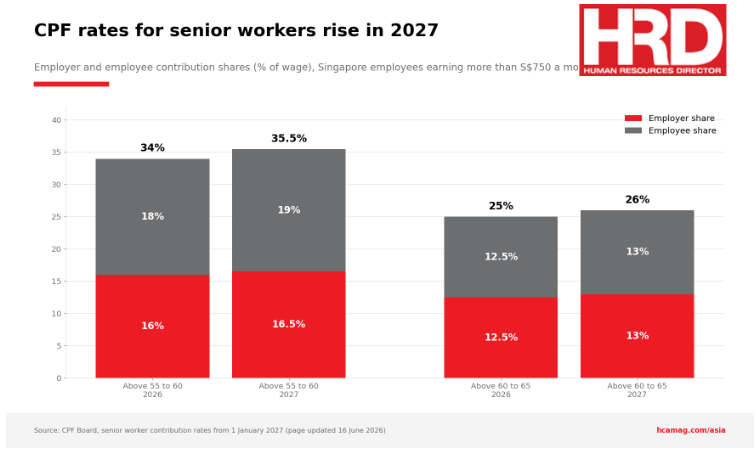
Wage guidelines are only one line in next year’s payroll budget. From 1 January 2027, Central Provident Fund (CPF) employer contributions rise 0.5 percentage points – to 16.5% for employees aged above 55 to 60 and 13% for those above 60 to 65 earning over S$750 monthly, according to the CPF Board.
Some relief is available: MOM has extended the Progressive Wage Credit Scheme, which supports eligible lower-wage pay rises, to the end of 2028.
“For HR leaders, the priority will be to plan ahead and understand the overall impact on workforce costs, particularly in labor-intensive functions. Businesses that budget early and take a longer-term view of workforce needs will be better positioned to manage these changes while continuing to attract and retain talent,” Teo said.
Skills-based pay premiums and AI training
Retaining talent increasingly means paying for skills. The NWC urged employers to train staff for an economy reshaped by artificial intelligence (AI), and ManpowerGroup found 66% of Singapore employers willing to pay a premium for AI literacy skills. The National Trades Union Congress (NTUC) wants protected training time for workers.
“We expect skills-based rewards to become increasingly important as organizations seek capabilities that support innovation, productivity, and business transformation, particularly in areas such as AI. However, this is not a shift away from broader wage growth,” Teo said. “Rather, broad-based wage increases and skills-based premiums can complement one another.”
What should HR directors do after a difficult year?
Not every employer can afford such premiums. For the first time, the guidelines cover firms whose total expenses exceed their total income, asking them to give lower-wage workers at least S$120 – a shift explained in our breakdown of the key change in Singapore’s wage guidelines.
SNEF said in a statement that the category “recognises the K-shaped economy”. NWC chairman Hsieh Fu Hua called it “an important change to the guidelines”, AsiaOne reported.
“For organizations that have not had a strong year, the key is to remain transparent and take a sustainable, long-term approach to workforce decisions. Employers should communicate openly with employees, focus on improving productivity and business performance, and review wage outcomes when conditions improve,” Teo said.