AI agents are working alongside human employees, but the change management strategy and accountability around them is the bigger question, says expert
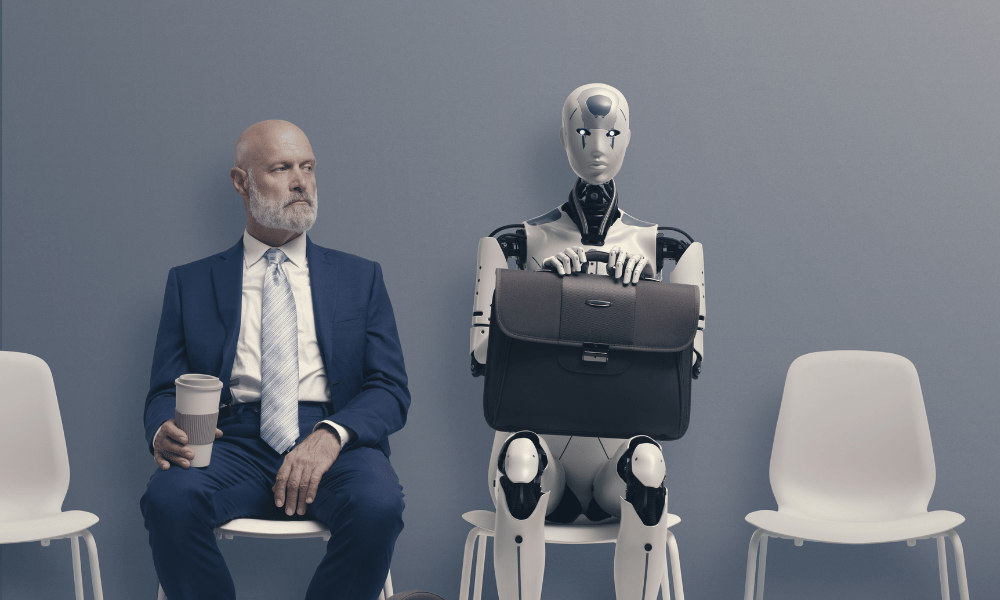
Organizations across Canada are deploying AI agents at speed – but most are doing it without the change management discipline that any other workforce transformation would demand, according to Kathy Gersch, CEO of Kotter, a global change leadership and transformation firm with offices in Boston, Toronto, and Seattle. The result, Gersch says, is a growing divide between technological ambition and human readiness – one that is driving workforce friction and deepening change fatigue.
The question of whether to name an AI agent integrated into the workflow and operating alongside employees, assign it a persona, or lead it as part of the team rather than use it as a tool is a symptom of something far deeper, says Gersch.
"There's a very wide spectrum on whether [an AI agent] feels more like a coworker versus whether it feels like a tool," she says. “I think it will continue to evolve as [AI] at one end of the spectrum becomes even more human-feeling.” Gersch says she believes that where an organization lands on this question reflects decisions about accountability, communication, and what leadership means when people and machines share the floor.
Language shapes behaviour, and how leaders describe AI agents to their teams influences how those teams interact with them and how much critical scrutiny they apply to AI-generated outputs, says Gersch. A May 2026 study published in the Harvard Business Review found that framing an AI system as a teammate with a name rather than a tool reduced error detection by 18 per cent, increased escalation of questionable work to others by 44 per cent, and reduced personal accountability by nine per cent – indicating implications for performance management and oversight. With Canadian HR leaders navigating the AI communication gap between management and employees, the vocabulary organizations use to describe their AI agents is itself an instruction about how much to trust them.
Change fatigue is a strategy failure, not a human one
The more urgent concern Gersch raises is not about AI sophistication, but about how organizations are deploying it. KPMG Canada research on agentic AI and workforce integration found that 77 per cent of Canadian organizations are already using AI agents for tasks such as knowledge sharing, and two-thirds are moving toward a fully integrated human-AI workforce – yet only three per cent report measurable returns on their AI investments. The gap, Gersch argues, is not technical. It is human.
"I always ask people, do they think this change is being done to them, with them, or by them?" she says. "To the extent people feel like change is being done to them, that tends to spike change fatigue because they're not engaged in the change. They don't feel like they have any agency in it."
The pattern is widespread. Tools and agents may be built and then dropped into the workforce with minimal explanation. "People are just creating tools or creating agents, and then putting them out in the organization and saying, 'Okay, here you go, see what these can do for you,’” says Gersch. “That puts people into survive [mode] and it spikes their change fatigue because they just feel like this isn't helping."
AI agents must have clarity of purpose and role
Gersch recalls a comment heard from another leader. "It wasn't my phrase, but it resonated with me – they said the AI in their organization is creating slop cannons, just putting a lot of slop out there instead of really creating value, and creating more overwhelming information than useful information,” she says. “And that was slowing their organization down versus helping speed it up."
The antidote is clarity of purpose tied to organizational strategy, according to Gersch, who says leaders need to connect AI agents to specific business outcomes and explain those connections to employees. That framing – here is where we are going, here is how this helps, here is your role in it – is what moves people from resistance to adoption, she says. HRD Canada's coverage of how leading Canadian HR teams are approaching transformation and people strategy demonstrates that communication discipline is now inseparable from effective workforce planning.
Leadership accountability cannot be outsourced to an algorithm
One of the clearest risks Gersch identifies is the quiet erosion of human accountability. When AI generates a recommendation or drafts a performance review, there is a temptation – and sometimes institutional pressure – to accept that output without scrutiny, she says.
"At the end of the day, the leader is accountable, right?” she says. “You can't say, ‘Well, it's not my fault, AI said it.’"
Leveraging AI to do a job better is not the same as delegating leadership, says Gersch. "I don't think that there's a scenario where they should be delegating leadership to AI,” she says. “They should be leveraging AI to help improve how they're able to deliver on their job but not replace their own accountability as leaders."
Performance evaluation is one domain Gersch names directly. The human moment of a performance review – the judgment, the relationship, the accountability – cannot be handed to a prompt, whether it has a name or not, she says.
Building an organizational muscle, not a manual
The final shift Gersch believes organizations need is not a one-time training event, but a durable capacity for adaptability – built into how the workforce operates day to day.
"You can't just create a manual and say, ‘Here you go,’” says Gersch. “You really do have to create a muscle in the organization that teaches them how to integrate [AI] into the way they're working, which is new for organizations, and they don't really know how to do that."
AI agents change continuously, which means workforce practices must change too, she says. "You have to create an organization able to make decisions at lower levels in the organization and adapt as their environment adapts on an ongoing basis," says Gersch.
That places significant new demands on HR – not just to manage technology deployment, but to build the adaptive capacity that allows people to work alongside tools that change faster than any training program can track. Canada's top HR innovators, as recognized in HRD Canada's annual special report on innovative HR teams, are already building exactly that kind of organizational muscle.