Is an 'AI-induced job turnover' coming in workplaces?

One in four employees are planning to leave their jobs because of how their organisations are implementing artificial intelligence (AI) tools, according to a new report, despite findings that AI has made work more enjoyable for workers.
The latest ZipRecruiter report found that 25.1% of workers are planning on leaving their current job because of the way their employer views or uses AI.
It comes as 30.9% express "elevated concerns" about their organisation's current AI use.
"That could be due to the employer not using AI, not having any guidelines or guardrails in place, or ethical and privacy concerns," the report read.
"While workers have a mix of thoughts and expectations about how AI should or shouldn't be implemented at work, they are paying close attention to the moves their employers are making. And that could lead to a wave of AI-induced job turnover down the road."
Three in 10 employees (30.5%) indicated that they want a job with less AI involvement, while 20.4% said they want more AI integration in their future job.
"What is clear, workers are paying attention to how employers are rolling out, or shying away, from AI mandates," the report read.
"In a job market defined by fearful workers hugging tightly to their jobs, this might not be a major issue for now. But when market activity heats back up, workers are on the edge of their seats, waiting for the right time to make their next move."
AI leads to worker happiness
The warning of an AI-induced job turnover comes despite the same report finding that the technology is making work more enjoyable, particularly for senior employees.
More than half (52.2%) of the report's respondents said AI has made work more enjoyable, with the figure rising to 76.5% for senior leaders, such as directors, vice presidents, and others in the C-suite.
The report attributed the satisfaction growth to how AI deals with reading long documents or writing long emails, tasks that require a lot of focus amid people's decreasing attention spans.
Research emerged as the top use among AI users, as cited by 52.1% of the respondents. This is followed by summarising information (41.6%) and drafting and editing text (40.9%).
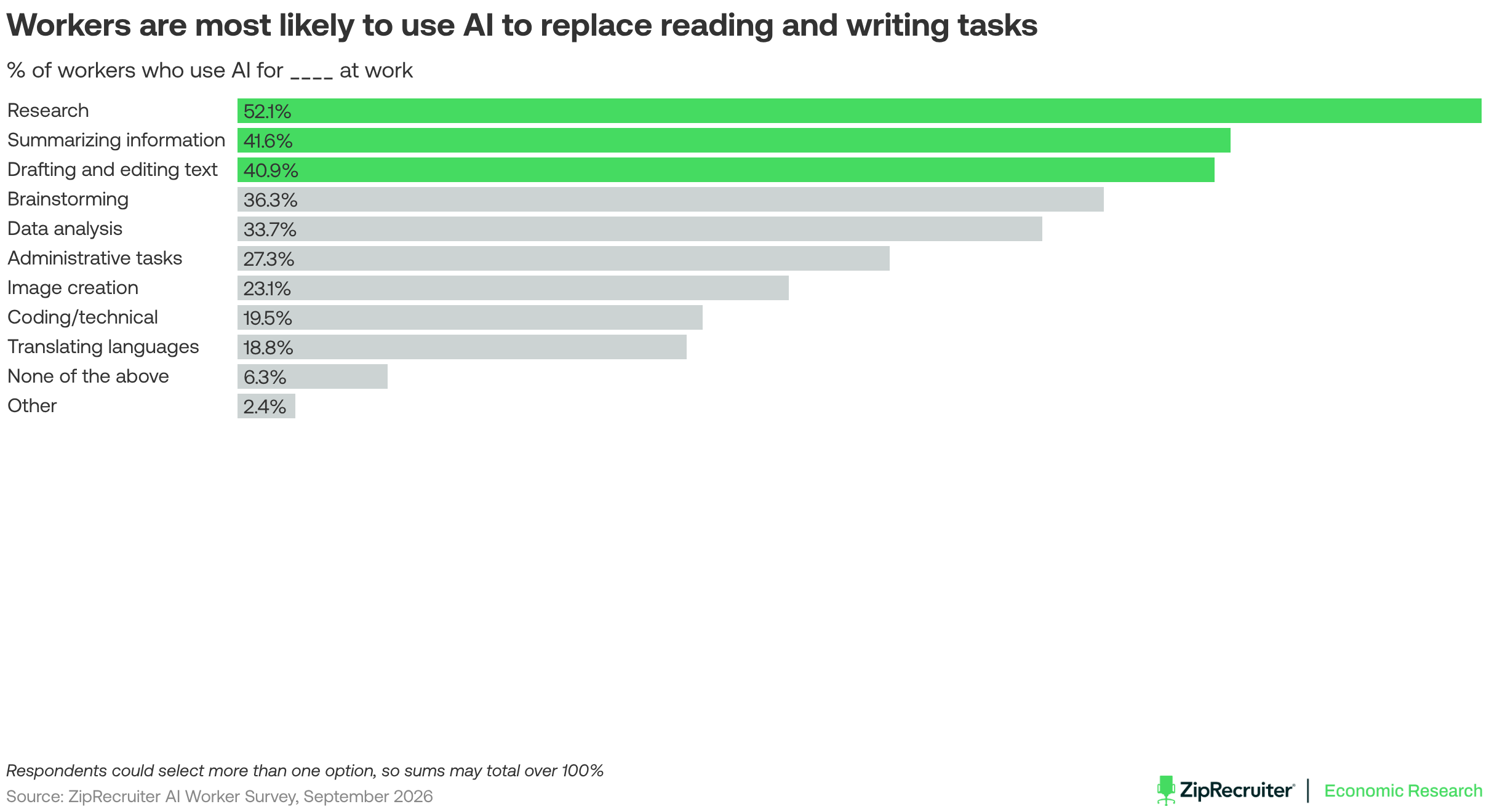
The report pointed out that senior workers are using AI to reduce friction at work, such as reading and writing, and that could be the reason they use it more frequently.
"But the base of the workforce, the people building the end products, are feeling a little left behind," it noted.
"Many of the tasks AI is automating, like taking meeting minutes, summarising research, or drafting text, were all tasks that entry-level workers once owned. There are now fewer opportunities to learn how to work, and the bar for entry-level workers is rising."
Training gaps on AI
Training also appears to be limited to senior employees, according to the report.
Senior leaders were the most likely to have access to AI training at their organisation, at 83.5%. Individual contributors and entry-level workers lagged well behind, at 46.4% and 45.3% respectively.
"This disparity may stem from how companies deliver training: leadership receives broad, strategic overviews that fit their high-level role, while the more front-facing staff, like ICs and entry-level workers, need more hands-on instructions for daily tasks," the report read.
This comes as more employees believe AI is making their skills decay faster, triggering AI-related anxiety and prompting them to teach themselves how to use AI.
"The lack, or insufficiency, of formal training in the workplace is leading many workers to teach themselves how to use AI tools, decentralising learning and putting the burden on the shoulders of workers directly," the report read.
It urged employers to formalise training on AI, stressing that it is vital to helping workers understand what's expected of them.
The lack of formal support from employers can also stop employees' outputs from having any real impact at work, according to the report.
"The door is wide open for employers to regulate and formalise AI training to unlock the full potential of their workforce," it added.