New insight says cyclical and structural risks are to blame for 'crisis-level' figures
New Zealand's youth unemployment rate may be due to a "perfect storm" driven by cyclical and structural risks at work, according to experts, who warned that economic recovery may not be enough to fix the crisis-level figures of unemployed young people.
A new insight from the New Zealand Institute of Economic Research (NZIER) said the country's youth unemployment rates may also be influenced by factors such as business uncertainty, technological change, and government policies.
"Many young people may be locked out in a perfect storm," said Daniel Hamill, senior economist at the NZIER, in a statement.
"We can't be certain about the role of each individual factor, but there appears to be a complex combination of cyclical and structural risks at work, including a sluggish recovery, business uncertainty, unhelpful policy responses, pre-existing structural problems, accelerating technological change, and increasing reliance on temporary migrant workers in some sectors where young people are also concentrated."
Hamill made the remarks as New Zealand's youth unemployment rate has risen to 25.3% among 15- to 19-year-olds and to 12% among 20- to 24-year-olds since COVID.
These rates are similar to those seen at the peak of the global financial crisis, despite overall unemployment remaining relatively stable, according to the NZIER.
"Youth unemployment has reached a crisis level without an economy-wide unemployment crisis," the NZIER insight read.
"The lack of a shared problem is likely one reason that youth unemployment hasn't had the pre-election attention that it might normally attract."
Factors behind youth unemployment
Among the potential reasons that the insight cited for New Zealand's youth unemployment rate are the policy decisions made during and after COVID and in response to high rates of inflation.
"The current government has prioritised fiscal restraint over fiscal support," the NZIER said.
"Policies focused on strengthening incentives to work overlook the shortage of genuine employment opportunities and reduce access to employment support."
The rise of artificial intelligence tools also added another layer to the problem, according to the report, which noted that uncertainty over the technology's impact may have made employers put hiring on hold.
Sarah Hogan, principal economist at the NZIER, added that New Zealand's education and training sector has "always been slow to adapt."
"The impacts of that are worse when technology is moving very fast and in ways that make it unclear what skills employers and workers will need in the near future," Hogan said.
The growing reliance on temporary migrant workers by sectors traditionally hiring young people, such as construction and the retail, food, and accommodation sector, also played a role in youth unemployment, according to the insight.
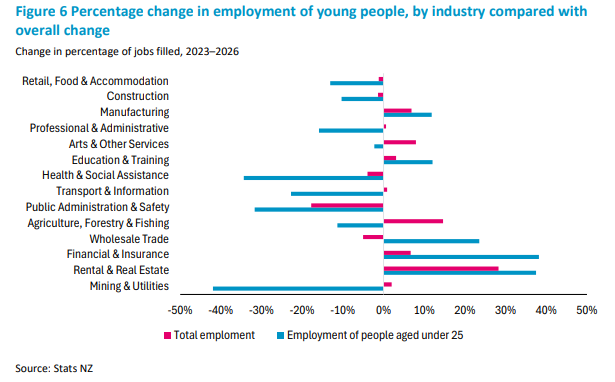
Stats NZ data cited in the report shows that young people lost the most ground in the retail, food, and accommodation sector, where it found a 13% reduction since 2023.
"Professional & administrative and construction show 16% and 10% declines, respectively, while manufacturing has grown slightly in its share of young people," the insight added. "Patterns of reduced employment among young people do not always reflect an overall reduction in employment."
What can fix the problem?
The NZIER warned that the problem may persist despite economic recovery due to the structural factors identified in the insight.
It said the "most immediate" need is support to help young people who are currently unemployed into work to minimise the long-term costs.
"But the government should be thinking more strategically than that," it added.
"With structural changes likely to result from AI adoption and other ongoing technological change, and with existing and known challenges in education, training and immigration, New Zealand needs a coherent workforce strategy to improve long-term economic resilience."