Spark survey finds 48% of businesses faced cyber incidents, but few test their resilience plans

Training and upskilling employees is the main focus of employers to boost their organisation's resilience in case of disruption, according to a new report, which also found that many businesses still go without a resilience plan or basic cyber security safeguards.
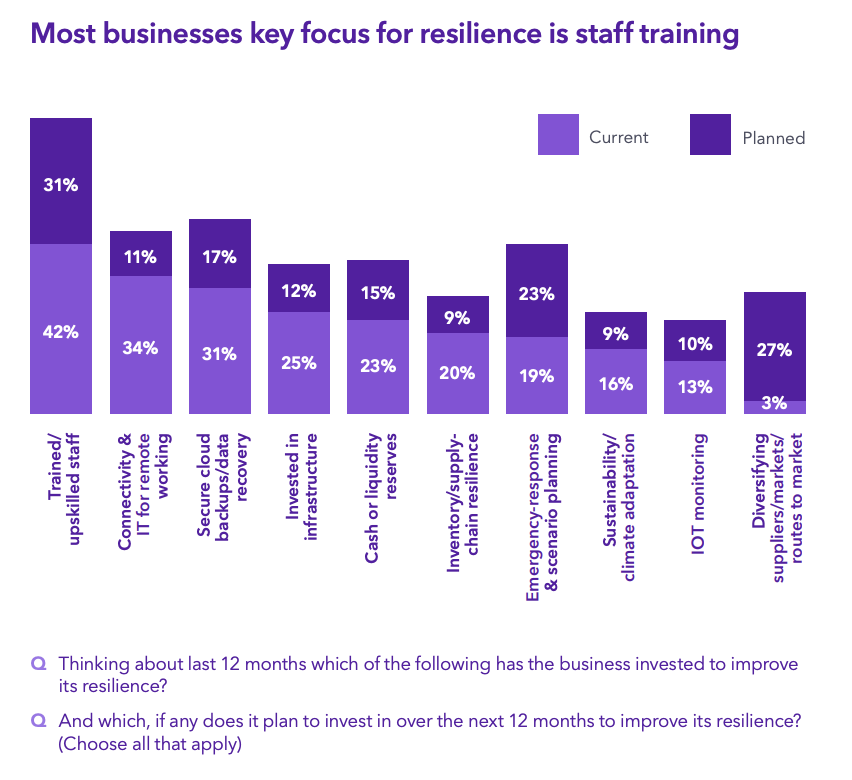
Spark's 2026 report, Built to succeed: Resilience in the age of disruption, cyber risk and AI, found that 42% of New Zealand businesses invested in upskilling staff over the past year to improve their resilience.
This was ahead of investment in connectivity and IT for remote working (34%) and secure cloud backups and data recovery (31%).
Staff training also remains the biggest focus for the next 12 months, cited by 31% of businesses, followed by diversifying suppliers and markets at 27%.
The emphasis on training comes as skills remain a hurdle.
A lack of skilled workers topped the list of barriers to digital adoption among businesses facing such barriers, at 31%, while employee resistance or a lack of skills and training was among the most common obstacles to further AI adoption, at 30%.
"Resilience is not simply about getting through the next incident. It is about protecting customer trust, productivity, and the ability to keep growing," Sam Thumath, Spark's general manager of business connectivity, said in a statement.
Fewer businesses are investing in preparing for a crisis itself. Just 19% put money into emergency response and scenario planning over the past year, although 23% plan to do so in the next 12 months.
Plans rarely tested
The report also found that only 44% of businesses have a resilience plan, and just 16% regularly review it or undertake scenario planning. It noted that "for many, resilience remains an informal discipline."
Meanwhile, 48% of businesses have experienced a cyber security incident in the past 12 to 24 months, rising to 58% among organisations with more than 100 employees.
However, most described these as isolated incidents with no noticeable disruption, and only 10% reported significant impacts such as downtime or data loss.
"The low impact so far may explain why so few (19%) see cyber security as a priority for further investment," the report said.
Basic safeguards are also lacking. Only 54% of businesses have a formal password and authentication policy, while 29% have a formal business cyber security policy.
According to Thumath, businesses tend to revisit their resilience only after something goes wrong, but the pressure is increasingly coming from outside.
"Insurers, regulators and customers want proof that critical systems, information and services are protected – and you need to get ahead of that," he said in the report.
'Confident performers' lead the way
The report identified a group of "confident performers," about nine per cent of respondents, who rated both their productivity and their confidence in meeting growth ambitions at nine or 10 out of 10.
Three-quarters of these businesses have documented resilience plans, and 66% have a formal business cyber security policy, compared with 29% overall.
"These findings suggest resilience should be seen as an investment in performance and future growth, rather than simply as a cost," Thumath said.
The survey, conducted by Clemenger for Spark, polled 404 managers, directors and owners of New Zealand organisations with 10 or more employees between 21 August and 5 September 2026.