As wage growth struggles to keep pace with living costs, HR leaders say a well-targeted benefits package can decide whether talent stays or walks
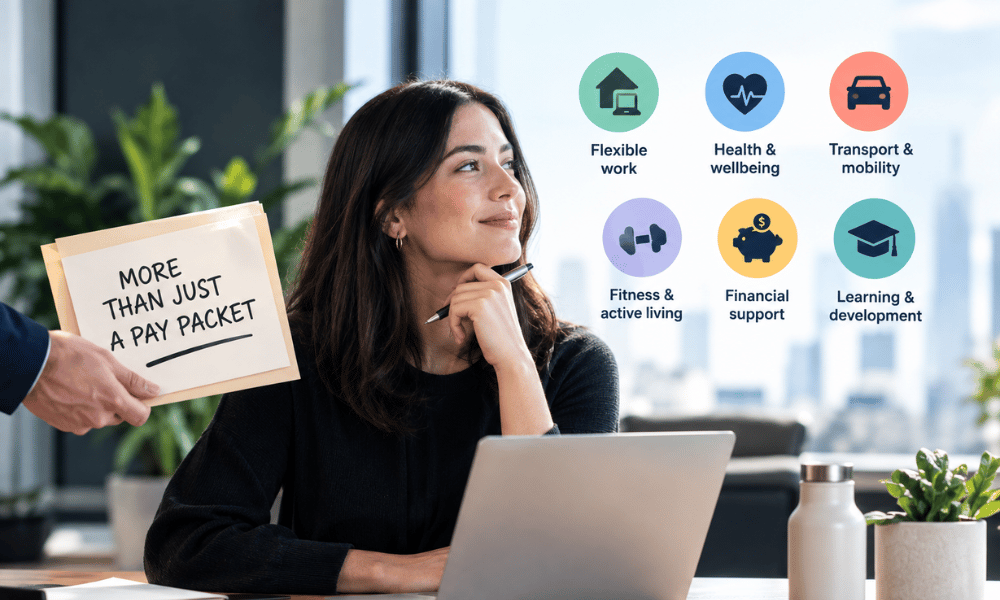
More than three in five (63 per cent) employers have watched a candidate accept a job despite a salary shortfall, purely on the strength of the benefits on offer.
Wage growth is struggling to keep pace with the cost of living, and employers are having to compete on more than pay alone.
For HR leaders, the benefits conversation has moved from a nice-to-have to a core part of the employee value proposition, but only when what's on offer is relevant, not just plentiful.
Lauren Waddell, HR manager at global visual effects house Framestore, has built her benefits strategy around exactly that principle. "Benefits is such an interesting space because it's almost like an economic indicator sometimes to tell you what's actually happening in workplaces," she said.
"Certainly since COVID it's changed a lot, because some of the things that were benefits pre-COVID are now just a given. Flexible work or remote working, we used to pitch those as something we offer that other places don't. Now they're a standard, and we've had to go out and find new things, in quite a tight economic environment."
Legacy perks give way to smarter benefits spending
Waddell points to employee assistance programs (EAPs) as the clearest example of a benefit that has been overtaken by expectation. "EAPs used to be something we'd pitch as a really exciting benefit," she said.
"Now, with [new workplace health and safety obligations], it's compulsory. You pretty much have to have an EAP. So all of these things that used to be exciting are now offered as standard, and we have to refresh our whole mindset of what's the next benefit that can come through."
She includes office perks such as kitchen food and workplace design in the same category: "Those things are just standard and part of what people expect now."
The task for HR teams, she said, is finding benefits that genuinely help staff without hitting the bottom line. "Finding benefits that work for employees but aren't a huge expense to the business has become a really big priority in the last few years."
Relocation and everyday-cost benefits deliver measurable value
Framestore recruits visual effects talent globally and regularly relocates staff internationally, and Waddell has leaned on benefits that ease the cost of settling into a new country, such as discounted health insurance, gym memberships and, most notably, a vehicle salary-packaging arrangement.
"Moving to Australia, getting a car is essential, and novated leasing pops up straight away as something people are really excited about, because we can't buy people cars," she said. "It was a nice in-between to help get people settled."
That reflects a broader shift toward benefits that deliver real, quantifiable financial value rather than simply adding to a perks list. Simon Southwell, chief executive of Positive Salary Packaging (PSP), an Australian salary-packaging provider, said the data his company holds backs up what Waddell is seeing on the ground.
"Employees are increasingly taking an active role in sourcing the benefits they want," Southwell said, pointing to a 32 per cent year-on-year rise in employee-originated demand for novated (salary-packaged) leasing recorded by PSP in 2026.
"This suggests the benefits conversation is increasingly flowing from employees into the workplace, giving HR teams another signal of what their people value."
Southwell added that PSP's own employer base grew 18 per cent over the same period, which he said reflects HR teams looking for benefits that deliver value while remaining practical to administer. "The perceived effort of offering a benefit shouldn't be a reason to leave employee demand unmet," he said.
Turning employee feedback into benefits policy
Waddell said Framestore relies on direct conversation over formal surveys to shape its benefits mix. "We have a fortnightly rotation of meetings with leadership and with all staff. We track really closely the engagement on current benefits. We've offered a couple of different gym memberships, some weren't as popular, so we've dropped a few and brought a couple of others on."
A request for help covering the cost of home-office tech, for instance, led Framestore to introduce salary sacrificing for equipment. "That came out of people coming to us and asking, what can I do, this stuff is so expensive," she said.
That responsiveness, Waddell argued, matters more than the size of the benefits budget. "Sometimes you think something's going to be really popular and it's not, or vice versa," she said, citing an unexpectedly popular staff discount on eyewear.
"It can be a little unpredictable, but there's core things people really love, and it becomes a really important tool for attraction and retention."
With wage growth unlikely to outpace living costs any time soon in most major economies, HR leaders may increasingly find that a sharper benefits strategy, not a bigger pay packet, is the more realistic lever they have to pull.