AI is in the room whether you invited it or not. Here's how leading HR teams are adapting
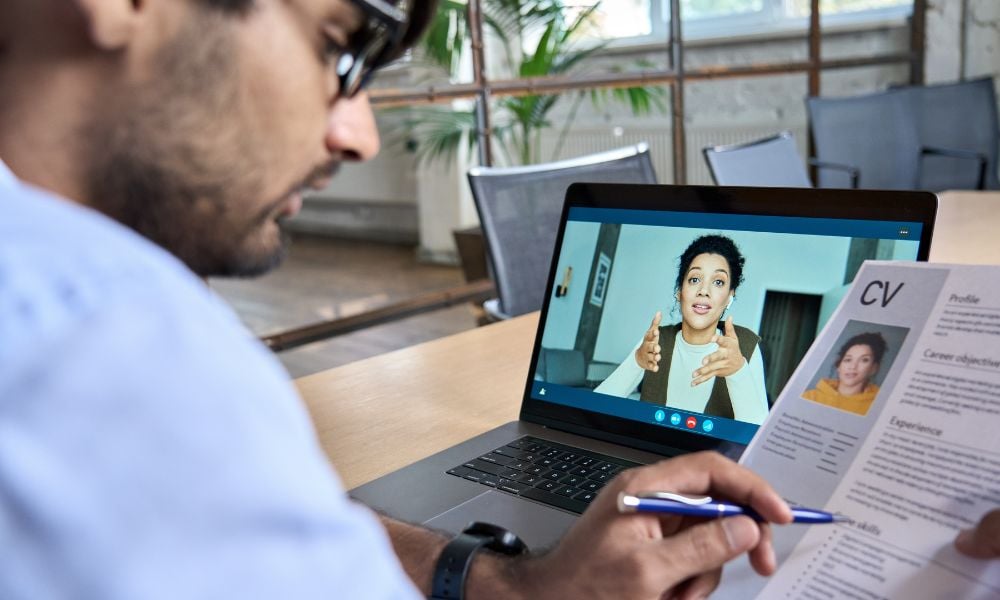
The remote interview has become standard practice. But a new wrinkle is emerging in virtual hiring: candidates who appear composed, articulate, and perfectly prepared may have a silent co-pilot – an AI tool feeding them answers in real time.
It's a challenge that Shawn Gibson, Chief People Officer at Info-Tech Research Group, encountered firsthand.
"What we're finding is that sometimes we get a sense that candidates are using AI right in the actual interview with the recruiter," he said. "And that's just not acceptable. It's not evaluating the candidate properly."
Gibson's concern is increasingly shared across the industry. Tools like Final Round AI and Interview Copilot now boast millions of users who receive live response prompts during interviews – prompts that are invisible to the interviewer. The problem has grown acute enough that, according to recent research, over 72% of recruiting leaders are now conducting some interviews in person specifically to counter the trend.
A global hiring problem
For organizations with distributed workforces, the challenge is compounded. Gibson noted the particular difficulty for companies like Info-Tech, which operates across six countries with recruiters based in North America.
"That's global for us because our recruiters are based in North America. So, then that's an issue when we look to hire someone in Singapore,” he said.
The mechanics of AI-assisted interviewing, he explained, are deceptively simple: "AI can actually take the question in and immediately provide the answer and then the candidates are just using that."
READ MORE: Google opts for in-person interviews amid surge in AI-aided candidates
In response, Gibson floated one potential workaround – a hybrid human presence model.
"Could we have a senior leader that's based in Singapore meeting in person but then having the recruiter on virtually?"
That way, someone physically in the room can observe behavior that a remote screen can't detect.
The telltale signs are there for those who know what to look for.
Christine Vigna, Chief People Officer at Dejero, said experienced hiring managers can spot AI-assisted answers relatively quickly.
"There are long pauses. They will give an extremely well-articulated answer – and then you ask the next question, there's a pause and then they go again,” she said.
The hypocrisy question
For Vigna, the question didn't stop with the candidates. While AI assistance during interviews can undermine authentic evaluation, she argued that employers need to examine their own role in this dynamic.
"So many employers are now using AI in the hiring process themselves," she said. "A lot of times, AI is used to screen resumes. It's used to evaluate candidate responses and score them. So, in my mind, it's a tad hypocritical that employers can use AI for all of their processes, and yet we're saying that employees should not be using AI in that hiring process."
It's a position gaining traction. Workflows, she noted, are increasingly being built AI-first, which means a candidate who is fluent with AI tools may, in some roles, be exactly the hire an organization needs.
"If we have candidates who are comfortable using AI, it's a bonus,” she said.
READ MORE: Hiring professionals back 'live-only' interviews to prevent AI-aided candidates
This thinking has prompted Dejero to quietly reframe how it assesses some candidates. Rather than disqualifying applicants who lean on AI, the company digs deeper afterward.
"We actually don't shy away from candidates using AI to help them generate some of their answers, but we rather dig into those post-technical assessment conversations: 'What was your prompt? How did you use it? How could you have improved your output? Why did you choose to go that route?'"
The result is an evaluation that tests both AI fluency and underlying knowledge – a skill set that increasingly reflects the actual demands of the job.
When AI meets AI
Gibson acknowledged the broader tension playing out across talent acquisition: "Candidates are applying with AI, but then recruiters are using AI to look at it. So, you literally have AI to AI issues being created."
His own team at Info-Tech recently deployed an AI-enabled talent acquisition tool that improved candidate quality, candidate experience, and decision-making. But he remains wary of AI-to-AI dynamics that cut humans out of the loop entirely, particularly when confidential or sensitive judgment is required.
The emerging data supports caution. A recent Newsweek-cited survey found that 22% of job seekers admit to using AI during live interviews – a figure HR consultant Bryan Driscoll suggested is likely far higher. Meanwhile, separate research found that 70% of candidates were never informed that AI would be evaluating them during a hiring process.
Both Gibson and Vigna pointed toward the same underlying principle: governance and intentionality must precede adoption.
"The pace of adoption gets ahead of the governance around it," Gibson said, describing how Info-Tech paused a planned AI-powered HR assistant when it recognized that privacy guardrails needed closer attention before moving forward.
What HR leaders should do now
The path forward, both executives agreed, starts with intentionality.
Vigna recommends treating AI literacy as a measurable competency, not a disqualifier. Rather than trying to catch candidates in the act, build interview structures that require them to demonstrate reasoning, not just output. Ask candidates to walk you through how they used a tool. Probe for the thinking behind the answer.
Gibson's advice is more structural: consider whether the remote-only format still serves your hiring needs, and where human presence – whether virtual or in person – can restore the judgment that AI obscures.
"Where can we have employees interject? Where do we really need human scrutiny, human touch?” he said.
The question of AI in interviews is not going away. As Vigna put it, "There needs to be a world in which our hiring practices are thoughtful and inclusive about the fact that candidates are using AI."
The organizations that get there first won't just find better hires; they'll build the kind of candidate trust that a purely algorithmic process never can.