The ABS says September's fall was the sharpest since the 2021 lockdowns

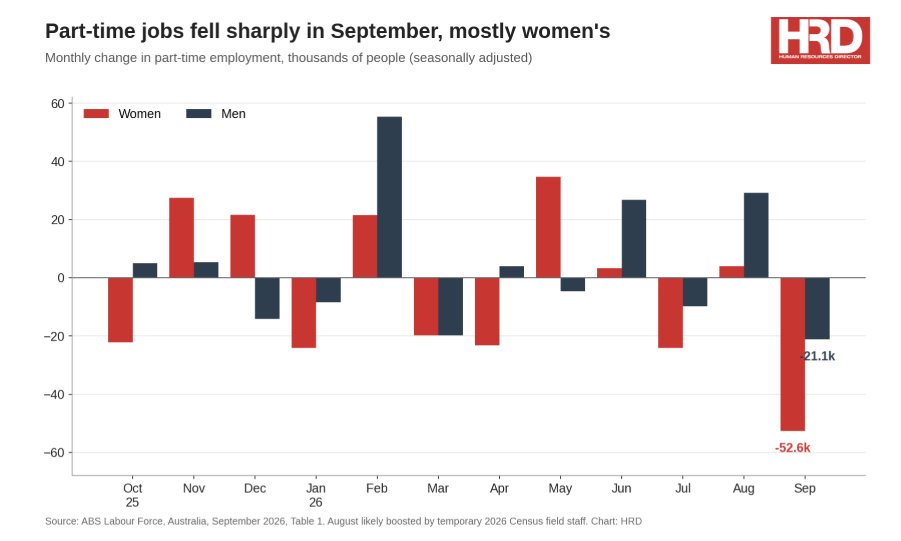
Women shed 52,600 part-time jobs in September, the largest monthly fall since the Delta lockdowns of September 2021, according to seasonally adjusted figures from the Australian Bureau of Statistics.
Part-time employment fell by about 73,700 across the whole workforce, while full-time jobs rose by 34,400. Women accounted for most of both moves: their part-time jobs dropped sharply and their full-time jobs rose by 37,600.
The net result was 15,000 fewer employed women and 24,300 fewer employed men, as national unemployment rose to 4.7 per cent. The unemployment rate for women rose to 4.6 per cent, its highest since November 2021.
Some of it is the Census
Part of the fall was expected. An economist quoted by The New Daily warned that August's part-time figures included about 30,000 temporary staff hired by the ABS to run the 2026 Census, and that those jobs would likely fall away in September.
Even so, the September drop is more than double that number. And month-to-month part-time figures for women are volatile: they have fallen in six of the past 12 months and risen in the other six. The ABS has also cautioned that September's seasonally adjusted data may carry some leftover effect from changes to its survey methods, and it recommends trend figures as the better guide.
Read next: Unemployment rises to 4.6% as full-time jobs slip in August
The bigger shift
Step back toexamine the full year and a clearer pattern shows up.
Between September 2025 and September 2026, women's full-time employment rose by about 131,900 while their part-time employment fell by about 53,300. Men went the other way: their part-time jobs grew by 48,000, slightly more than their full-time jobs, which rose by 41,700.
Women now hold 40.1 per cent of all full-time jobs in Australia, the highest share since the ABS series began in 1978. The share of employed women working part-time has dropped to 42.2 per cent, its lowest since mid-2023.
The data doesn't say why. Cost-of-living pressure and four interest rate rises this year are plausible reasons for some women to take on more hours, but that is a theory, not a finding, and it deserves testing against employers' own workforce data.
Read next: Fixing productivity with better work design
Flexibility that stops at the manager's door
If more women are working full-time, the question for HR is whether those jobs lead anywhere.
The Bankwest Curtin Economics Centre and the Workplace Gender Equality Agency released Gender Equity Insights 2026 this week. It found 86 per cent of organisations offered part-time work in 2024-25, but only 13.2 per cent had designed management roles that could be done part-time. Women were also more likely than men to resign from leadership positions.
"Offering part-time work is very different from designing senior jobs that can actually be done part-time," said report co-author Dr Silvia Salazar, a senior research fellow at BCEC.
Women who have moved to full-time to progress may drop back out if senior roles stay rigid. And women who need part-time hours, often because of caring responsibilities, can find the path up blocked. The report also found women do more unpaid work than their partners even when both work full-time.
For HR teams, three questions follow from the numbers. Which of your part-time roles were cut or not replaced this year? Are part-time staff being promoted at the same rate as full-time staff? And could any of your management roles be done in fewer than five days?