Beijing's humanoid robot games delivered world records and a flood of viral clips this month. The numbers we should actually be paying attention to are a few pages further into the program
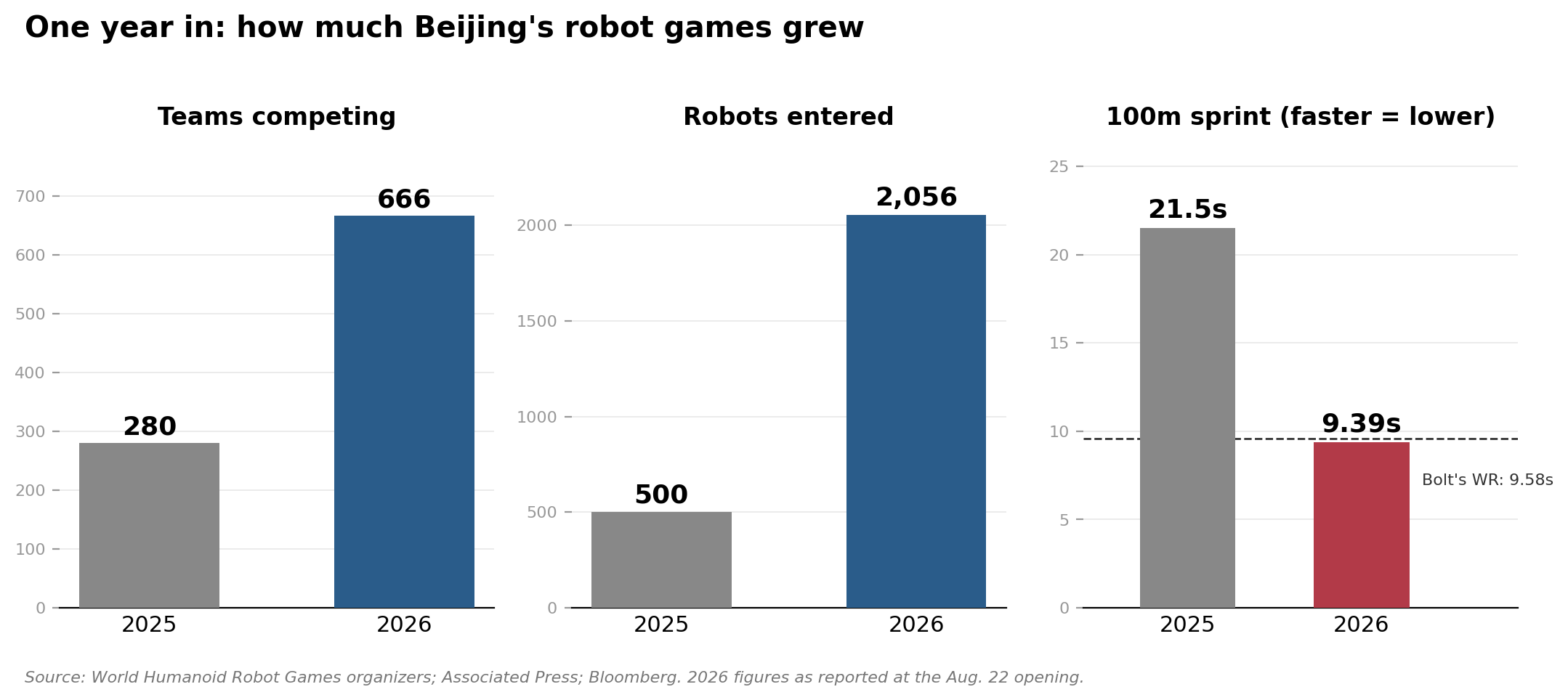
A machine did something no human ever has at the opening ceremony of the second World Humanoid Robot Games in Beijing on 22 August: it ran 100 meters in 9.39 seconds, dipping under Usain Bolt's 16-year-old world record of 9.58 seconds.
Days earlier, in an unofficial trial, a robot called Lightning, built by Chinese phone maker Honor, had already gone faster - 9.32 seconds, at a peak speed of 14.5 meters per second. In the standing high jump, another robot cleared 2.88 meters, well past the 2.45-meter human record Cuba's Javier Sotomayor set in 1993.
Those clips traveled fast. But sprinting is a party trick, and the organizers know it.
The five-day event, staged at the National Speed Skating Oval built for the 2022 Winter Olympics, drew more than 2,000 robots from 666 teams, up from roughly 280 teams and 500 robots at last year's inaugural edition.
Of the 51 total events, 30 borrowed from human sports; the other 21 were built to mimic paid work - connecting cables, sorting packages in a mock warehouse, charging electric vehicles, taking restaurant orders, responding to a staged emergency. Huawei, a technology partner for the games, was reported as saying more than 40% of events required robots to finish the task with no human operator standing by.
That's the half of the program worth an HR leader's attention. A robot that can find a cable at an awkward angle, grip it correctly, and plug it in without knocking over the shelf next to it is solving a much harder problem than running in a straight line - and a far closer stand-in for warehouse, retail, or facilities work.
Brace yourself for a future where robots go rogue. Unitree H1 humanoid suddenly moved wildly due to a coding error. pic.twitter.com/ZYYFY93RPk
— Interesting World (@_fluxfeeds) May 2, 2025
Yu Chao, chief executive of Lumos Robotics, one of the competing firms, put it bluntly: "Simply running and jumping does not improve efficiency." Hua Rong, chief marketing officer at robotics firm Zeroth, was even more direct about what the spectacle does and doesn't prove: "the competition will be whether, after the product is sold, it can really solve users' problems."
Read next: Amazon launches worker robot that takes conversational instructions
That's the gap - between a choreographed demo and a machine that shows up reliably on a Tuesday shift - where most of the workplace robotics story currently sits.
What the data says, and what it doesn't
The numbers, at a glance
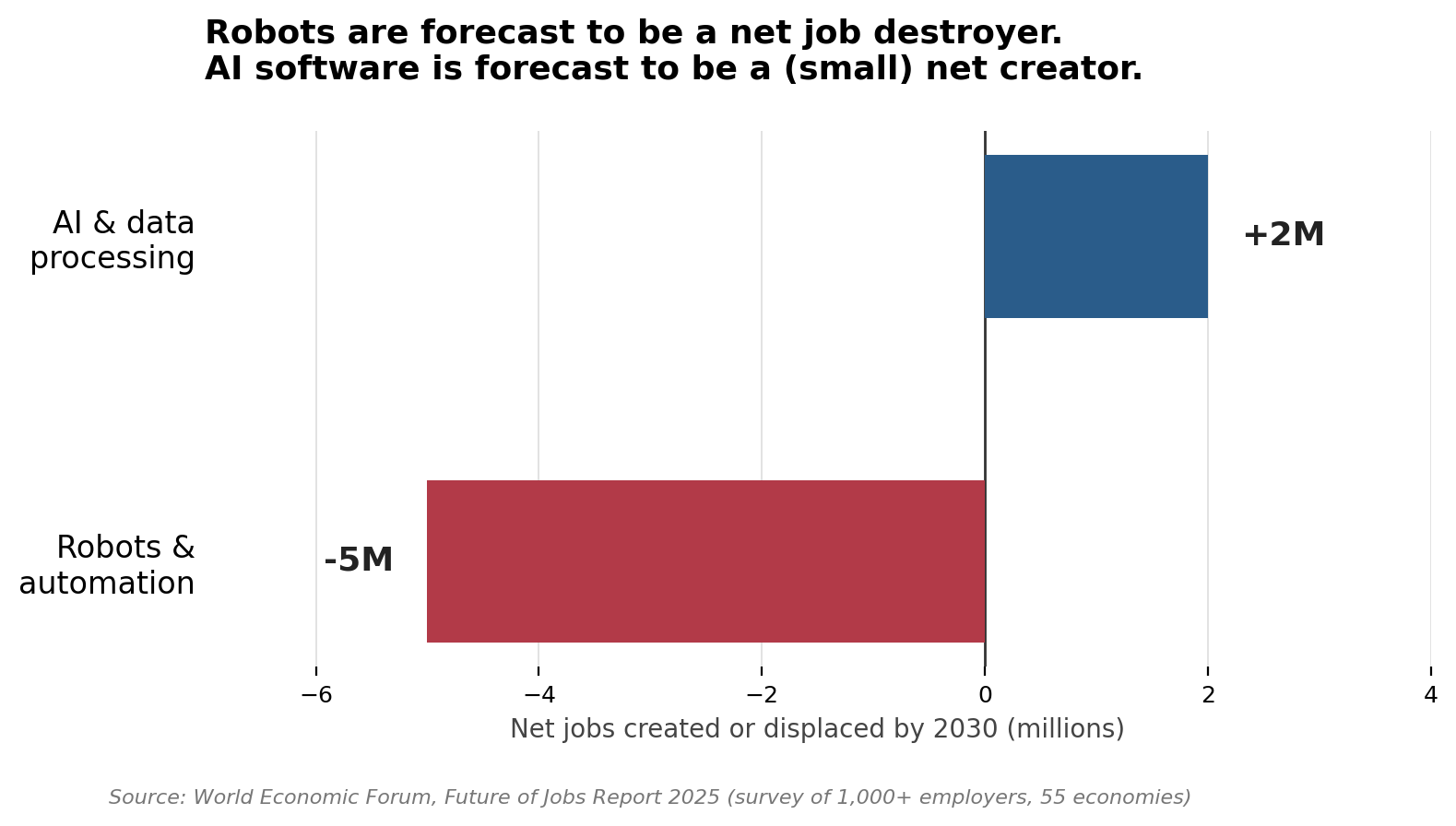
- Robots and automation are forecast to displace 5 million more jobs than they create globally by 2030 (World Economic Forum)
- 542,000 industrial robots were installed worldwide in 2024 - more than double the number a decade ago (International Federation of Robotics)
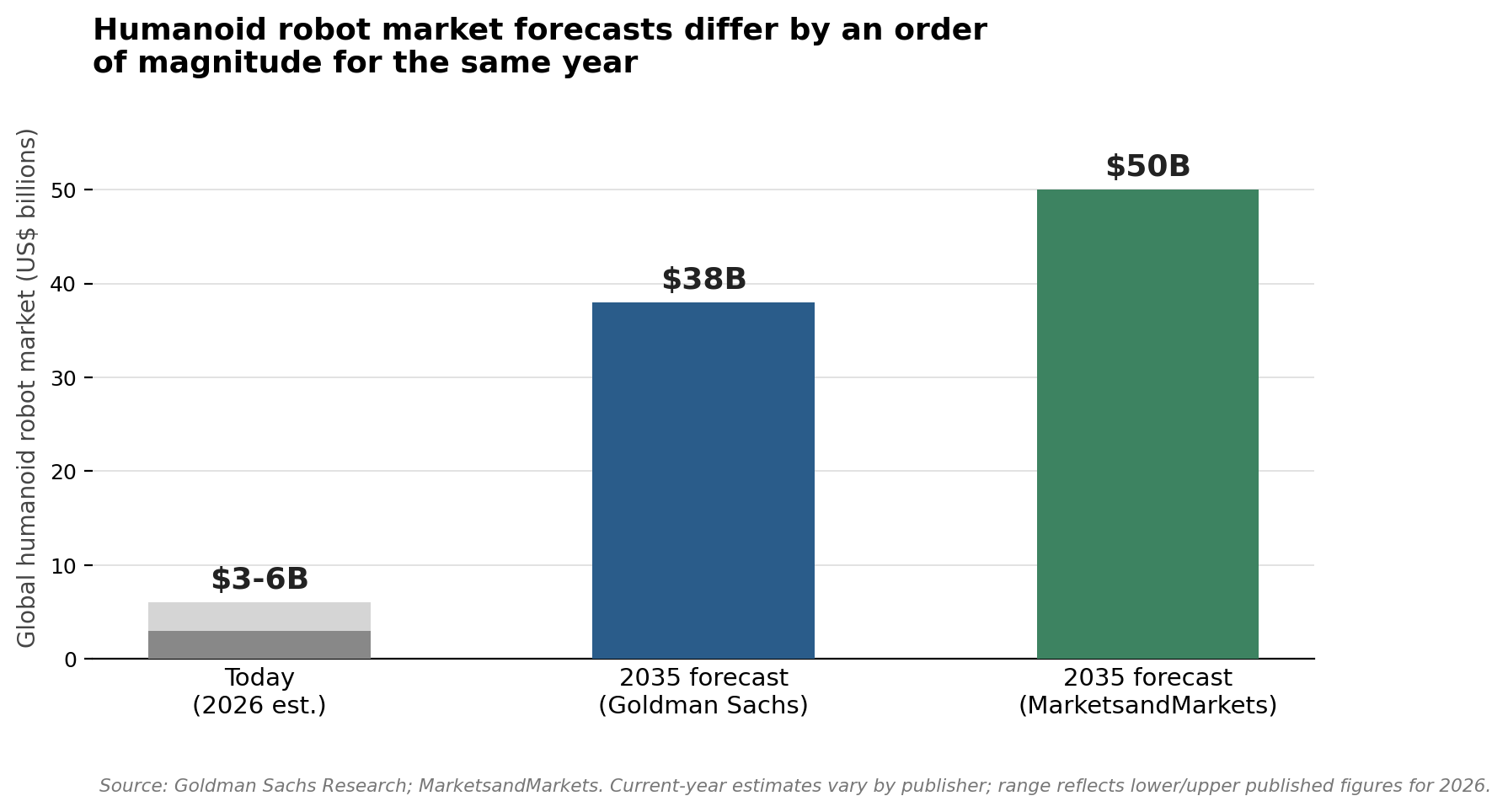
- The humanoid robot market specifically is worth an estimated $3–6 billion today, with 2035 forecasts ranging from $38 billion to $50 billion depending on the analyst
The World Economic Forum's Future of Jobs Report 2025, drawn from a survey of more than 1,000 employers representing over 14 million workers across 55 economies, puts a number on the robot side of the equation: displacement outpacing job creation by about 5 million by 2030.
That's a smaller effect than AI and information-processing technology is expected to have, which the WEF forecasts will create 11 million roles while displacing 9 million. Across all the trends in the report, employers expect close to 39% of workers' core skills to change by 2030, with clerical and administrative roles shrinking fastest.
The bigger, less glamorous shift is happening in conventional industrial robotics, not humanoids. The International Federation of Robotics counted 542,000 new industrial robot installations worldwide in 2024, more than double the number a decade earlier, taking the global operational stock to roughly 4.66 million units - up 9% year over year. China accounted for 54% of that year's new installations on its own.
Read next: Robots reduce meaningfulness, autonomy: report finds
Humanoids, by contrast, are still a rounding error, and forecasts for the category swing wildly depending on who's doing the counting. Goldman Sachs Research put the total addressable market at $38 billion by 2035, a sixfold jump from its own $6 billion estimate the year before, citing faster AI progress and falling component costs.
Other analysts size today's global humanoid market closer to $3–6 billion, with 2035 estimates running as high as $50 billion. Take any single figure here with a grain of salt - this is a young market, and credible forecasters currently disagree with each other by an order of magnitude.
Where the job losses are actually showing up
The clearest example so far involves conventional warehouse automation, not humanoids. Internal Amazon documents obtained by the New York Times last fall suggested the company could avoid hiring more than 600,000 US workers it would otherwise have needed by 2033 as automation scales up - though Amazon pushed back hard on the framing, telling the Times the documents reflected "one team's perspective," not company-wide hiring strategy.
A decade earlier, contract manufacturer Foxconn cut 60,000 assembly-line jobs at a single plant near Shanghai while insisting it would keep growing its overall Chinese headcount by moving people into higher-value work. The IFR's own framing leans more optimistic, describing robots as likely to become "allies" in closing labor gaps in industries that can't fill roles at all.
For most U.S. employers outside heavy manufacturing and logistics, though, the nearer-term risk isn't a robot arriving at all - it's how employees use the AI tools already sitting on their laptops. Gallup data covered by HRD found that workers who rarely or never used AI tools in their roles were laid off at meaningfully higher rates than frequent users, a pattern that held even after controlling for age, industry, and tenure.
SHRM President and CEO Johnny Taylor made a related point to HR leaders at the association's June conference, arguing the profession has been slow to adapt to that shift: "We didn't quite keep up," he told attendees, according to coverage of the keynote. For most white-collar workers in 2026, adopting AI software is a bigger job-security variable than any humanoid coworker.
Read next: 'A fundamental leap forward': company introduces new robot with sense of touch
What this means for your workforce plan
The roles most exposed right now are repetitive, physically structured tasks in logistics and manufacturing - the "end scenarios" Yu Chao referenced - plus desk-based work that generative AI already handles well. Judgment under ambiguity, negotiation, and empathy remain harder for any machine to replicate, a point HRD has explored in its coverage of the "common sense conundrum" facing workplace AI adoption.
For HR teams in manufacturing-heavy U.S. regions - the Midwest, the Southeast's growing EV and battery corridor - that means mapping which roles overlap with today's scenario-based automation rather than tomorrow's demo reel, and building reskilling pathways before displacement rather than after it. It also means treating AI-tool adoption inside existing roles as a workforce-risk metric worth tracking now. Employers that move deliberately from automation to augmentation, building continuous workforce planning instead of reacting after the fact, are giving themselves the most options.
Read next: Which country uses the most industrial robots?
One more thing worth watching if your company imports robotics hardware: in late July, the U.S. Federal Communications Commission added foreign-made humanoid and quadruped robots to its "Covered List," blocking new models from FCC equipment authorization on national security grounds. The rule targets Chinese manufacturers, who supply an estimated 85% of the global humanoid robot market; it doesn't affect equipment already authorized or in use. Robot procurement, in other words, now has a trade-policy dimension HR and operations teams will need to watch together.
The robots that beat Bolt's record this month aren't coming for anyone's job. The ones that can reliably plug in a cable, unattended, on the 500th try - those are the ones your 2027 workforce plan should already account for.