
Treasury said switching from bananas to apples means workers are keeping up just fine
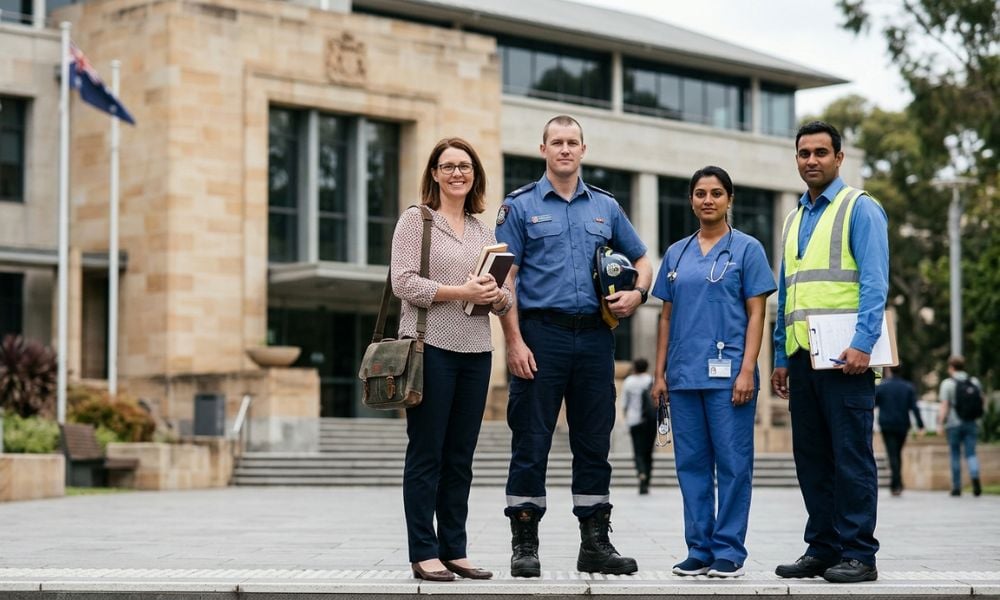
NSW public sector workers just landed a 3.5% pay rise - and the government's own inflation measure went down with it.
The New South Wales Industrial Relations Commission handed down its annual State Wage Case decision on October 8, 2026, setting the paid rates adjustment for public sector awards at 3.5% for the 2026-27 financial year. The figure splits the difference between the NSW Government's preferred 3% and the 4.5% sought by Unions NSW - but the reasoning matters more than the number.
At its core, the case turned on a surprisingly basic question: how should you measure inflation?
The government argued for 3%, matching its own budget, and relied on expert evidence from a senior Treasury official. That evidence introduced a measure called the NSW Household Final Consumption Expenditure deflator - an inflation index calculated internally by NSW Treasury but never published by the Australian Bureau of Statistics. The pitch was that NSW HFCE better captured real household cost pressures because it accounts for changes in consumer behaviour. The go-to example: if bananas get expensive and households switch to apples, NSW HFCE picks up that shift faster than CPI does.
The Commission was not persuaded.
As counsel for Unions NSW put it, the index "treats substitution as a costless exercise." Swapping bananas for apples might keep total spending the same, but the Commission noted that an employee forced to holiday locally instead of interstate or overseas has plainly lost something. It found that while NSW HFCE had some utility, it was not superior to CPI for wage-setting purposes.
The practical problems stacked up too. NSW HFCE is not published by the ABS in any form accessible to the Commission or the public. The June quarter figure was not even available at the time of the August hearing, requiring the government's expert to estimate it. And the expert's report did not identify the deflator figure on which the calculations depended.
The government also tried to frame the adjustment around real wage changes for two specific employee groups - a Senior Education Officer and a Senior Firefighter. The Commission rejected that approach outright. The firefighter classification was a particularly poor fit: those employees had received above-inflation arbitrated increases in the preceding years (4% in February 2024, 4% in February 2025, and 6% in February 2026) and were not even eligible for a paid rates adjustment until February 2027.
With those arguments out of the way, the Commission turned to CPI. Three reference points were on the table: Australian headline CPI at 3.9%, trimmed mean at 3.6%, and Sydney headline CPI at 4.0%. It landed on 3.5%, placing greater weight on the trimmed mean because single point-in-time measures are vulnerable to short-term volatility. The Commission also noted a modest upward bias in CPI due to delayed basket reweighting, and gave some weight to the 0.5% increase in compulsory superannuation contributions that took effect on July 1, 2026.
On the fiscal side, the government's concerns did not hold up to scrutiny. Evidence showed the decision directly affects just five awards covering 4,564 full-time equivalent employees. Two of those awards cover Fire and Rescue NSW firefighters (4,361 of the total), and the NSW Government contributes only 14.6% of the funding for firefighter wages, with the balance coming from insurer and local government contributions. A 2% increase above the budgeted position would add $5.9 million to gross debt over four years to 2029-30 - representing 0.003% of the state's gross debt in 2026-27. It would not prevent the state returning to a net surplus in 2027-28.
The second half of the decision dealt with the Award Making Principles - the framework that guides the Commission when making or varying awards. The Public Service Association pushed for a fundamental rewrite, proposing to collapse multiple principles into one and introduce new grounds for pay increases, including one based on staff shortages. The government opposed the overhaul.
The Commission declined the wholesale restructure but accepted the principles need a refresh. It agreed to strip out outdated phrases - language like "wage leapfrogging" and "comparative wage justice" that the PSA described as "archaic" and "arcane" - and to expand the rules on when comparable pay rates can be considered. It also endorsed a new procedural expectation that parties confer before arbitration to agree on efficient case management, including the use of sample classifications for large workforce cases.
Draft amended principles were annexed to the decision. Parties have until October 29, 2026 to file submissions on the proposed wording.
For HR teams managing NSW public sector workforces, the decision delivers a concrete number for the year ahead and a clear signal: the Commission will not accept an unpublished, government-produced inflation measure as a substitute for ABS-published CPI data when setting the baseline for pay adjustments.
The decision is final. The paid rates adjustment of 3.5% applies to eligible public sector awards for the 2026-27 financial year under s 51 of the Industrial Relations Act 1996 (NSW).


