The company had 13 prior safety convictions and once tried to blame the worker
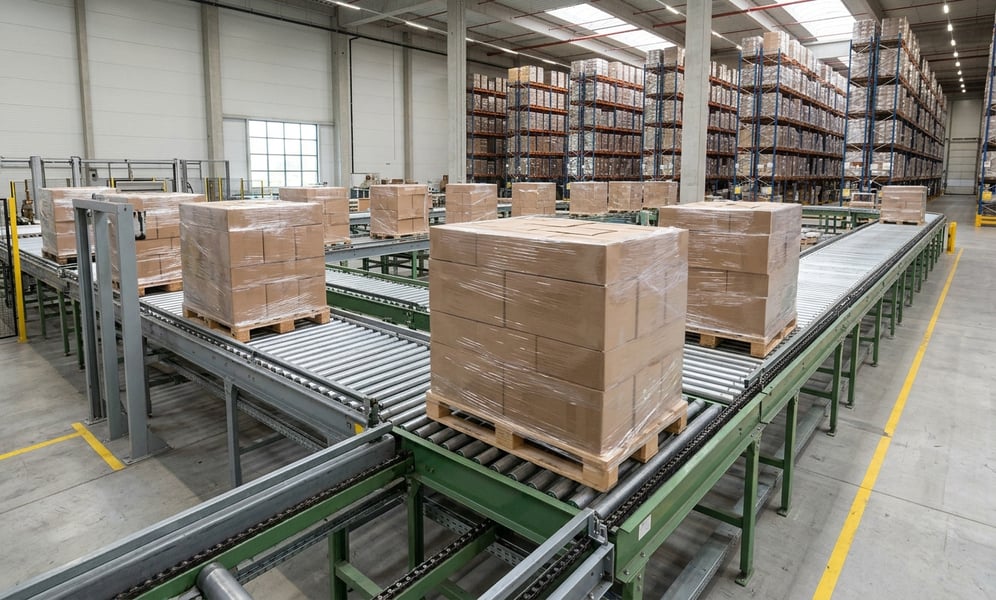
A worker stood on a warehouse conveyor with a crowbar, trying to free a jammed pallet. Nobody had told him the machine could restart on its own.
When the 1.31-tonne pallet lurched forward on December 20, 2022, it pushed him over and pinned his left leg against the turntable at Toll Transport's Banksmeadow facility in Sydney. He stayed trapped for roughly 10 minutes while co-workers pulled 25-kilogram bags off the pallet one by one.
The Industrial Court of New South Wales on October 26, 2026 fined Toll Transport Pty Ltd $807,500 for the incident - a Category 2 offence under the Work Health and Safety Act 2011 (NSW). The company had pleaded guilty to failing to comply with its duty to ensure workplace safety, thereby exposing the worker to a risk of death or serious injury.
The short version of what went wrong: there was no safe work procedure for clearing pallet jams. No written instructions. No standard operating procedure. No training on how to isolate the machine before getting near it.
A crowbar and a procedural vacuum
The worker had been employed at the Banksmeadow site since 2018 and moved into the packline operator role in early 2022. His job involved running a conveyor system - known as the "bag line" - that filled, sealed, stacked and wrapped 25-kilogram bags of polyethylene beads onto pallets.
Pallet jams were not unusual. After the company's sole customer at the site, Qenos Pty Ltd, switched to softer pinewood export pallets in mid-2022, jams went from occasional to roughly once or twice per shift. The new pallets were rectangular rather than square and prone to catching on chains and rollers.
Workers dealt with jams however they could: forklifts where access allowed, the control panel to nudge the conveyor, unloading bags by hand, or a crowbar kept near the line. No procedure governed which method to use or when. Workers chose for themselves.
The critical gap: the worker had never been trained on how to cut power to the machine. He did not know the conveyor ran on an "automatic cycle" - meaning that once the bag line was switched on and its safety gate was closed, a jammed conveyor would resume forward movement the moment the obstruction cleared. The court found this ignorance was "clearly demonstrated" by his actions on the day.
He had never been given the machine's own operations manual, which explicitly warned that the automatic machinery "could start without warning" and required full isolation before anyone walked on the conveyors. He was not given the company's internal lockout procedure either.
The morning everything went wrong
On the morning of the incident, the worker first tried the control panel to reverse the conveyor. That failed. He entered the wrapper area through a safety gate with the crowbar, adjusted the turntable, came back out and tried restarting. Still jammed.
He called a forklift operator to the control panel, showed him how to reverse the conveyor, and climbed onto the turntable through an unfenced section - while the bag line remained live.
As he levered the pallet with the crowbar, it came free. The automatic cycle kicked in. The pallet rolled forward and crushed his ankle.
He sustained a bimalleolar fracture - a break on both sides of the ankle - requiring surgery. According to the court, his treating doctor recorded permanent impairment. He can now work no more than five hours a day, three days a week, with no more than two consecutive days, and needs a 15-minute break every 45 minutes. His condition is not expected to improve.
"Courting trouble, if not disaster"
The court found the risk of exactly this kind of incident was "readily foreseeable, even obvious." Toll Transport knew pallet jams happened regularly. Its own incident records from 2019 and 2021 explicitly mentioned the use of crowbars. A 2021 hazard report noted operators had been "getting onto the pack line" and identified the need for a risk assessment and a safe procedure. None was developed.
At the time of the incident, the warehouse manager position was vacant. The operations manager had gone home sick that morning. The most senior person on site was a transport supervisor with no experience with the bag line and no training on it.
The court did not mince words, finding the system for clearing pallet jams that Toll Transport "tolerated was courting trouble, if not disaster."
13 convictions in 26 years
The company's criminal history weighed heavily. The court found Toll Transport had 13 prior work health and safety convictions recorded between 1999 and 2025 across New South Wales, Victoria, Queensland, Western Australia and Tasmania. These covered failures to provide safe working environments, failures to implement safe systems of work, and incidents resulting in serious or fatal injuries.
In 2016, the County Court of Victoria fined the company $1,000,000 after a stevedore was killed by a MAFI trailer during wharf loading operations. As early as 2009, a court had observed that Toll Transport "does not have a fine industrial record." A 2024 conviction in Tasmania involved a forklift incident where there was no safe system of work, no risk assessment and the operator lacked necessary training - a pattern strikingly similar to the Banksmeadow case.
The court found the record could not be written off as "an uncharacteristic aberration" and held that Toll Transport had "manifested a continuing resistance to the requirement for a proactive approach to eliminating or minimising safety risks."
Blaming the worker - then backing down
Before changing its plea, Toll Transport spent months actively contesting the charge. In written submissions filed in April 2026, the company described the worker as having "managed to allegedly injure himself by intentionally circumventing all engineered and behavioural controls" in a "significant, unpredictable and inexplicable departure from the established safe system of work."
The court found that characterisation hard to square with the evidence. There was no established safe system of work to depart from. The worker's behaviour was neither unpredictable nor inexplicable - he acted within the discretion that filled what the court called "a virtual procedural vacuum created by the offender."
Toll Transport changed its plea approximately six weeks before a scheduled seven-day hearing and received a 15% discount on what would have been a $950,000 fine. The court accepted the company's eventual remorse as genuine but gave it limited weight given the earlier attempt to shift responsibility.
The fine and what it means for safety teams
The maximum penalty for the offence was approximately $1.86 million. The court gave significant weight to both general and specific deterrence, noting Toll Transport still employs around 4,950 people across Australia and continues to operate machinery with conveyors for packing and palletising.
On remediation, Toll Transport took the bag line out of service immediately and spent approximately $416,000 on engineering modifications. It paid a deposit of approximately $1,350,000 for a replacement line, though that purchase was later cancelled with roughly $962,000 non-refundable. The Banksmeadow site closed permanently after Qenos entered receivership in early 2023.
For HR and safety teams, the decision is a pointed reminder that so-called "administrative" controls - safe work procedures, training, lockout requirements - are not optional extras. The court expressly rejected Toll Transport's argument that failing to implement measures that only minimise risk is inherently less serious than failing to eliminate it, and found a properly communicated and enforced lockout procedure may well have eliminated the risk entirely.