Canberra research on "formalism" shows what happens when scrutiny outruns trust, as psychosocial and digital-work laws tighten at home

Some useful recent evidence on what fear does to a workforce comes from a Canberra research centre that studies rural Chinese local government.
Professor Ben Hillman directs the Australian National University's Australian Centre on China in the World. With co-author Tan Zhao, he drew on fieldwork across six provinces to study county and township officials after a decade of stricter discipline, mounting paperwork and detailed performance evaluations. Their study, published in The China Journal in January, found many officials respond "for the purposes of self-preservation" with what Chinese policy writers call formalism: shirking, feigned compliance, falsification and putting process ahead of outcomes.
Beijing treats formalism as a serious threat to its agenda. Hillman and Zhao argue its crackdown is failing and making the problem worse.
The findings land as China's leadership presses harder. In a speech published this month, Xi Jinping complained that officials feign obedience and likened the corrupt to "sick trees" that should be pulled out. Discipline authorities punished 983,000 people in 2025, up from 889,000 the year before, according to official figures, and senior officials meet in Beijing this week for a Central Committee session.
Read next: When safety becomes oxygen: The rise of psychosocial risk in Australian workplaces
Fear is now a compliance issue
For Australian employers, a culture in which people hide bad news is more than a culture problem. Every jurisdiction now regulates psychosocial hazards, with Victoria's regulations in force since 1 December 2025, and high job demands and poor support are on the hazard list. Yet HiBob data reported by HRD this year found only 10% of organisations had completed formal psychosocial risk assessments.
Monitoring is next. In February NSW passed the Work Health and Safety Amendment (Digital Work Systems) Act 2026, the first Australian law to set specific safety duties for algorithms, AI and online platforms at work. The risks employers must consider include excessive or unreasonable monitoring or surveillance of workers. The duty covering work allocated by digital systems starts on a date yet to be proclaimed.
The middle manager problem
In Hillman's account, the strain falls on officials who must deliver central targets with thin resources. In Australian organisations, that is usually the middle manager.
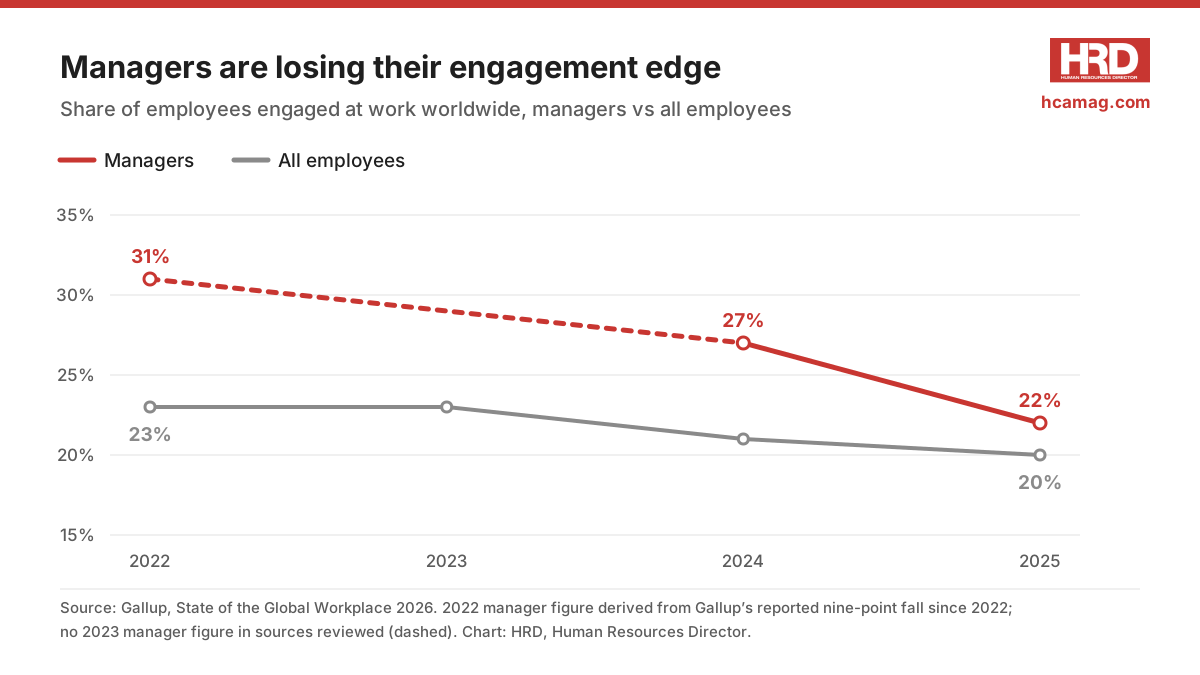
Gallup's State of the Global Workplace 2026 found manager engagement worldwide fell from 27% to 22% in 2025, its steepest annual decline, and that this drove most of the drop in overall engagement to 20%.
Harvard Business School professor Amy Edmondson's research on psychological safety shows why that matters. Teams improve when members feel safe raising errors and asking for help. Under pressure without that safety, people protect themselves.
Where to start
Begin with workload, because regulators already treat it as a hazard. Count the reports, check-ins and attestations managers file, and drop the ones nobody acts on.
Then take stock of digital work systems before the NSW duty applies: what each tool measures, who sees the data and whether workers were consulted, as WHS law already requires.
After that, look for the signs Hillman describes. Targets that are always met, engagement surveys that never dip and problems that surface only once they are crises can all point to people managing appearances. The last step is the hardest: make sure the person who raises a problem early is thanked rather than investigated.
Read next: Respect workers' privacy when spying on them
Hillman's research is about Chinese bureaucrats, but its lesson travels. Pressure without trust tends to buy the appearance of performance, and under Australia's psychosocial rules, appearances may not satisfy a regulator either.