The gap between $42.75 and $79.62 an hour came down to three words
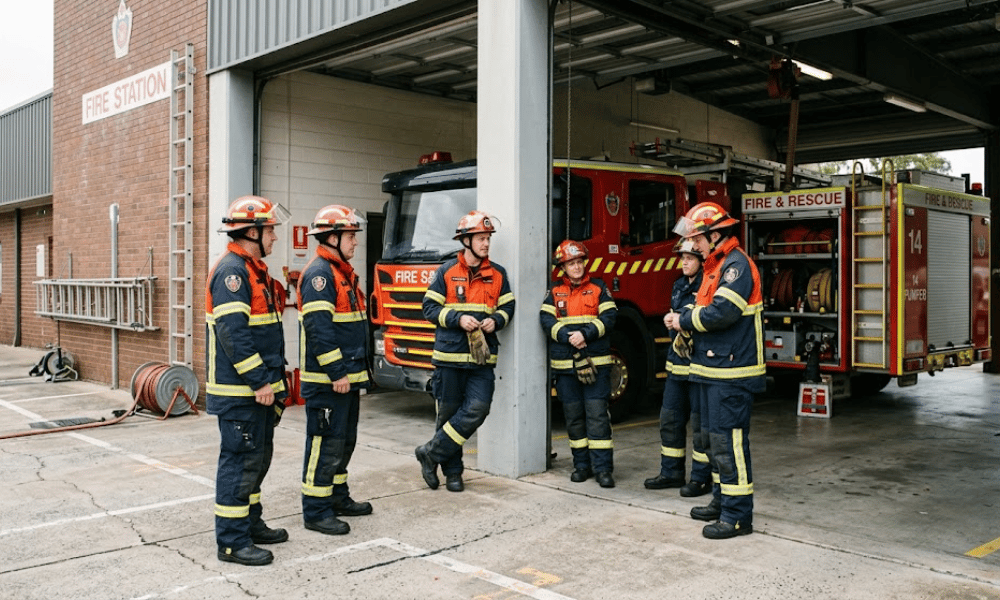
A push by the firefighters' union for higher pay rates when retained crew cover training absences has been knocked back by the NSW Industrial Relations Commission.
The dispute between the Fire Brigade Employees' Union (FBEU) and Fire and Rescue NSW (FRNSW) came down to three words in an industrial award: "maintain minimum staffing." Both sides agreed on what the words said. They disagreed on what they meant.
The question, decided on October 2, was whether retained firefighters directed to cover a station while permanent crews trained elsewhere were performing "relief duties" under their award - and therefore entitled to roughly double the standard pay rate.
The money made the fight worth having. The relief rate sits at $238.85 for the first three hours - roughly $79.62 an hour - then $95.56 an hour after that. The standard rate for a retained firefighter turning up for work starts at $42.75 for the first hour and $21.39 per half-hour thereafter. That is a substantial gap for identical-looking work.
Two scenarios, one question
The Commission was asked to rule on two specific situations. In the first, a retained crew was directed to move their fire truck from one station to another because the truck normally based at the second station had left with its permanent crew for training. In the second, a retained crew was told to stand by at their own station to crew a truck because the permanent crew normally assigned to it had taken it to training elsewhere.
The union's argument was straightforward: when permanent firefighters leave a station for training, the station's minimum staffing drops. Retained firefighters called in to plug that gap are maintaining minimum staffing and should get the higher rate.
FRNSW saw it differently. The employer argued that "minimum staffing" in the award means the minimum crew needed to safely operate a fire appliance - a fire truck - not the number of people required at a station. Since the retained firefighters in both scenarios turned up with their own crew on their own truck, nobody was filling a staffing gap on any particular appliance. They were providing extra operational coverage, not relieving an understaffed truck.
Where the Commission landed
The Commission found the phrase "maintain minimum staffing" was ambiguous on its face. The word "staffing" could plausibly refer to a station or an appliance.
So it looked at context. That context pointed to appliances. The award's safe staffing provisions prescribe minimum crew numbers for specific types of fire appliances - four firefighters for a pumper, two for a tanker - but set no minimum staffing figures for stations. The Commission found this was the clearest indicator of what "minimum staffing" actually means.
The union pointed to language in the relief clause itself, which refers to "non-availability" of firefighters "at another station." That phrasing, the union argued, tied the concept to stations, not trucks.
The Commission accepted that the station reference identified where firefighters ordinarily work. But it held that this did not create a minimum staffing requirement for the station itself. The key phrase was "required to maintain minimum staffing" - and the only minimum staffing requirements in the award attach to appliances.
The history told its own story
Evidence traced the relief clause back to 2014. Before that, the award had a similar provision compensating retained firefighters for "standing by for non-available staff." The 2014 version introduced the "maintain minimum staffing" language that remains today. The relief rate was designed to roughly match the overtime rate a permanent firefighter would earn for equivalent work - creating cost parity that discouraged FRNSW from using cheaper retained staff to backfill permanent roles.
The Commission accepted this was a legitimate purpose. But it found this explained the size of the payment, not when it kicks in. The trigger remained tied to appliance-level staffing shortfalls.
The union also pointed to two earlier episodes - in 2020 and 2025 - where retained firefighters had been paid the relief rate for similar work. The Commission gave these limited weight, noting that one payment was made on a without-admission basis following an industrial dispute.
The illogic problem
One point worked squarely against the union. Both sides agreed that when retained firefighters move up or stand by because of an active incident - a bushfire surge, say - the relief rate does not apply. The work looks identical: same crew, same truck, same operational coverage.
The Commission found it illogical that the same task would attract a premium rate simply because the reason for the direction was training rather than firefighting.
The application was dismissed.
For HR and industrial relations teams managing award-covered workforces, the case is a sharp reminder that minimum staffing clauses mean exactly what the instrument defines - and the definition may be narrower than you think.