NSW tribunal upholds SafeWork notices against a school system after a 14-year employee's probe dragged on for 10 months
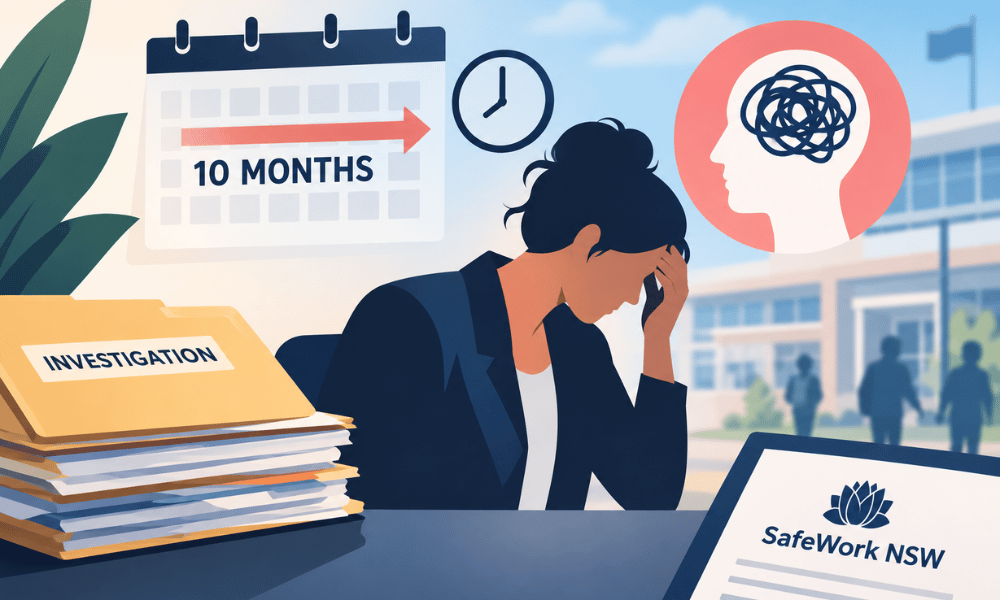
A New South Wales tribunal has confirmed what employment lawyers have been warning HR teams about for months: the investigation itself, not just the alleged misconduct behind it, is now treated as a workplace health and safety risk in its own right.
In Secretary, New South Wales Department of Education v SafeWork NSW, a 2026 case before the NSW Industrial Relations Commission, upheld two improvement notices issued against the state's Department of Education, finding that the way it ran a misconduct investigation exposed a long-serving employee to psychosocial harm. The case has been described by lawyers as confirming that "the investigation process itself is a psychosocial hazard."
The employee, a business manager with 14 years' service, was told in April 2023 she was under investigation, stood down and moved to lower-level administrative duties at another site, with no detail of the allegations against her.
She attempted suicide shortly afterwards and survived. The investigation ran for close to a year before SafeWork NSW inspected the Department's processes and issued the notices in February 2024, one covering the timeliness of investigations and communication with staff, the other covering the suitability of alternative duties assigned during an inquiry.
For Sarah Wood, partner and employment practice leader at Clyde & Co, the ruling reflects a shift she has watched build over several years.
"The complexity of investigations has been really apparent," Wood said, "a complaint can start out as one sole issue, but because of the way the complaint is handled, [there is] the potential to involve regulators, for other claims to be made of bullying during the investigation, adverse action or other retaliation claims because of the investigation itself."
She pointed to the growing role of SafeWork as a regulator that now scrutinises the investigation process rather than only the conduct being investigated. "SafeWork are receptive to complaints about investigation management," Wood said, noting that anyone touched by an inquiry, "whether they're a witness, a complainant, a respondent to allegations," can now raise it with the regulator.
Timeliness, in her experience, is the single biggest driver of complaints. "Investigations that are taking a year is not good for anybody's mental health," Wood said, "and actually not good for anybody's decision-making process during the investigation itself either."
In the earlier case, the Department argued the psychosocial hazard framework was too legally uncertain to apply, that the SafeWork inspector lacked reasonable grounds to issue the notices, and that some of the required measures weren't practicable for an employer with responsibility for more than a million people.
The Commission rejected all three arguments, save for one narrow point: a requirement for formal written updates was set aside after the inspector accepted the Department's existing practice of updating staff each school term already met the standard.
The Commission's broader finding was that individual differences in how people respond to an investigation do not excuse an employer from managing the hazard, and that a notice arising from one case can properly be directed at an organisation's entire investigation system.
What employers should be doing differently
Wood's advice to HR teams centres on process, not paperwork for its own sake. "Broadly, conducting fair and timely investigations is what the business wants to aim for," she said, pointing to state work health and safety Codes of Practice, which are now a legal requirement in New South Wales, as the starting point.
She recommends a psychosocial risk assessment before significant investigations begin, realistic timeframes set at each stage, identification of any vulnerable participants, and close attention to whether an employee on alternative duties is isolated or given work well below their normal role.
She also cautioned HR leaders against going it alone on the hardest calls. "Having good external advisors that you can call on quickly, and having people that you can talk through these issues with, I think is really important," Wood said, "because the answers to some of these questions … they're not always immediately apparent or easy answers."
With SafeWork's psychosocial enforcement still building momentum and further scrutiny of high-profile investigations continuing to make headlines, Wood expects the pressure on employers to intensify rather than ease. "As the investigation landscape gets more complicated, with various regulators being involved," she said, "there's just the potential for more claims to run off, not just the subject matter of the investigation itself, but the way the investigation was handled."