Why are Universities always at the centre of Australian underpayment scandals?
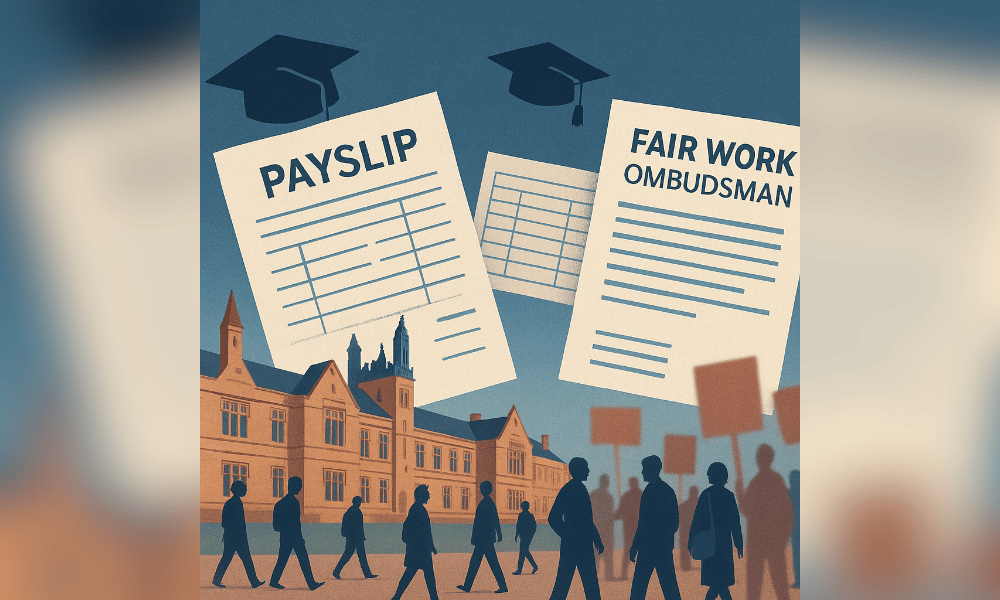
Those who keep up with the Fair Work Ombudsman may have noticed that a large portion of the underpayment breaches made by employers are Aussie universities.
This month saw UNSW slapped with a $213,120 penalty for record-keeping failures.
December 2025 saw the University of Tasmania, Monash University and the Queensland University of Technology all hit with underpayment breach charges and ordered to pay back staff.
Julian Arndt, director at Australian Business Lawyers and Advisors sat down with HRD to help unpack why universities always seem to be making headlines for underpayment issues.
According to Arndt, Australian universities are not systematically trying to short-change their staff but are trapped in a “perfect storm” of complex conditions, casual-heavy workforces and intense regulatory and union scrutiny that makes payroll compliance extraordinarily difficult.
The steady stream of underpayment headlines out of the higher education sector is far less about greed and far more about the sheer complexity of paying people correctly in such an unusual industrial environment.
Even in ordinary workplaces, getting payroll right is far from simple. Awards, enterprise agreements, loadings, penalties, minimum engagements and detailed record-keeping obligations already make compliance challenging. In universities, those challenges are magnified.
One of the core problems at universities is the highly casualised nature of the workforce. Large numbers of academics and professional staff are engaged on casual arrangements, meaning every hour worked needs to be captured and paid precisely.
In salaried environments, some over- and under-work can be absorbed within the fixed salary. In a casual-heavy setting, there is no such buffer, and every missed hour or misclassified duty is more likely to become an underpayment.
Layered on top of that are what Arndt called the “weird and wonderful” conditions unique to higher education. Teaching and research staff may be entitled to separate payments for preparation time, different kinds of marking that can resemble piece rates, minimum engagement requirements and other tailored entitlements that bear little resemblance to the fixed shifts and clear opening hours seen in retail or hospitality.
Much of the work is also performed at times chosen by the academic themselves, rather than under direct supervision.
In practice, this means staff might mark papers at night, prepare lectures on weekends, or answer student queries at odd hours, all of which may or may not be accurately recorded.
Arndt explained that this autonomy makes precise timesheets less likely, and once inaccurate or incomplete records feed into payroll systems, each additional layer of complexity makes it even harder to arrive at the correct answer.
Compounding the problem is that “smart, educated, reasonable, experienced people” can genuinely disagree on how industrial instruments should be interpreted. Even with good intentions and sophisticated systems, there is ample room for honest error about what is owed, when and at what rate.
Arndt also believes the culture and status of universities play a role. Universities are high-prestige institutions, and many academics see their work as a vocation tied to long-term ambitions, rather than a narrow exchange of time for money.
That can encourage significant discretionary effort, where staff put in extra hours for reasons that have little to do with their next pay slip. In such an environment, people may be less “laser focused” on logging every minute and every cent, which again creates fertile ground for gaps in records and, ultimately, underpayments.
However, Arndt is clear that these cultural and structural factors do not excuse non-compliance. The law still requires staff to be paid correctly, whatever their motivations for working. Instead, he framed these conditions as the context in which mistakes inevitably arise.
If that were the whole story, universities might face underpayment issues largely behind closed doors. But higher education is also one of the most heavily unionised parts of the economy, and that union presence is central to why underpayment cases keep surfacing.
According to Arndt, a “really, really successful union” in the sector deserves significant credit for bringing underpayments to light, identifying defects, organising campaigns and pushing institutions to remediate them.
In many cases, what turns a payroll error into a multi-million-dollar underpayment program is not just the initial mistake but the union’s capacity to cut through, publicise the issue and force a resolution.
At the same time, universities remain a declared focus area for the Fair Work Ombudsman. The regulator has made a priority of cleaning up the sector and has repeatedly engaged with institutions that run into trouble on wages and record-keeping.
Working in tandem with the union movement, the Ombudsman is able to identify systemic issues, negotiate remediation programs and then publicise the outcomes.
For the regulator, universities offer a particularly attractive enforcement target. They are large, high-profile employers with powerful brands and a vast alumni and student base, which makes any underpayment scandal “very clickable”.
When a university agrees to repay staff say $10 million over several years, involving thousands of current and former employees, the story carries a scale and resonance that a small-business case simply does not.
The irony is that universities often appear in the headlines precisely because they are willing to do the right thing once problems are identified. Rather than “lawyering up” to fight every interpretation point, they are more inclined to cooperate with unions and the Ombudsman, sign enforceable undertakings and run large remediation programs. That cooperation is positive for affected staff but inevitably generates more media coverage.
None of that means universities can simply invest their way to a future free of payroll controversies. Better systems and more specialist staff will help, and many institutions are already pouring resources into upgrading software and governance. Yet, even with the advent of artificial intelligence and more sophisticated payroll tools, the sector cannot escape a fundamental truth: good data is everything.
If the underlying information about when people worked, what they did, how they are classified and what qualifications they hold is incomplete or wrong, no amount of technological sophistication will guarantee a perfect outcome.
For Arndt, human error, messy real-world working patterns and the irreducible complexity of industrial instruments make flawless compliance almost impossible.
He does not see an obvious way for universities to persuade the regulator to “back off”, nor does he suggest that more union involvement is the missing ingredient, given unions in the sector are already “very active and very powerful”.
Instead, he sees a landscape in which universities must keep improving, regulators will keep watching, unions will keep pushing, and underpayment stories will continue to surface.
Taken together, Arndt’s analysis suggests that universities are not shady or reckless but are uniquely exposed. A highly casualised workforce, intricate and unusual employment conditions, a culture of discretionary effort, vigorous union activity, regulatory focus and the media appeal of big-name institutions and big dollar figures all intersect.
The result is a sector that finds itself repeatedly in the spotlight on wage compliance, and one that, in his view, is unlikely to achieve perfection any time soon.