Filings with 'apparent hallucinations', a rejected subpoena - and errors in Stantec's own sums
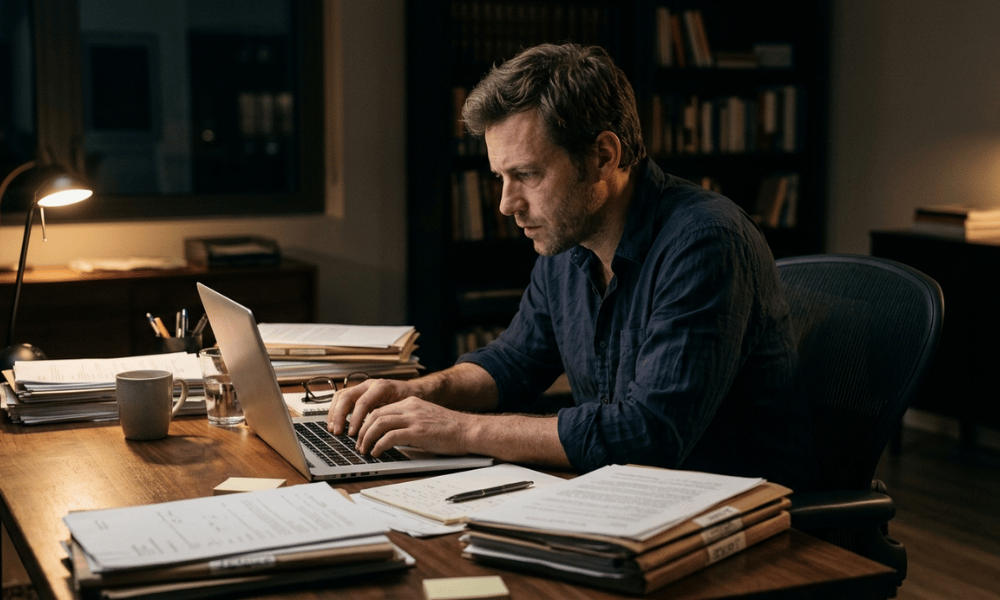
A former HR professional's court fight with Stantec was “always doomed to fail,” the Federal Court found. Now he owes the company $45,000.
On September 24, 2026, the court ordered the man, who had been employed by Stantec Australia in what it called “a professional human resources position,” to pay the company's legal costs of the case, fixed at $45,000 excluding GST.
That is a rare result in a Fair Work case.
Under the Fair Work Act, each side usually covers its own legal bills. A court can make one party pay the other's costs only in narrow situations, such as when a case is brought “without reasonable cause,” or when one side's unreasonable conduct runs up the other side's costs.
Stantec argued both applied. The court agreed.
Submissions that didn't exist
The costs ruling followed a September 15, 2026 judgment in which the court dismissed the former HR professional's bid to have it review two Fair Work Commission decisions.
His case was “incoherent in many respects,” the court said. Many of his arguments raised points he had never put to the Commission, so they could not show a legal error by it. His grounds, written evidence and submissions also failed to line up, leaving the court to piece his case together from “multiple conflicting documents.”
Then there was the AI question.
The court said his documents contained “apparent hallucinations,” including references to written submissions that did not exist. He told the court he had used artificial intelligence, but only to check the grammar and spelling of documents he otherwise prepared.
The court had its own view: “there is a likelihood that some of the anomalies in the applicant's filed documents were the product of the indiscriminate use of artificial intelligence.”
Where his arguments could be followed, the court said, they lacked merit. Some ran into “insurmountable and foreseeable obstacles.”
One challenged the authenticity of a complaint made against him by a former colleague, relying on a screenshot of the file properties of a document summarising that complaint. The court said objective evidence undermined the challenge, and that the Commission had clearly considered the material.
Another centred on phone records that Stantec's lawyer mentioned at the original hearing before the Deputy President but never formally put into evidence. He accepted that the Deputy President never received them.
The court said that argument was directed at resisting findings, based on objective evidence and informed by the Commission's assessment of witness credibility, of his “cynical fabrication” of a text message designed to undermine one of the complainants. It was “bound to fail.”
Chasing the audio
Even so, he had a subpoena issued to the transcript provider for the audio of the adjournment that followed Stantec's indication it would seek to put the phone records into evidence.
The court had directed its registry not to accept his first draft, because it was “on its face an abuse of process.” A narrower version was later allowed. But the court then found it served no legitimate purpose in the case, because he no longer alleged the Deputy President had returned to the bench while he was absent.
He said the Australian Government Solicitor had pointed him to the subpoena process. That did not make his attempts reasonable, the court said.
The court also said the correspondence showed Stantec's lawyers were put to “considerable time and effort,” including answering numerous emails, some seeking to add duplicate copies of documents already in the court book, the bundle of documents for the hearing. He said he made only six attempts to correct or add to the court book between May 19 and June 25, 2026.
Stantec had offered him a way out long before. On June 20, 2025, its lawyers invited him to withdraw his claim before the Commission, with no order for costs, on the basis that it was without merit. He refused the following Monday.
No free pass for going it alone
He represented himself. That, the court said, is not a privilege that shields him from the consequences of his actions. It quoted a 1990 case: “[l]ack of legal knowledge is a misfortune, not a privilege.”
The court also took his background into account. He had worked in a professional HR role and presented at the hearings as “articulate and capable of understanding the Court's processes,” which strengthened its conclusion that he should pay Stantec's costs.
His argument that paying would cause financial hardship did not get far. There was no reliable evidence of his finances before the court, and limited means is generally not a reason to deny the successful side its costs.
Stantec's sums had problems too
Stantec did not get what it asked for.
It wanted $84,345 on the higher “indemnity” measure, or $56,230 on the ordinary measure the court described as the usual course. It said its costs with its own lawyers came to $112,460.37. All three figures excluded GST.
The court refused the higher measure. Despite its criticisms, it noted he had agreed to and generally complied with the court's timetable, and with the limits it set on his evidence and submissions.
He also found problems in Stantec's figures. He pointed out that the hours and hourly rates in Stantec's costs affidavit, the written evidence setting out its costs, multiplied out to more than the fees total stated in the same document.
Stantec served a second affidavit on the morning of the hearing to address the problems. He objected, and the court refused to let Stantec rely on it.
“It is an unfortunate state of affairs that there are errors” in the calculations, the court said.
It questioned other items too. Stantec claimed $6,500 for 5.4 hours of partner time and 13.6 hours of lawyer time on the subpoena that was set aside, which the court called “a large amount of time spent on a relatively discrete issue.” The court also queried whether Stantec reasonably needed two solicitors instructing its barrister at the final hearing, and said his arguments about barrister's fees appeared “to have some degree of merit.”
Using Stantec's $56,230 as its starting point, the court then made “a further and substantial reduction” for the risk that parts of the costs evidence were unreliable. It landed on $45,000, which it called “a modest assessment.”
Stantec was also left to cover its own costs of the fight over costs, because errors in its evidence had to be corrected.
Setting a fixed sum, the court said, would avoid further disputes and bring the case to an end.
For HR teams defending Fair Work matters, the rule that each side usually pays its own way has real limits - and an employer chasing its costs still needs its own figures to add up.