About 6,000 jobs depend on a seven-day consultation and a sale process that isn’t finished
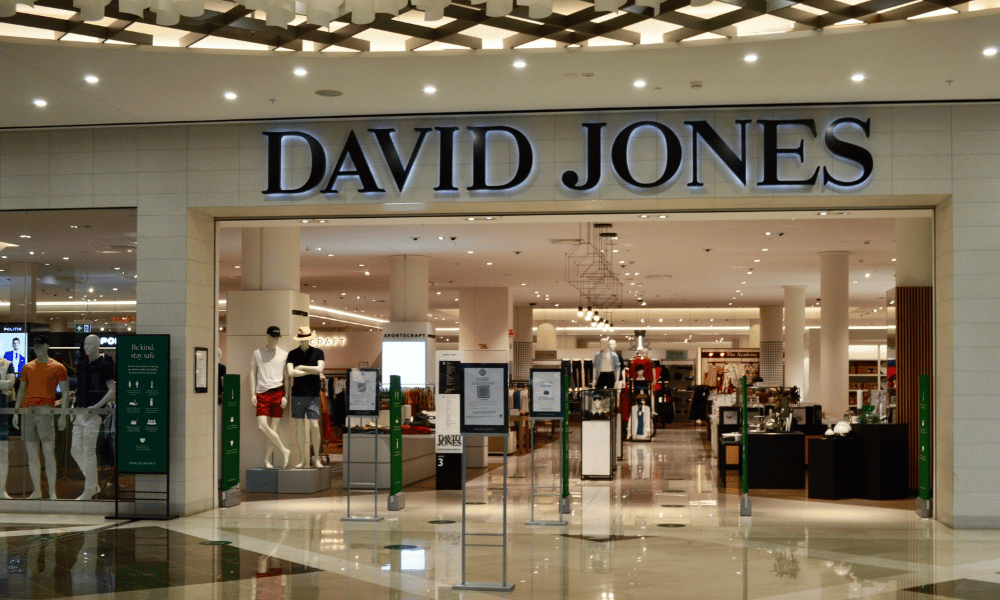
David Jones has just announced that half its stores will close by the end of the year. Staff were told earlier today, less than a week after the 188-year-old retailer went into voluntary administration.
Receivers FTI Consulting announced that 19 stores, mostly in suburban areas, will keep trading only until the end of December. Capital city flagships have largely survived, although the Hay Street Mall store in central Perth will close, as will the retailer’s only New Zealand store, at Newmarket in Auckland.
The full list covers Carousel, Garden City and Hay Street Mall in Western Australia; Glen Waverley, Highpoint and Malvern Central in Victoria; Green Hills, Hornsby, Macarthur Square, Macquarie Centre, Parramatta, Warringah Mall and Wollongong Central in NSW; Marion and West Lakes in South Australia; Robina Town Centre and Sunshine Plaza in Queensland; Woden in the ACT; and Newmarket in New Zealand.
The receivers have not said how many of the retailer’s 6,000 employees will lose their jobs. Chief executive Erica Berchtold took a similar line with suppliers. In a letter, she said the store portfolio was no longer the right shape for the business and the closures were about building a network that could be financially sustainable.
Seven days to consult
FTI’s Christopher Hill, David McGrath and Joanne Dunn have started consulting all staff linked to the 19 stores. That process will run for the next seven days. No final closure date has been set, but the receivers expect the stores to stop trading by the end of the year. In its statement, FTI acknowledged the restructure would hit many individual team members hard, and committed to “treating all employees with fairness and respect throughout the process”.
The timing puts HR in a difficult spot. Staff in the affected stores will be working through the biggest trading weeks of the year knowing their store won’t reopen in January. The stores are also busy. The receivers have reported record crowds since the collapse, as shoppers turn out for heavy discounts. Keeping people on the floor until the last day, and keeping them safe and supported while they’re there, will be a big job.
That leaves David Jones chief people officer Louise Harding with her hands full. Harding has championed a people-first culture at the retailer, and in May 2025 she told HRD that a people-first culture is the answer to success. “A strong people-first culture is critical to sustainable results,” she said at the time. The next few weeks will test that commitment harder than any trading season.
The retail union, the SDA, says the 2024 David Jones Enterprise Agreement alone covers 4,644 employees, not counting executives and warehouse staff.
Read next: David Jones staff face uncertain future as store closure reports mount
What the receivers have promised
Before Wednesday’s announcement, the receivers had already written to staff. They told employees that wages and other entitlements would keep being paid while they continued working, and that money owed from before the appointment would generally be paid ahead of other creditors. They said their current expectation was that there would be “sufficient realisations to meet your entitlements in full”.
That’s reassuring, but it’s an expectation, not a guarantee. If it falls short, the federal backstop has a catch.
Why the government safety net can’t help yet
The Fair Entitlements Guarantee (FEG) is a legislated safety net for employees who lose their jobs because their employer goes into liquidation or bankruptcy and who can’t recover their entitlements any other way. David Jones is in voluntary administration and receivership, not liquidation.
Retail workers have been in this position recently. When Mosaic Brands collapsed, Employment and Workplace Relations Minister Murray Watt said “FEG is usually activated once a business has gone into liquidation”. The government then fast-tracked FEG access for about 2,800 Mosaic employees before the retailer was wound up. No equivalent announcement had been made for David Jones at the time of writing.
FEG has caps even when it applies. It covers up to 13 weeks of unpaid wages, annual leave, long service leave, up to five weeks of pay in lieu of notice, and up to four weeks of redundancy pay per full year of service. It doesn’t cover unpaid super.
Read next: Government steps in to grant entitlements to Mosaic’s retrenched staff
Super is the one area where staff are better off than they would have been a year ago. The ABC confirmed David Jones was up to date with superannuation payments, in line with the payday super reforms that took effect in July. SDA national secretary Gerard Dwyer has said the changes would stop affected workers losing up to three months of super.
What should HR do when a company enters administration?
Nicholas Potter, practice leader at LegalVision and the firm’s employment law specialist, said HR’s first job is to get clear answers from the administrator and pass them on quickly.
“HR’s first priority should be to work with the appointed administrator to establish what administration means for employees and communicate that information promptly,” Potter told HRD. “This includes confirming whether staff will continue working, how wages will be paid, whether any roles are at risk and what happens to outstanding entitlements.”
Records matter just as much. “HR should also secure accurate payroll, leave and employment records, as these may be needed to establish employee claims,” he said. “Entering administration does not automatically terminate employment. Clear communication and accurate records are essential to protecting employees’ rights and managing the process lawfully.”
How HR can ease employee stress during administration
Potter said the uncertainty itself is a workplace risk. “Uncertainty about job security and unpaid entitlements can create significant stress for employees,” he said. “HR should provide regular, factual updates, even when there is no new information about the company’s future. Employees should know who to contact about their pay, leave, employment status and available support services.”
Given the gap between administration and FEG eligibility, he said staff need that distinction explained plainly. “Businesses should also explain the difference between administration and liquidation, including when government assistance through the Fair Entitlements Guarantee may become available.”
He also warned against reassurance that can’t be backed up, a point that matters at David Jones, where the receivers’ promise on entitlements is an expectation rather than a guarantee. “Managers should be trained to respond sensitively to concerns without making promises about job security or payment,” Potter said. “Honest, consistent communication can help maintain trust during an uncertain period.”
The obligations insolvency doesn’t erase
Employment law still applies to an employer in administration. Under the Fair Work Act, a business considering 15 or more redundancies must notify Services Australia in writing before the employees are made redundant, and penalties can apply if it doesn’t.
Consultation under the enterprise agreement matters as well. The Fair Work Commission has shown that a sound business case won’t save a redundancy if the consultation step is skipped, even when redeployment has been properly ruled out.
The closures will also reach people who aren’t on the David Jones payroll. Country Road Group, whose brands include Country Road, Witchery and Mimco, had already said it planned to pull out of nearly 100 of its 283 concession spaces in David Jones stores in early 2027. Staff employed by concession brands in the 19 closing stores will face decisions made by their own employers, on their own timelines.
Read next: Employer proves its redundancy case but loses on one missing step
What happens to the other 19
The surviving stores aren’t safe yet either. Creditors have until Monday to lodge proofs of debt ahead of the first creditors’ meeting on Tuesday, and only days remain for potential buyers to lodge expressions of interest. Administrator McGrathNicol also plans to ask the NSW Supreme Court for more time to run a sale or recapitalisation.
A new owner would probably want a leaner operation. Barrenjoey’s head of consumer research, Tom Kierath, has said buyers were likely to be interested in a handful of sites rather than the whole business. He argued a reshaped David Jones would need to move away from “huge spaces with not many staff” towards a smaller, more experience-led format. That suggests different roles on the floor, not just fewer of them.
A cooler job market to land in
Retail workers who lose their jobs will be looking for work as the labour market softens. CommBank’s latest Wage and Labour Insights series estimates about 18,000 jobs were added in October. That’s slightly below the pace needed to keep unemployment steady.
“Labour supply has also continued to outpace demand,” CommBank economist Harry Ottley said. Unemployment rose to 4.7 per cent in September, and the bank expects it to peak at 5.1 per cent at the end of 2027.
Plenty of others are looking too. Recruitment firm Samuels Donegan logged 493 candidate registrations in October, up 115 per cent on September, as employers pushed through year-end restructures. That includes NAB, which has flagged up to 2,500 role cuts, along with Canva and Telstra.
Read next: Redundancy season: HR’s job doesn’t end when the announcement does
The lesson for HR
David Jones shows how much an employee’s protection depends on the type of insolvency. Administration, receivership and liquidation each carry different safety nets, and most staff only find out which applies when they’re already in it.
There’s a second lesson for whoever runs the 19 surviving stores. Samuels Donegan co-founder Sarah Donegan made the point to HRD this week, talking about restructures generally: “A smaller workforce isn’t automatically a more productive one.”