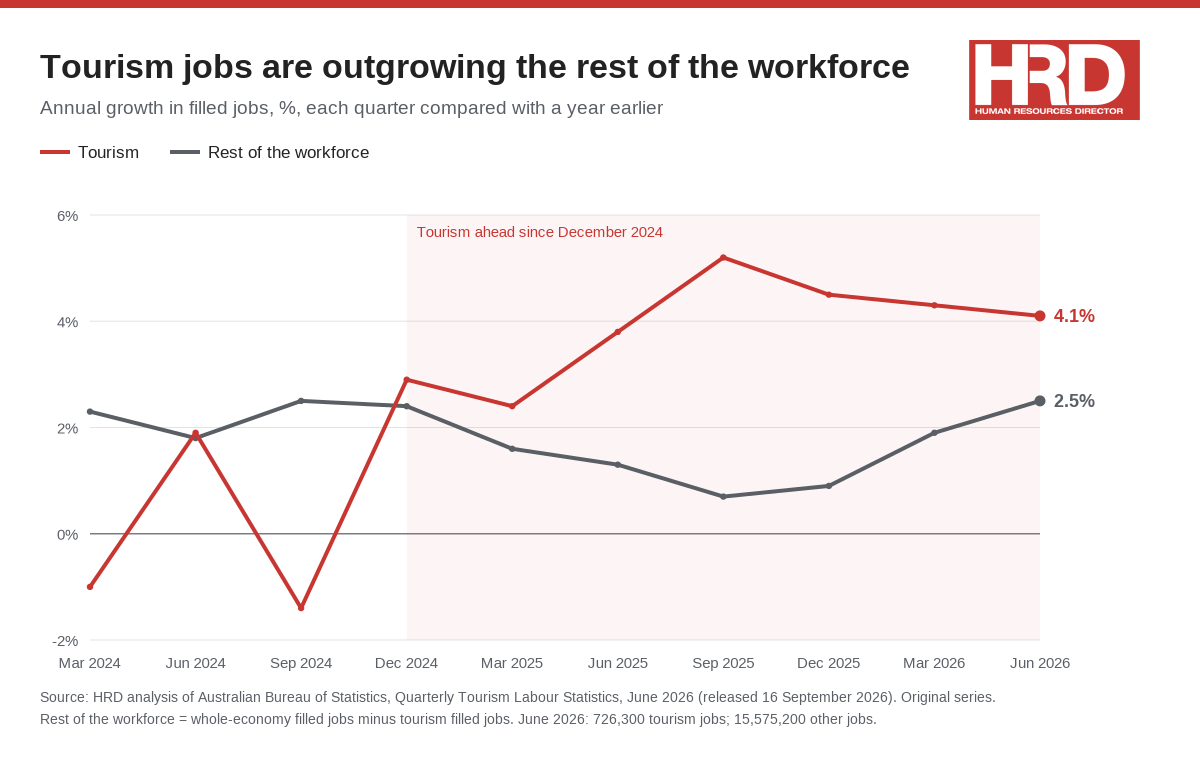
The visitor economy is hiring faster than the rest of Australia. Look under the bonnet, though, and full-time roles are going backwards while the pipeline of trained supervisors and chefs keeps thinning

Australia's tourism employers are putting on staff at a clip most industries would envy. HR leaders who take that as a sign the talent squeeze is over may want to examine the numbers behind the numbers.
Tourism accounted for 726,300 filled jobs in the June quarter of 2026, up 4.1% on a year earlier, according to the Australian Bureau of Statistics. Jobs across the whole economy grew 2.6% over the same period.
The catch is what kind of jobs they are.
Shifts, not careers
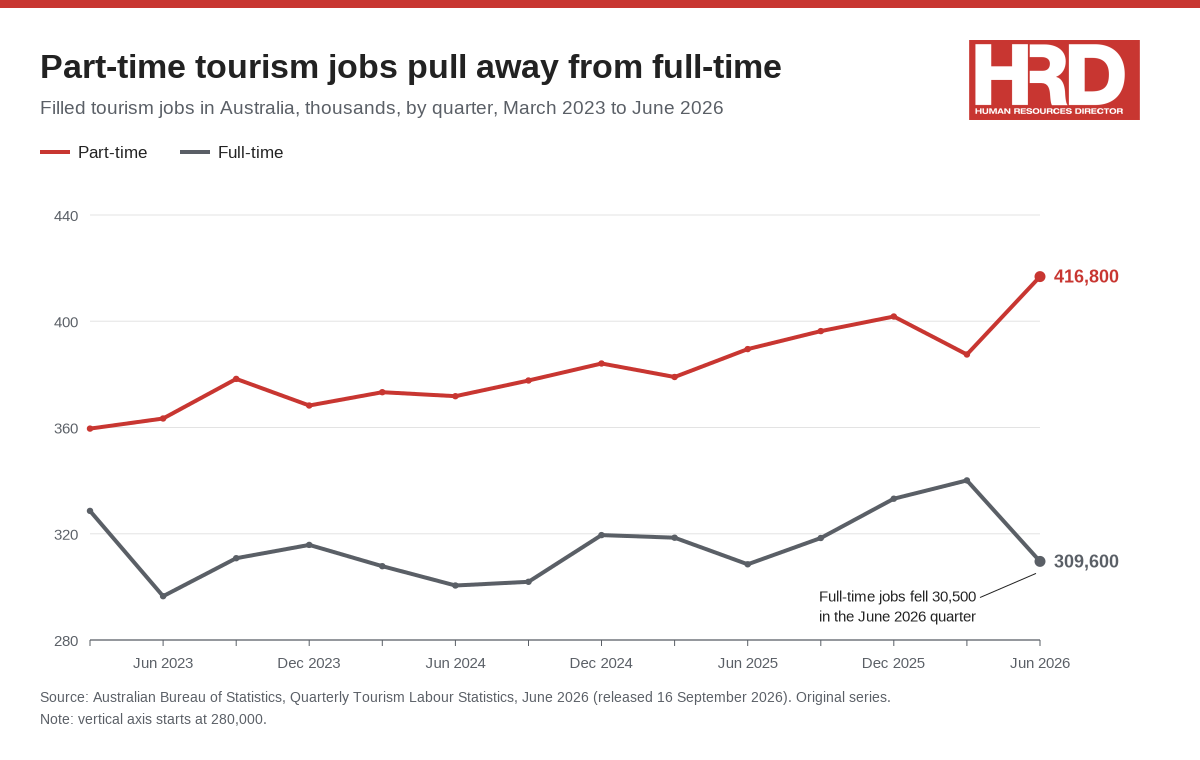
Over the year to June, part-time tourism jobs rose by 27,300, or 7%. Full-time jobs grew by 1,100, a rise of 0.4%. The June quarter was starker still: the ABS counted 30,500 fewer full-time tourism jobs than in March, a 9% drop, offset by 29,300 extra part-time positions.
Women accounted for the entire net gain, and then some. Jobs held by women rose by 29,100 over the year, while jobs held by men slipped by 800. Accommodation did most of the lifting, adding 20,500 jobs for a 17.7% jump.
A rostered, part-time workforce is easier to flex through a quiet winter. It is much harder to grow into the duty managers, head chefs and senior guides the industry keeps saying it can't find.
That tension sits at the heart of the 2026 Tourism, Travel and Hospitality Workforce Planning Update released on Tuesday by Service and Creative Skills Australia (SaCSA), the federally funded Jobs and Skills Council for the sector. The report draws on labour market and training data and consultation with more than 4,100 stakeholders across every state and territory.
SaCSA chief executive Natalie Turmine said attracting people was not the hard part. "Hospitality continues to attract large numbers of people into the workforce, but the challenge is ensuring they have opportunities to develop the skills and experience needed for long-term careers," she said, as reported by Australian Hotelier.
Read next: Workforce shortages ease, but challenges persist
City easy, country hard
On national numbers, hospitality looks like one of the easier places to hire. Jobs and Skills Australia's latest recruitment survey found accommodation and food services had the highest recruitment rate of any industry in the September quarter, at 66%, and the lowest share of recruiters reporting difficulty, at 26%.
Outside the capitals it is a different job. In outer regional, remote and very remote Australia, 52% of employers recruiting in the June quarter had trouble filling vacancies, according to Jobs and Skills Australia survey data cited in the hospitality chapter of SaCSA's update. On the tourism side, the report points to housing shortages, patchy access to training and competition from other industries as the main drags on regional recruitment, with tour guides and travel consultants among the roles in shortage.
The backpacker workforce many regional operators lean on over summer is also about to get more complicated. From 1 December, people seeking a second or third Working Holiday Maker visa will have to register and be invited before they can apply, and from 1 March 2027 the regional "specified work" needed for a second visa rises from 88 days to 120, according to the Department of Home Affairs. UK passport holders are exempt.
For HR teams, that means checking which of this season's working holiday staff are mid-way through their regional days, and planning rosters around the rule that limits most working holiday makers to six months with any one employer.
 Read next: WA directs $19.6 million to boost hiring of apprentices and trainees
The training tap is barely dripping
The longer-term worry is supply. Vocational enrolments tied to tourism and travel kept sliding in 2025, according to SaCSA. Traineeship commencements did lift 12% on 2024, but that only got them to 930, about three-quarters below their 2016 peak.
Kitchens are the sharpest pain point on the hospitality side. Cooks, chefs, senior chefs and pastrycooks face the most critical shortages, with employers struggling to hold on to experienced staff and few clear routes into management.
"Persistent shortages in culinary occupations show why we need to better understand the pressures facing kitchens, from training and recruitment to retaining experienced chefs and cooks," Turmine said.
"Building a stronger hospitality workforce means looking at the full career journey, from a student's first experience of the industry through to apprenticeship completion and progression into more senior roles."
The wider settings are not helping. Across all industries, non-trade commencements, which are mostly traineeships, fell 13.4% to record lows in the 12 months to March, the Australian Industry Group said, citing National Centre for Vocational Education Research figures. More cuts are coming. "From 1 January 2027, employers with more than 200 staff will lose access to all incentives and the incentives received by many small and medium sized employers will reduce," Ai Group chief executive Innes Willox said after the May budget, as HRD reported.
For large hotel groups and attraction operators above that headcount, the cost of growing their own talent is about to land more squarely on their own budgets.
Where AI fits, and where it doesn't
The update also looks at how booking platforms, automation and AI are reshaping travel and tourism roles. Its conclusion is that digital skills now sit alongside, rather than replace, the people skills visitors notice: communication, problem-solving, judgement and customer service.
SaCSA is already reworking training to match. In February it began a national update of the entry-level Certificate III qualifications in travel, tourism and guiding, with Turmine saying the roles had "changed dramatically" while the core qualifications had not kept pace.
Read next: Redesigning roles for AI? Start with strategy, not the org chart
What HR can do now
None of this needs a national strategy to get started. A few moves are within reach of most people teams heading into summer:
- Build a ladder for part-timers. If most new hires are part-time, supervisor and leadership training has to reach them too, not only the full-time core.
- Offer more hours where demand is steady. Where rosters are reliably full, extra hours or a full-time offer can hold on to good staff who might otherwise leave for a second job elsewhere.
- Treat housing as part of the offer. For regional employers, staff accommodation or rental support can decide whether a candidate says yes.
- Audit your working holiday staff. Map who is affected by the December and March visa changes and the six-month employer limit before peak season, not during it.
- Lock in trainees early. Larger employers should look at traineeship and apprenticeship intakes before incentive settings change on 1 January 2027.
- Get in the room. SaCSA's qualification reviews are open to industry input, and employers who turn up get a say in what new starters learn.
As Turmine put it, the research is meant to show "where pathways are working and where workers and employers face barriers". For HR, the June numbers suggest the barriers start well after the hire.
Read next: Inflation jumps to 4.9% as wage growth falls behind: what HR must know