Private sector pay including bonuses grew just 2.8% over the year, the widest shortfall against base pay since records began
Although private sector employers handed out bigger base pay rises over winter. They were far less generous with bonuses and commissions.
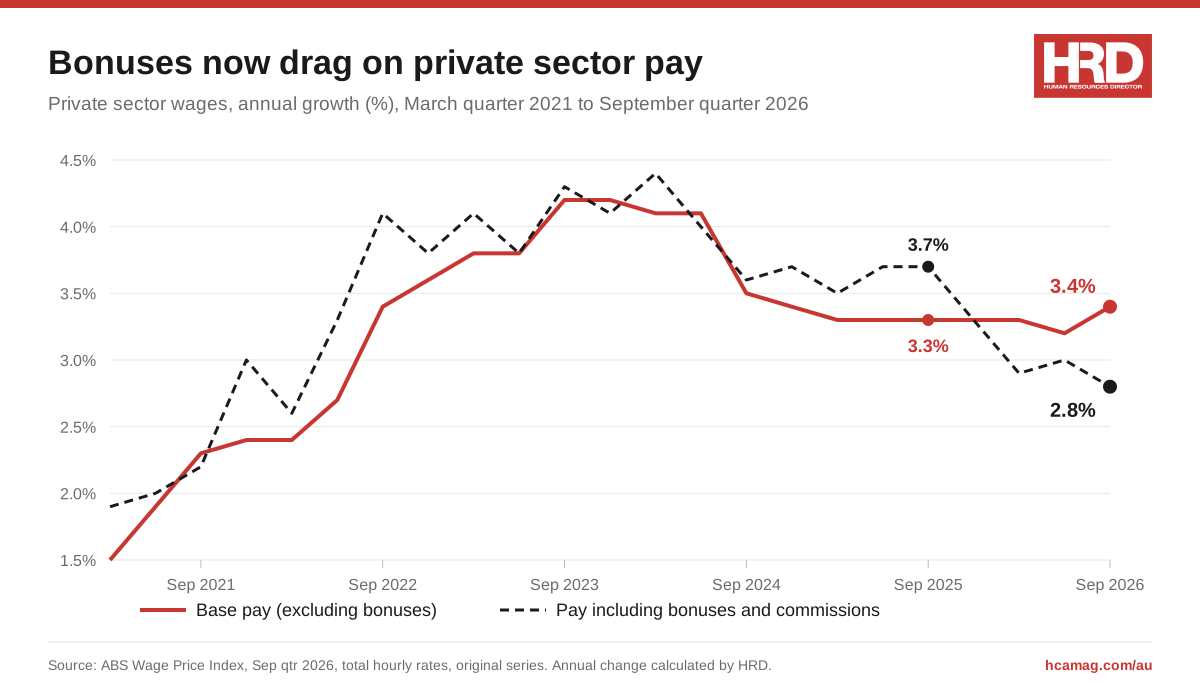
Australian Bureau of Statistics Wage Price Index figures released earlier today show private sector base pay rose 3.4% in the year to the September quarter. Add bonuses and commissions, and annual growth falls to about 2.8%.
The 0.6 percentage point gap is the widest since the ABS began publishing comparable annual figures in 1998, according to HRD's analysis of the bureau's original (unadjusted) data.
Twelve months ago the gap was the reverse. In the September quarter of 2025, private sector pay including bonuses rose about 3.7%, against 3.3% for base pay alone.
Growth in private sector pay including bonuses is now at its slowest since the March quarter of 2022.
 Read next: Australian wages rise 1.1% in strongest quarter since December 2023
Award decisions did the lifting
A lot of this wasn’t necessarily a choice - most of the rise in base pay came from decisions employers had to follow. Rachael McCririck, the ABS head of prices statistics, said the Fair Work Commission's 4.75% increase to modern award rates was "a key driver of much of the growth in private sector wages this quarter".
Award rates and enterprise agreement increases must be paid. Bonuses and commissions are discretionary, which is why finance teams usually cut them first when margins tighten.
This year has given them reasons to. The Reserve Bank lifted the cash rate to 4.85% on 3 November, its fifth rise in 2026 and the highest level since 2008. Headline inflation reached 4.3% in the year to September, pushed up by fuel and housing costs.
Timing could also be paying a large part in this apparent gap. Several industries pay bonuses in September, and the ABS has previously noted a seasonal spike in total wages paid each September. Last year's September quarter included a strong round of bonus payments, so this year's figures are measured against a high base.
Read next: Company performance overtakes individual performance in bonus decisions
Bonus pools follow company results
Employers have been telling surveys as much. Robert Half research published in July found 72% of Australian employers use company performance as the main factor in setting bonus amounts, ahead of individual performance (69%) and available budget (62%).
"Amid the current economic landscape, bonuses are functioning as a barometer of organisational performance rather than purely individual achievement," Nicole Gorton, director at Robert Half, said at the time.
For a high performer who hit every target, a weaker company result can still mean a smaller payment.
Most firms in the same survey had held bonuses steady or increased them in the previous cycle. The ABS figures may therefore reflect cuts concentrated in some industries rather than a retreat across the board.
In the public sector, where bonuses are uncommon, pay including bonuses rose about 4.1% over the year, slightly ahead of base pay growth of 3.9%.
Read next: Australian salary budgets hold steady at 3.6% for 2027
Before the year-end bonus round
Reward teams heading into December and March bonus conversations should expect total remuneration to grow more slowly than base pay figures suggest. Staff in commission-heavy sales and financial services roles are likely to notice first.
Where bonus pools are tied to company results, explaining the formula well before payout day can head off disappointment later.
With inflation above 4%, a smaller bonus also buys less than it would have a year ago. Employers trimming variable pay may need to lean on recognition, flexibility or development opportunities to keep the people they most want to hold on to.
The ABS will publish December quarter wage figures in February.