Are retrenchments going up because of AI?

Retrenchments in Singapore went up in the second quarter of 2026 with laid-off workers taking a longer time to find new jobs, according to the latest Labour Market Report from the Ministry of Manpower (MOM).
The report revealed that retrenchments rose to 4,620 in Q2 2026, increasing from the previous 3,830 retrenchments in Q1.
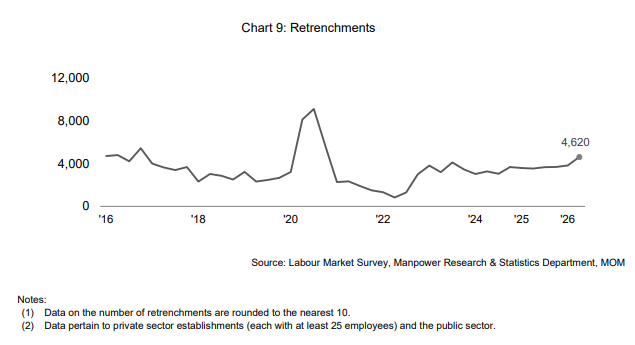
"Over the quarter, the incidence of retrenchment also increased from 1.6 retrenched per 1,000 employees to 2.0 retrenched per 1,000 employees," the report read.
The increase in retrenchments was concentrated in outward-oriented sectors, such as Manufacturing (870 retrenchments), Information & Communication (720), and Financial Services (710).
Residents in their 50s also logged the highest incidence of retrenchment, with 3.6 retrenched per 1,000 resident employees, followed by those in their 40s, with 3.0 retrenched per 1,000 workers.
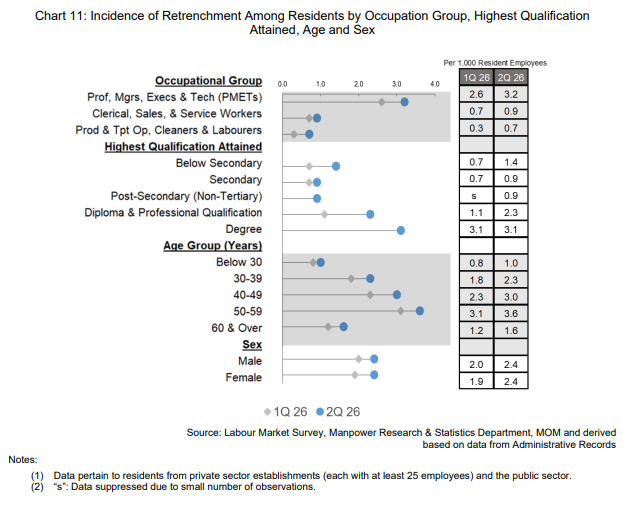
"The high retrenchment incidence among residents in their 50s, coupled with their higher longer-term unemployment rate, suggests they are at greater risk of involuntary displacement and may face greater job search challenges," the report read.
"Skills upgrading and career conversion programmes can help equip these workers with relevant skills to support their transition into new job opportunities."
Are retrenchments due to AI?
The increase in retrenchments in Singapore comes in the wake of widespread AI adoption across the country, with some experts warning that the deployment of the technology will lead to large-scale job losses.
But MOM previously said it is "currently difficult" to isolate the impact of AI or automation as a primary driver of retrenchments, as automation is usually implemented as part of a broader business transformation or restructuring exercises.
As of the second quarter, business reorganisation or restructuring is the leading reason for retrenchments, as cited by 72.1% of employers, according to MOM.
"The Ministry will continue to study how we can better capture the impact of AI and automation in its retrenchment statistics," it previously said.
Re-entry rate getting longer
Meanwhile, the re-entry to employment for laid-off workers took longer in the second quarter, according to MOM.
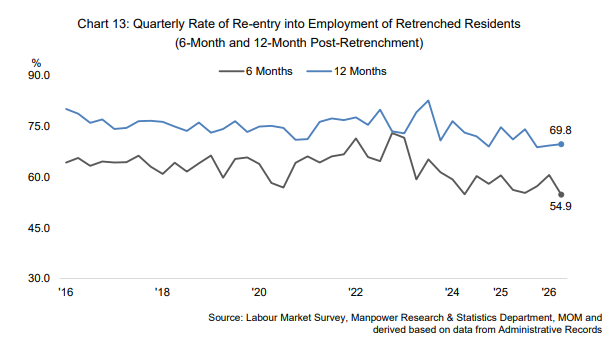
Retrenched workers who were able to return to work within six months declined to 54.9% in Q2, down from the 60.7% in the first quarter.
"The decline in six-month re-entry rates among retrenched residents in 2Q 2026 was broad-based across occupation," the report read.
"It was most pronounced among clerical, sales and service workers... Re-entry rates among PMETs also declined from 59.6% to 54.1%, and this group had lower re-entry rates than non-PMETs."
The 12-month re-entry rate, which covers earlier retrenchment groups, remained broadly stable at 69.8%. This indicates that retrenched workers "were taking longer to secure new employment," according to MOM.
'Resilient' labour market
Overall, the ministry determined Singapore's labour market remained resilient in the second quarter, as total employment increased by 11,400 to mark its 19th consecutive quarter of growth.
Unemployment also remained low and stable in June 2026, with an overall 1.9% unemployment rate.
"However, conditions became less favourable for some resident workers, as resident employment growth moderated, retrenchments increased and six-month re-entry outcomes weakened," MOM said.
"The Government will continue to support employers and workers by investing in workforce transformation and human capital development through a suite of programmes."