New report shows the emerging skill shift in Singapore amid AI adoption

Skills related to human capabilities will be present in many Singaporeans by 2031, according to a new report, as the implementation of artificial intelligence tools reshapes work.
Findings from the 2026 Workforce Skills Forecast showed that "uniquely human capabilities" will be the top skills when it comes to the number of people that have them by 2031.
Project management skills and leadership skills have emerged on top of this major shift, with the report expecting over 2,000 people in Singapore to be equipped with these skills by 2031.
Other top skills based on the number of people equipped with them are also related to human capabilities, such as collaboration, problem solving, analytics skills, stakeholder engagement and team management.
Python and SQL were the only technical skills to land in the top 10, according to the findings.
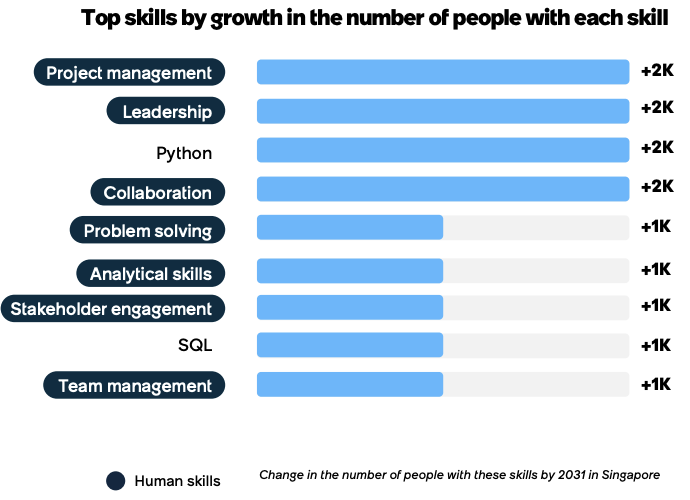
"As digital processes absorb more transactional tasks, demand shifts toward the uniquely human capabilities that determine how effectively new tools are adopted, governed, and applied," the report read.
Top skills in growth sectors
Even in sectors that are projected to lead Singapore's workforce growth, the report expects them to see major increases in employees with skills related to human capabilities.
The manufacturing sector, projected to record the largest absolute increase in headcount by adding approximately 16,000 roles by 2031, saw leadership skill as the largest projected increase in workers using the skill.
Other skills include project management, problem solving, collaboration, analytical skills, and Python.
Healthcare, which is forecast to add 12,000 roles, is also expecting project management skills to have the biggest growth in the workforce.
This is accompanied by leadership, collaboration, Python, stakeholder engagement and communication.
"The Singapore research highlights changing skills needs across industries, with Manufacturing projected to experience the largest absolute headcount shift and Healthcare the highest percentage workforce growth among those analysed," said Ashish Pandey, Solution Sales Executive, Risk Solutions (Asia) at ServiceNow, in a statement.
"These shifts make industry knowledge important: teams need to understand how changing roles and processes affect risk in their own environment. Technical skills help them assess the technology; human judgement and collaboration help them apply that knowledge responsibly."
Shifting skills demand in Singapore
The findings come amid widespread technology adoption in workplaces, according to the report.
Despite estimates that human skills will be among the top skills for workers by 2031, skill demand remains very tech-inclined.
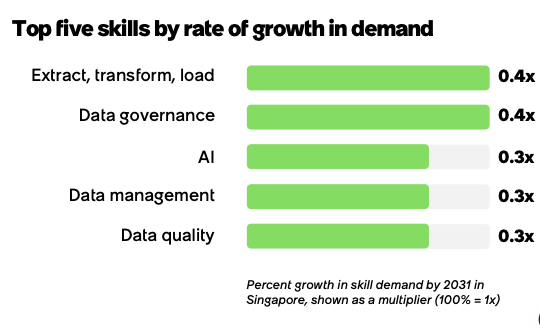
According to the report, the top skills by rate of growth in demand are extract, transform and load skills, as well as data governance and AI.
"Skills linked to data, AI, and software signal where the most immediate upskilling pressure lies," the report read.
Demand for human skills is growing at a rate of five per cent, according to the report, which attributed this to the universality of these skills.
"Human skills are already more universal and typically have slower growth rates," the report read.
Amid the ongoing skills transformation in the workforce, the report urged leaders to create "clear pathways" to future roles.
"Design development pathway and reskilling programmes that open opportunities as new roles emerge," the report read.
It also advised workers to prioritise learning in skills shaping future demand, as well as to use their existing skillset as a springboard.
"Invest in technical and human capabilities together. Planning now builds readiness for where demand is heading," the report read.