She filed statutory declarations, turned up at Jardine House - and got escorted out by security
A Hong Kong court has granted a broad injunction against a woman who bombarded one of Asia's oldest conglomerates with demands after declaring herself the reincarnated spirit of its 19th-century founders.
The High Court handed down the decision on November 13, 2026, after the Jardine Matheson Group - whose operations span property, hotels, and financial services across Asia - brought a harassment and nuisance claim on behalf of six of its companies and their staff.
How it started
It began in late November 2023, when staff across the Jardine Matheson Group started receiving letters and emails from the woman asserting she was the "reincarnate" of William Jardine and Sir James Matheson - the two men who founded the trading partnership in the 1800s.
That was just the opening.
According to the court's findings, the woman went on to issue directions about the group's affairs, demand share certificates for what she claimed was her interest in the business, instruct the withholding of dividends and payment of those dividends to herself, and direct the dismissal of key employees. She also claimed an entitlement to occupy all or part of Jardine House, the group's landmark Hong Kong headquarters.
The group had no evidence she held any shares, any partnership interest, or any entitlement to any of it.
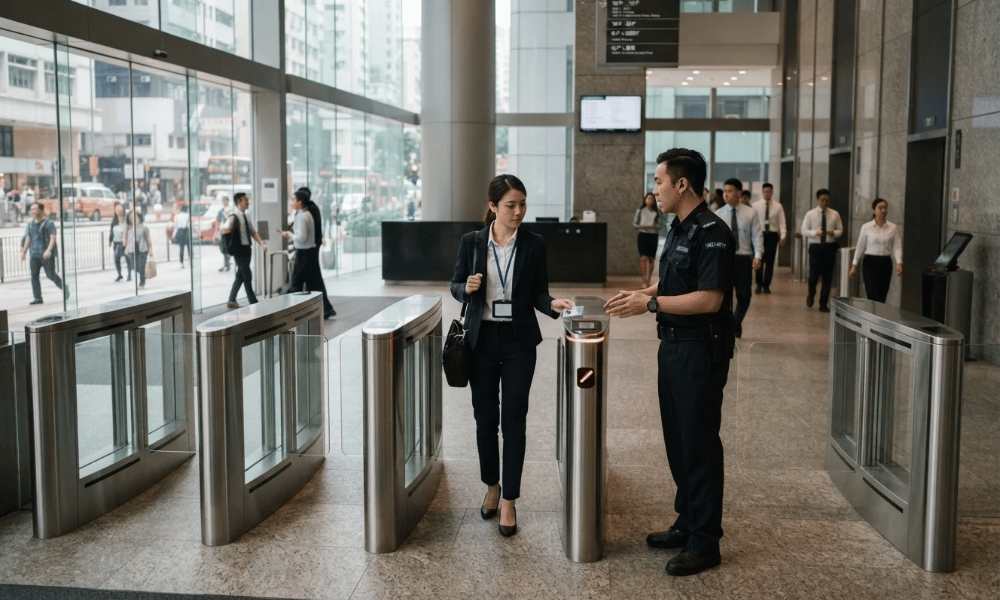
By October 2024, the correspondence had escalated to in-person visits. The court found she attended the group's Jardine House and Devon House offices on at least four occasions - including on October 30, 2024, November 15, 2024, and April 8, 2025 - seeking out senior management to press her demands. Each time, security staff had to escort her from the premises.
The numbers alone told the story: at least 27 letters, 38 emails, and 11 unsolicited phone calls to the group or its officers and employees.
None of it slowed down despite repeated requests from the group to stop.
She also sent communications to group companies, officers, and employees outside Hong Kong, as well as to unrelated third parties, holding herself out as a representative of the original partnership or as someone authorised to act on its behalf.
A separate lawsuit - and two sworn statements
In early 2025, the woman took a further step. She filed a civil action against the executive chairman of the group's ultimate holding company, Jardine Matheson Holdings Limited, claiming her name "is or was 'William Jardine'" and asking the court to prevent certain group entities from using certain assets and to close down the company. That action was struck out in November 2025 on the basis that she had no reasonable cause of action.
She had also filed two statutory declarations - formal sworn statements carrying legal weight - one in December 2024 declaring she "is/was Sir William Jardine," and another in August 2025 declaring she was the sole partner of the original partnership.
What the court found
The group brought the present action in June 2025, seeking a final injunction on two grounds: harassment at common law, and private nuisance over the office visits.
The harassment claim drew on a legal framework only recently confirmed at Hong Kong's highest level. In Sir Elly Kadoorie & Sons Limited v Samantha Jane Bradley [2026] HKCFA 2, the Court of Final Appeal recognised for the first time that a pattern of unreasonable, oppressive, and repetitive conduct causing distress can ground a civil harassment claim. That decision also confirmed that an employer can seek an injunction on behalf of its employees where the harassment concerns the workplace.
The court found all the elements satisfied here. The conduct was sufficiently repetitive and persistent. It was unreasonable and oppressive given the complete absence of any factual or legal basis for the woman's claims. She ought reasonably to have known it would cause distress. And it did.
The group's general counsel spent no less than 100 hours dealing with the matter - reviewing correspondence, coordinating security protocols, issuing cease-and-desist letters, and liaising with solicitors and police. The group's chief financial officer described feeling annoyed at reading about his own purported dismissal and repeated negative comments on his job performance, and worried about what the woman might do next.
On the reincarnation claim itself, the court was blunt. The assertion was "a mere assertion unsupported by any evidence apart from her own say-so and is incapable of belief." The court added that "the law simply does not recognize the concept of reincarnation."
The woman did not appear at the hearing and filed no written submissions in response.
The private nuisance claim succeeded on a narrower basis. The visits to Jardine House without permission, requiring security escorts, constituted unlawful interference with the company's enjoyment of its leased office premises.
The outcome
The court granted summary judgment - meaning it decided the case without a full trial, finding the woman had no arguable defence. It entered a final injunction restraining her from contacting or visiting the group's staff or premises, making representations about any affiliation with the group or its predecessors, or entering any premises leased or occupied by the plaintiffs. It also ordered the woman to pay the group's legal costs.
For HR teams managing external harassment, the decision offers a concrete example of how the newly recognised tort can work for employers acting on behalf of their staff - and a signal that Hong Kong courts will move quickly when the conduct is persistent and the defence, in the court's view, amounts to nothing.