Her own safety duties sank this cleaner's slip and fall claim
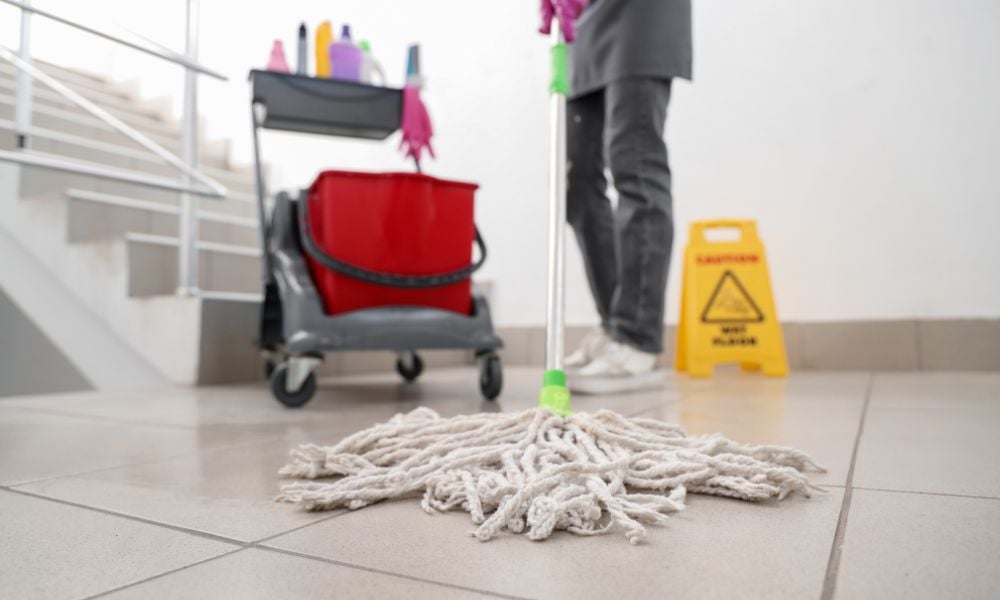
Judge Harold Leong ruled on 11 September 2026 that a cleaner's own job undid her slip-and-fall lawsuit against her employer.
The cleaner worked for Kai Fu Property Services Company Limited, keeping a public housing estate in Ngau Tau Kok, Kowloon clean. She said that back in March 2021, she slipped on water inside a storage room at the estate and hurt her left ankle. So she sued, arguing the company had left the floor wet, skipped a warning sign, and failed to give her a safe way to do her job.
There was just one problem: mopping up wet floors and putting out warning signs when needed was her job. Under cross-examination she admitted as much, and she never disputed that the company had given her a pair of anti-slip boots, which she was wearing when she fell. Hearing the case as DCPI 3250/2023, cited as [2026] HKDC 1634, the judge said this evidence knocked out most of her complaints in one go, since she was the person meant to be managing the very hazard she blamed for her injury. After she closed her case at trial, the judge put a blunt question to her lawyer: "Where was the breach?"
Her account of the accident did not help either. She first said she slipped on water and fell flat, but at trial admitted she had actually twisted her ankle and sat herself down, a different story from the one in her original claim. None of the paperwork from the time backed up a wet floor: her hospital notes from that night recorded only that she had "sprain L (left) ankle tonight when walking, cannot recall exact mechanism," and the company's own incident report described a fall with no mention of water or sewage. She had also already lodged, and settled, a separate employees' compensation claim worth around HK$281,000 without ever bringing up a wet floor, only raising one for the first time in a legal letter sent more than two years after the accident.
The judge found that the accident had not happened the way she described, and dismissed her argument that the facts alone should prove her case. With no breach established, he concluded that "the plaintiff has failed to establish liability on part of the defendant," so he did not even need to weigh the company's claim that she had contributed to her own fall.
The judgment also worked out what she would have won had she succeeded. An orthopaedic expert put her total permanent impairment at 4.5 percent, while a psychiatrist diagnosed an adjustment disorder linked to the accident, with only mild symptoms left by the time of trial. The judge would have awarded roughly HK$150,000 for pain and suffering, about HK$250,000 for lost earnings and provident fund contributions over a reasonable two year recovery, HK$30,000 for a dent in her future earning power, and around HK$20,000 in medical and other costs, adding up to about HK$450,000 before the HK$281,000 she had already received in compensation was deducted. That would have left a further HK$168,500 or so, plus interest. Instead, with the case thrown out, the cleaner was ordered to cover the company's legal costs, while her own costs will be settled through the legal aid scheme that funded her case.
The judgment made clear that such a claim needed to point to something specific the company failed to provide, whether training, equipment or a safer system of work, and that an accident and a wet floor were not enough once her own evidence showed managing that hazard was part of her job.