Singapore's budgeted salary hike falls behind Southeast Asian neighbours amid double-digit attrition rates

Singapore's budgeted salary increase for 2027 remained steady, according to a new report, while neighbouring markets set aside bigger salary budgets amid double-digit attrition rates.
Aon's latest report revealed that the budgeted salary increase in Singapore is at 4.1%, unchanged from the actual salary increase in 2026 and down slightly from the 4.3% actual salary increase in 2025.
This is the lowest budgeted salary increase among the Southeast Asian markets covered in the Aon report, where Vietnam logged the highest budgeted salary increase of 6.7% for 2027.
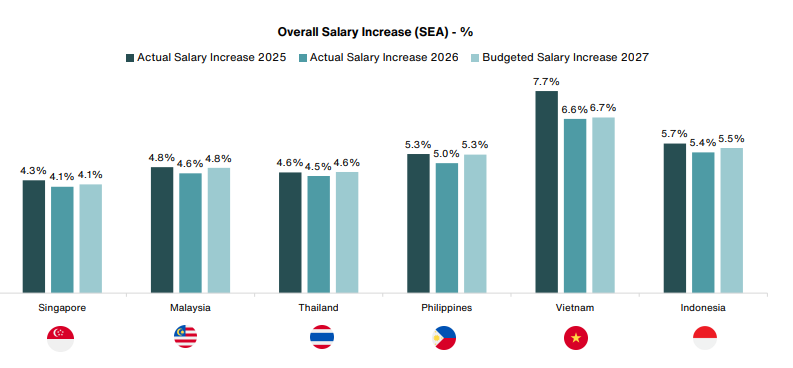
Singapore was also the only market to not log any changes between the budgeted salary increase for 2027 and the actual salary increase in 2026.
Its retail and hospitality sector has the highest budgeted salary increase for 2027 (4.8%), while the energy and financial services sectors have the lowest at 3.8%.
Overall, Southeast Asian markets recorded a 5.2% budgeted salary increase for 2027, slightly higher than the 5.0% in 2026.
Double-digit attrition rates
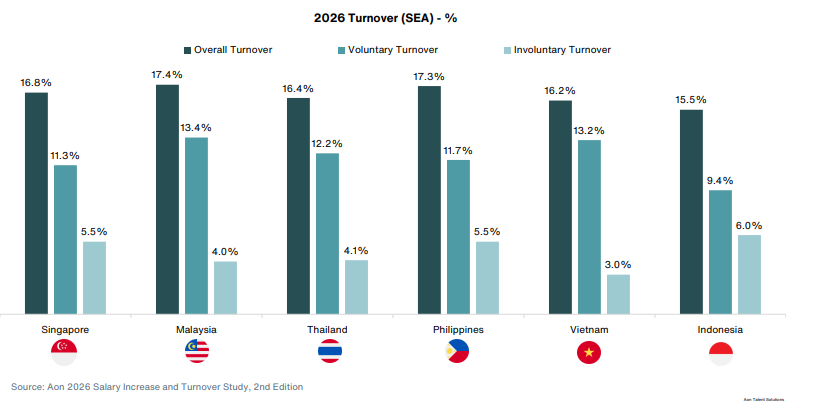
The increase in budgeted salary comes amid persistent double-digit attrition rates across the region, which had an average of 16.6% in 2026.
Malaysia and the Philippines saw the highest attrition rates in Southeast Asia, with 17.4% and 17.3%, respectively, despite both markets seeing a decline in attrition levels.
Singapore's attrition levels also declined to 16.8% in 2026, from 19.3% in 2025, while Indonesia registered the lowest attrition rate of 15.5%, even though it increased from 15.0% in 2025.
Voluntary exits drove turnover across the region, with Malaysia and Vietnam seeing the highest voluntary turnover rates of 13.4% and 13.2%, respectively.
Indonesia saw the highest level of involuntary turnover, at 6.0%, followed by Singapore and the Philippines, which both logged 5.5%.
Rahul Chawla, partner and head of talent solutions, Southeast Asia, Aon, said the findings come as boardrooms have to balance investment in technology and people.
"Persistent inflation and ongoing skill shortages are directing investments toward the roles and skills that will drive returns on their broader business investments," Chawla said in a statement.
"While competitive pay remains important, organisations must also consider the broader employee value proposition including growth opportunities, purpose and career development to create opportunities for long-term organisational growth."