As AI accelerates execution, the workplace needs to evolve around how teams collaborate, connect and make decisions
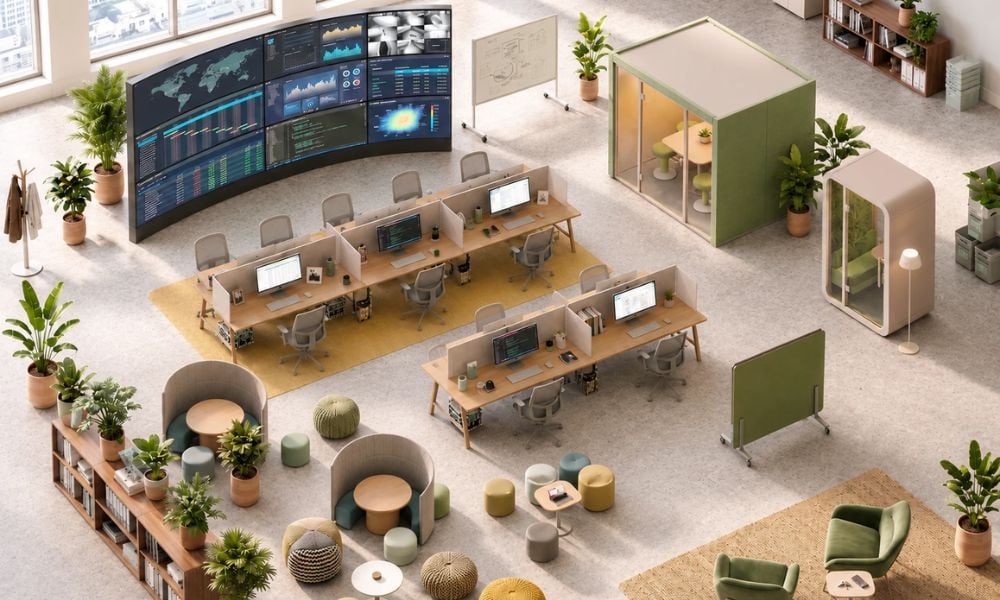
Main image: An AI-enabled office is shown in this rendering. (Supplied: Atlassian)
What does an AI-enabled office actually look like?
For Atlassian, it could mean spaces where employees can throw out half-formed ideas without overthinking them, huddle around a shared screen for 15 minutes, or step outside and leave the technology behind. The company is experimenting with spaces designed around what people need to do together as AI takes on more of the execution work.
"The way that people are working is changing," said Gina Creegan, Head of Workplace at Atlassian, based in Sydney, Australia. "It just made total sense to me that that means you need to think about the spaces where they're doing the work."
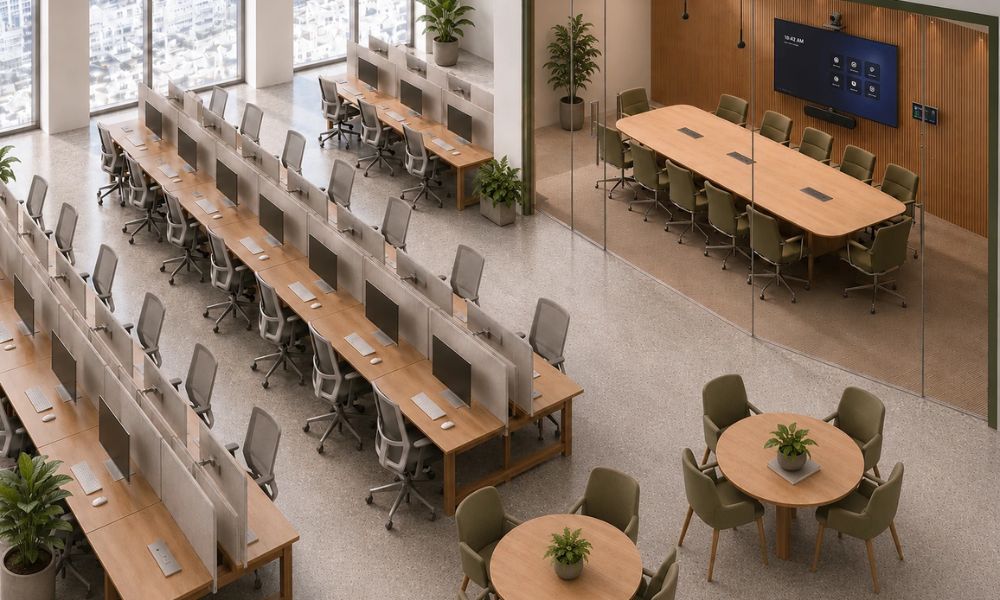
This image shows a rendering of a traditional office. (Supplied: Atlassian)
That thinking is leading Atlassian away from the traditional desk-and-meeting-room model and toward three types of spaces: ideation, calibration and regulation.
The office was built for a different kind of work
Creegan said the redesign grew out of what Atlassian was seeing in its own research. The company's office model was built around the idea that execution, the actual doing of the work, was the biggest constraint on getting things done. But its 2026 State of Teams research, which surveyed 12,000 knowledge workers and 172 Fortune 1000 executives, found that AI is changing that equation. As execution gets faster, judgment, alignment and decision-making become the bigger bottlenecks. Atlassian estimates that this fragmentation costs large companies $1.61 billion a year.
Creegan said that change has implications for the physical workplace, too.
"Most offices are designed around a traditional model of knowledge work, focused work at the desk, then moving to the office to connect with people," Creegan said. "So that made total sense for the way we did work a few years ago. But AI is speeding up execution... the bottleneck has shifted. The work has moved to where people are aligning, where they're applying a lot of judgment, where ideation is happening. That old model of desk and meeting room isn't helping to unblock that bottleneck, and in some ways it's hindering it."
Gensler's 2026 Global Workplace Survey, polling more than 16,400 office workers across 16 countries, found something similar. Employees who use AI most heavily report spending less time working alone and more time learning and connecting with colleagues, a sign the office's role is evolving rather than shrinking.
Three spaces built for the AI era
To address the fragmentation tax, Creegan and her team identified three types of spaces to experiment with, each built for a different type of AI-augmented work.
The first, ideation, calls for low-friction, informal spaces, which might include things like writable walls and casual seating instead of a conference table, giving people room to work through an idea before it's fully formed.
"You can say something out loud, a half-formed idea, without feeling uncomfortable exploring a different perspective," Creegan said.
The second, calibration, replaces the traditional room with spaces designed for a faster pace of work.
"We're talking about a series of connected spaces with shared screens, where you can huddle together and have 15-minute bursts of collaboration," she said. "Not a traditional meeting room where you go in for an hour."
The third, regulation, is meant to counter the toll of working alongside AI all day.
"There's a lot of tax on us as humans as we're working with AI," Creegan said. "These are quieter spaces, maybe outdoor or spaces with nature, or social spaces without screens. They're there to help protect our wellbeing and protect the deep knowledge work we need to do."
Creegan's team is testing calibration in Atlassian's new San Francisco office redesign, opening next year. In Sydney, a new headquarters under construction will apply a related framework she calls Design for Flow, meant to let people move between focused work, collaboration, connection and recharge.
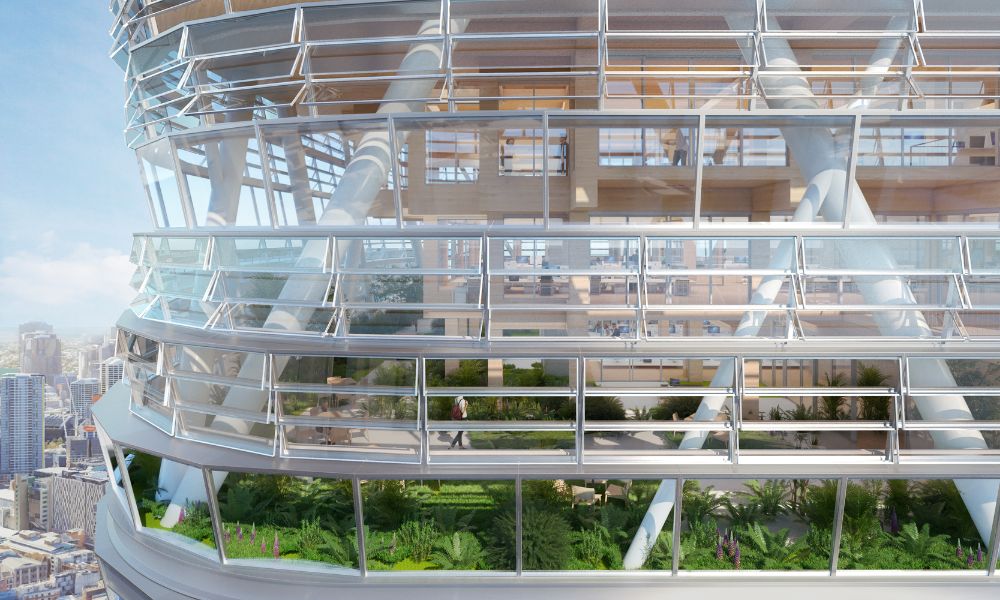
This image shows Atlassian Central, located in Sydney, Australia. (Supplied: Atlassian)
Trust and advice for getting started
Creegan said the framework also needs what Atlassian calls trust architecture, simple, visible ways of showing employees whether AI is present and listening in a given room.
"The idea originated from the studio, from the on-air signs you'd see at the BBC," said Creegan, who worked in broadcast before relocating to Australia. "Simple signage, simple ideas, can really support people knowing which spaces are enabled by AI and which aren't."
HRD America has covered trust, not technology, as the reason many AI rollouts underdeliver and separate concerns about AI making the workplace lonelier this year, both signs of a broader trust deficit around AI at work.
For organizations thinking about redesigning their own workplaces, Creegan said the starting point should be the work itself, not the technology.
"Don't forget physical space if you're doing an AI transformation. It's part of it," she said. "Start with the work. Understand how the work your teams are doing is changing and where the bottlenecks are."
The pace of change also means organizations shouldn't expect to get the design right on the first try, she said. Flexibility, experimentation and small pilots can help teams adapt as the technology evolves.
"I also think the pace of change is phenomenal, and I'm not sure we're there at our final destination," Creegan said. "Don't think that you need to know the whole answer, because we certainly don't know that, but I'm excited that we're starting to figure it out."