A former CHRO who's navigated two sudden leadership departures shares lessons for HR when an interim CEO takes over
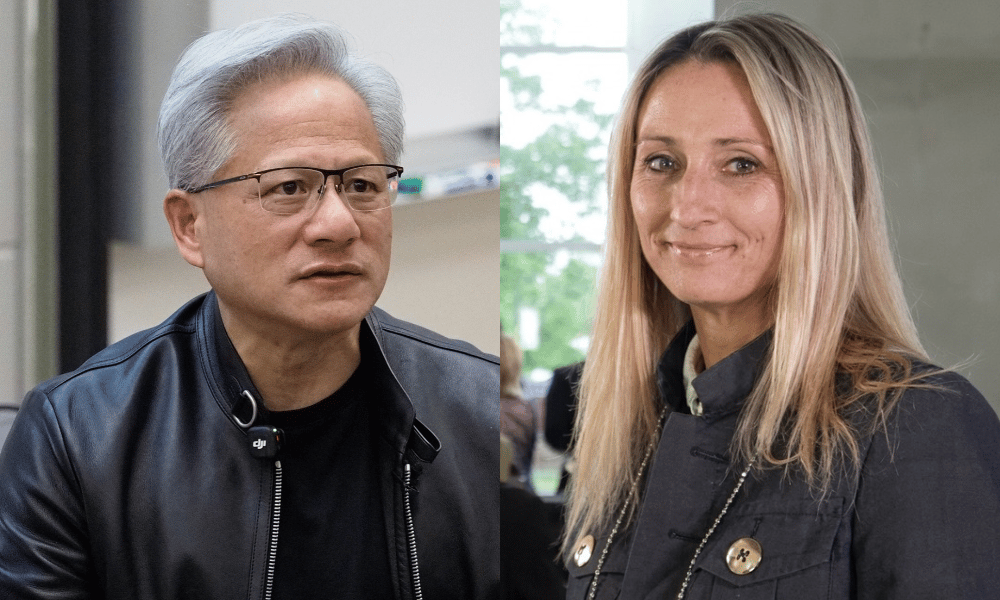
Nvidia’s former CEO, Jensen Huang, and interim CEO, Colette Kress, are shown in this composite image. (Wikimedia Commons)
A sudden CEO departure can put an organization on shaky ground. While the board works out who should take the top job, the interim leader has to steady the executive team, manage uncertainty and establish credibility with a workforce that may not be ready for change.
It's a challenge playing out at Nvidia, where Colette Kress has stepped in as interim CEO following Jensen Huang's sudden resignation. The board, which has pushed back on calls for Huang's return, is now searching for a permanent successor, while an online campaign calling for Huang's return has attracted thousands of signers who identify themselves as Nvidia employees, according to its organizers.
Few people understand the challenges of a sudden leadership transition better than Betsy Rodriguez. The current president of the American Research Universities Human Resource Institute in Denver and a former CHRO at the University of Missouri System and Children's Hospital Colorado, she's led HR through two abrupt leadership departures.
"An interim is going to have to immediately establish some executive presence and build trust very, very quickly," Rodriguez said.
The challenge of following a popular CEO
One of the biggest challenges for an interim CEO is establishing their own authority, particularly if their predecessor is still involved behind the scenes. Rodriguez said a former CEO's continued presence can help smooth the transition, but it can also make it harder for the interim to step into the role if employees remain loyal to the person who left.
At Nvidia, the online campaign calling for Huang's return suggests Kress could face some of that resistance. Rodriguez said she believes Kress needs to address the situation directly, provided she has the board's backing.
"I think she has to establish herself as the CEO regardless of how people feel and ask for their trust and for them to get on board with her," Rodriguez said.
Still, Rodriguez described it as an "uphill battle" for Kress, particularly when the departing CEO appears to have such strong support.
The transition could be easier if Kress isn't being considered for the permanent CEO position, Rodriguez said. In that case, employees may be more inclined to see her as someone tasked with maintaining stability until the board settles on a successor, rather than someone looking to replace Huang permanently.
Keeping the leadership team together
Kress has already made a public appearance, holding the company's first all-hands meeting since Huang's exit on Wednesday. But Rodriguez said the most important work for an interim CEO happens behind the scenes, as they work to keep the executive team united.
"It's great that she's meeting publicly with the employees, but it's really ensuring that her whole team is supporting her and not kind of splintering off," she said.
That's where the CHRO can play an important role. Rodriguez said the CHRO should help leaders feel comfortable raising concerns and working through their own reactions to the departure.
"Anytime there's an interim CEO, especially if it's sudden, the CHRO is in a really important position in terms of having to make sure that the executive team is speaking as one voice," she said.
The CHRO also needs to be a close source of support for the interim CEO, Rodriguez said. She said the transition can leave leaders with competing emotions and concerns, particularly when they've worked closely with the person who left.
Rodriguez said some executives may feel a personal attachment to the departing CEO, while others may wonder where they stand. She called the risk of key leaders leaving "a huge possibility" and said the CEO and CHRO should make time for individual conversations with senior leaders.
"Let them vent, let them deal with what's going on," she said. "Try to find out if there is a flight risk."
A senior Nvidia employee reportedly warned the board in a letter that the company could lose "irreplaceable talent" if it didn't consider reinstating Huang, according to CNBC. Rodriguez also cautioned that competitors may see a leadership transition as an opportunity to recruit.
"To me, it's also a time when other corporations are going to start wanting to pick off some talent," she said. "It's a good time to do that. So I think you have to be very aware of that."
That makes succession planning important, too. Rodriguez said companies should have backup plans in place in case other members of the executive team decide to leave.
What boards and CHROs can learn from sudden exits
Rodriguez has seen firsthand how difficult a sudden leadership departure can be when a board isn't prepared. In both of the abrupt presidential exits she led HR through, the board had a long-term succession plan but no emergency arrangement for who would step in.
"The board had a succession plan that was kind of a long-term development plan but didn't have an emergency plan," she said.
The circumstances were very different. In one case, the president left because of a family situation and helped appoint the interim, making for a relatively smooth transition. In the other, she said, a crisis that was mismanaged led the president to resign on national television.
"The board absolutely did not have an interim in place, and that was the most difficult thing," Rodriguez said.
Within 24 hours, she was working with the board to find someone to take over.
"There wasn't a logical choice," she said. "And because of the crisis that happened, it was even more difficult to find someone who would even want to do it."
Having an emergency successor identified in advance can spare an organization that scramble. Anthony Nyberg, a professor at the University of South Carolina's Darla Moore School of Business who researches CEO succession, has said boards answer to shareholders for having a succession plan ready. A 2025 report he co-wrote with Ani Huang of the HR Policy Association found that even when an emergency successor is named, the plan is rarely stress-tested or kept current.
But having someone ready to take the top job is only part of the preparation. Rodriguez said her experiences also reinforced how important it is to keep the executive team from fracturing when a leader leaves.
"The executive team falls apart, not because they're bad people," she said. "Everybody has their own emotions about it."
That puts the CHRO in a position to help bring leaders together and provide stability while the organization adjusts to new leadership. Rodriguez said HR shouldn't wait to be asked to step in.
"This is the time where a CHRO can really show their value," she said. "It's an opportunity to really make an impact on the organization in a really difficult time, and whether or not the CHRO is asked, they need to really step up and take a lead role in what's going on."