Legal and workforce researchers warn that employers are eroding the leadership pipeline as AI reshapes early-career roles
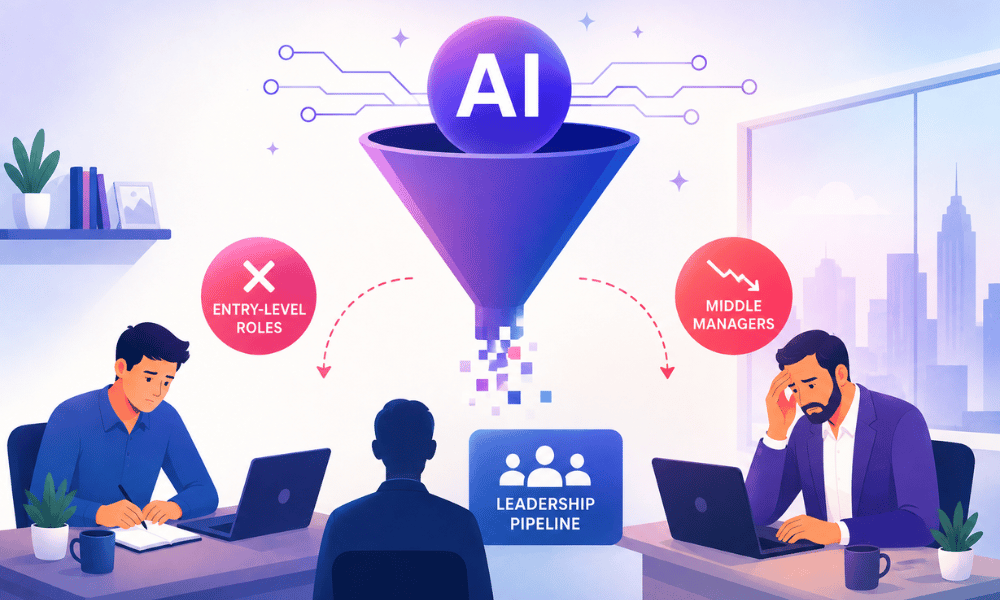
Employers racing to redesign work around artificial intelligence (AI) risk stripping out the very roles that build future leaders, according to a Mallesons Digital Future Summit session and new benchmark data from workplace researcher BoldHR.
Together they point to a compounding problem: middle managers are retreating into operational execution just as entry-level roles – where those managers themselves learned the job – are being automated away.
Entry-level work is where leaders are made
Speaking with Cilla Robinson, a partner in Mallesons' Employee Relations and Safety team, professor Toby Walsh, chief scientist at UNSW.ai, the AI Institute of the University of New South Wales (UNSW), said generative AI tools are now capable of much of the work traditionally given to junior staff to build their expertise.
"If the generative AI tools that we have today are really good at doing some of the stuff that entry-level people used to do, which they are in many, many cases… then what happens to the entry-level people who used to do those tools?" Walsh said. "And if you don't hire those people in those positions, where are people going to come [from]? Organisations are pyramids."
Walsh argued the risk extends beyond headcount to competence. "If you haven't put the hard work in doing that, then how do you actually get to be an expert in contract law so that you can oversee a human clerk or an AI clerk drafting the contracts and working out which clauses need to be modified?" he said, adding that some businesses may need to "pay the humans to do that, even though that's not as efficient as it could be because we've got to invest in our people."
Robinson said the pattern is already visible inside professional services. "There's that anxiety of the seniors that if the juniors are just outsourcing their brain, their function to Harvey or whatever other AI tool is being implemented, that they're just not getting that skill so that they can then use that judgment," she said, noting the tension between client demands for AI-driven speed and the time firms need to invest in developing junior talent.
Middle managers are retreating, not advancing
That pipeline concern is reinforced by BoldHR's 2026 B-Suite Benchmarks report, based on 1,627 respondents. The research found 47 per cent of middle managers remain at the "order-taker" maturity level – the profile the report identifies as most exposed to AI-driven automation and organisational redesign – with no improvement in the proportion reaching top-tier "B-Suite Leader" status since 2024. Some 63 per cent of middle managers reported high frustration, up five percentage points on the prior benchmark.
Rebecca Houghton, founder and director of BoldHR, said the driver isn't AI directly replacing managers but a lack of engagement in how AI is rolled out. "We're just seeing droves of them going back to their operational roots … rolling their sleeves up, pitching in because the pressure to be productive has gone up," Houghton said.
"And that's a problem for us because of course it means that middle managers are regressing, not progressing." She added that the risk to individual managers is "not of AI taking their job, but of their job being downgraded."
Influence has overtaken burnout as the top challenge
BoldHR's data shows influence – the ability to align stakeholders and shape decisions without direct authority – has overtaken burnout as middle managers' primary challenge for the first time, cited by 32 per cent of respondents, up from 27 per cent.
Houghton linked this directly to AI transformation efforts that bypass the middle layer. "It's actually impossible for exec levels or AI experts to answer that question, and it's not actually possible for teams at the grassroots level to answer that question either," she said, referring to decisions about which tasks AI should take on.
"That is the classic only-middle-managers-know kind of question. And we're not really asking them that question enough."
What HR leaders should do next
Both experts pointed to the same structural risk: organisations investing heavily in AI while leaving the managers meant to translate that investment into results out of the conversation.
Robinson noted the shift is unfolding alongside growing regulatory attention to psychosocial risk in restructures, with WHS regulators increasingly focused on the mental health impact of workplace change on remaining staff.
HR leaders assessing restructures involving AI may need to weigh these obligations alongside the longer-term cost of a thinning leadership pipeline.