Global survey finds AI expanding workloads while making work more collaborative
Artificial intelligence is adding to employees' workloads rather than freeing up their time, according to a new global study, which also found that workers are collaborating more than they did a year ago.
Jabra's WorkLife 2026: The New Shape of Work report surveyed more than 6,000 knowledge workers worldwide. It found that 85% of respondents reported doing more of at least one type of work over the past year, while only 35% said any part of their work had shrunk.
"Every category of work grew," the report said.
Strategic planning and analysis recorded the largest increases, with 51% of workers saying they spend more time on each than they did a year ago.
Creative work followed closely at 50%, which the report said challenges "the idea that AI is replacing creativity rather than expanding it."
The finding comes amid fears that the technology could erode such skills. A separate report from the Acceleration Community of Companies (ACC) found that two in three employees believe AI will erode their creativity, with the same proportion expecting it to erode their writing skills.
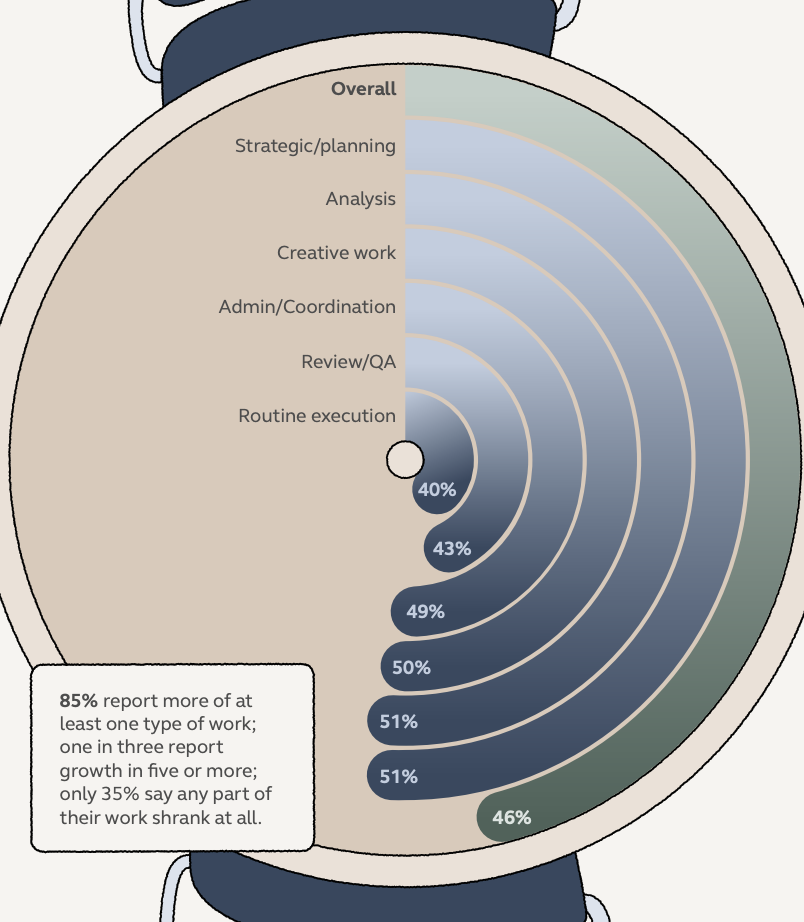
Meanwhile, 49% of Jabra's respondents reported spending more time on administrative and coordination tasks. Routine execution grew the slowest, though 40% still reported an increase.
"Rather than reducing work, AI is broadening it. The time it creates isn't being banked as spare capacity. It's being reinvested into more decisions, more responsibilities, more collaboration and more opportunities to contribute," the report read.
More collaboration, stronger connection
The study also found that the workday has become more collaborative. According to the report, 42% of workers said they collaborate with colleagues more than they did a year ago, against 13% who said they collaborate less.
The report linked this to frequent AI use. It said 64% of frequent AI users work more with their colleagues than they did a year ago, compared with 25% of employees who use AI less often.
Separately, 39% of respondents said AI has strengthened their sense of connection with colleagues, while 14% said it has weakened it. Feelings of loneliness and disconnection, both reported by around six per cent, were among the least frequently reported emotions in the study.
"The modern workday hasn't become isolated. If anything, it has become more collaborative," the report said.
Meetings shift towards problem solving
The findings also point to a change in what meetings are used for. Four in 10 workers said they spend most of their meeting time solving problems, and 39% said they spend it making decisions.
Smaller shares said their meetings are mostly taken up by status updates and coordination (30%), stakeholder alignment and approvals (29%), and one-to-one coaching and feedback (28%).
"Far from being a distraction from 'real work,' increasingly, meeting-based collaboration is the work," the report said.
Calum MacDougall, president at Jabra, said leadership will shape how organisations benefit from the technology.
"The winning companies of the future will be the companies that win at AI deployment," he said in a statement. "Winning at AI deployment depends on leaders listening and engaging with their teams to fully understand what they need to work with AI productively."