Employers warned that psychosocial risks can be 'just as significant' as physical risks at work
Employees are suffering from work-related stress, anxiety, and depression despite employers saying health and safety is a real investment in their business, according to WorkSafe New Zealand.
An infographic from New Zealand's work health and safety regulator revealed that 60% of employees experienced work-related stress in the last 12 months.
Another 31% reported work-related anxiety, 20% experienced work-related depression, and 11% reported new mental health or wellbeing issues.
The most common psychosocial risks, which can lead to these psychological harms, include high work pace, high demands for hiding emotions, and high quantitative demands.
Offensive behaviours are also rampant in New Zealand workplaces, where 23% of employees reported being exposed to bullying and 16% reported cyberbullying.
Some 14% of employees also said they were exposed to threats of violence, while others said they were exposed to sexual harassment (11%) and physical violence (11%).
Peter McDevitt, head of health and safety at Peninsula New Zealand, commented that the findings indicate that psychosocial risks can be "just as significant" as physical risks, and can affect any workplace.
"Workplace stress is often viewed as an individual issue, but many of the factors that contribute to stress are directly related to how work is designed, managed, and supported," McDevitt said.
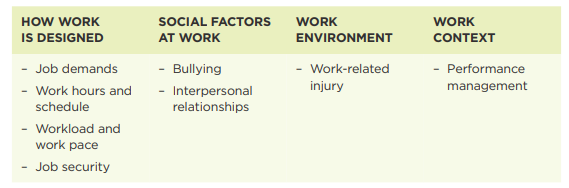
In fact, WorkSafe revealed that various work stressors are also behind work-related suicide cases in New Zealand between 2017 and 2021, where 246 cases were classified as "potential work-related suicide" and 197 were determined as "actual work-related suicide."
Among those work stressors include job demands, workload and work pace, bullying, interpersonal relationships, work-related injury, and even performance management.
 Investment in health and safety
WorkSafe's findings come despite 66% of employers saying health and safety is a "real investment in their business."
Another 74% said they make the time and effort to ensure they're up to date with changes in health and safety legislation, while 82% believe they have a "strong safety culture" where employees look out for each other.
Among the health and safety practices implemented by employers include:
- Making changes to the work environment or equipment to reduce the risk to people's health and safety (57%)
- Developing or updating a formal management plan or policy to address key health and safety risks (40%)
- Assessing workers' level of exposure to a health risk (34%)
- Providing workers with health checks or monitoring health problems that could be related to work (24%)
But to support employees' mental wellbeing, employees in a WorkSafe poll in 2021 said they want the following protective factors:
- Security over working conditions
- Sense of community at work
- Role clarity
- Meaning of work