Psychological readiness, quiet quitting among top concerns for employers, says expert

Organisations in New Zealand are grappling with overlapping tensions rather than a single defining challenge as artificial intelligence (AI) reshapes work, according to one expert.
Currently, employers are operating in a “brittle” environment with high performance pressure, fast‑moving markets and rising employee expectations, says Nithya Ramaswamy, LHH’s Solutions Director for Australia and New Zealand.
Ramaswamy says the dominant pattern across clients is a set of “tension points” rather than isolated problems. “The landscape is quite brittle, there’s high pressure to perform,” she says, adding that market shifts are “not very linear” and technology is a major accelerant.
One major tension is between speed and stability. Boards and markets are demanding rapid innovation, but people are already exhausted by disruption. “You don’t want to destabilise your people as a result of the speed,” she says. “That speed has to be balanced out with what we call psychological readiness,” including space for conversations and trust.
A second tension lies between aggressive AI adoption and maintaining a human‑centred culture. Organisations are “investing in AI and digital capability and using data to predict and anticipate, which is fantastic,” Ramaswamy says, but if leadership teams are not aligned, do not role‑model curiosity and do not “augment AI appropriately”, technology becomes another source of strain.
“It’s not something like you just throw at employees and you expect them to use and be productive,” she says. Instead, AI should be used to “free up time” so leaders and managers can have “more meaningful conversations, whether it’s about careers, whether it’s about having that trusted space”.
A third tension centres on performance, wellbeing and career direction. Ramaswamy says employees increasingly expect visible progression pathways and that retention “often hinges on progression”. If staff cannot see “what the next line of sight is,” she warns, “that’s what we call quiet quitting or disengagement… they might not leave you immediately,” but disengagement builds over time.
AI optimism, but gaps in purpose and impact
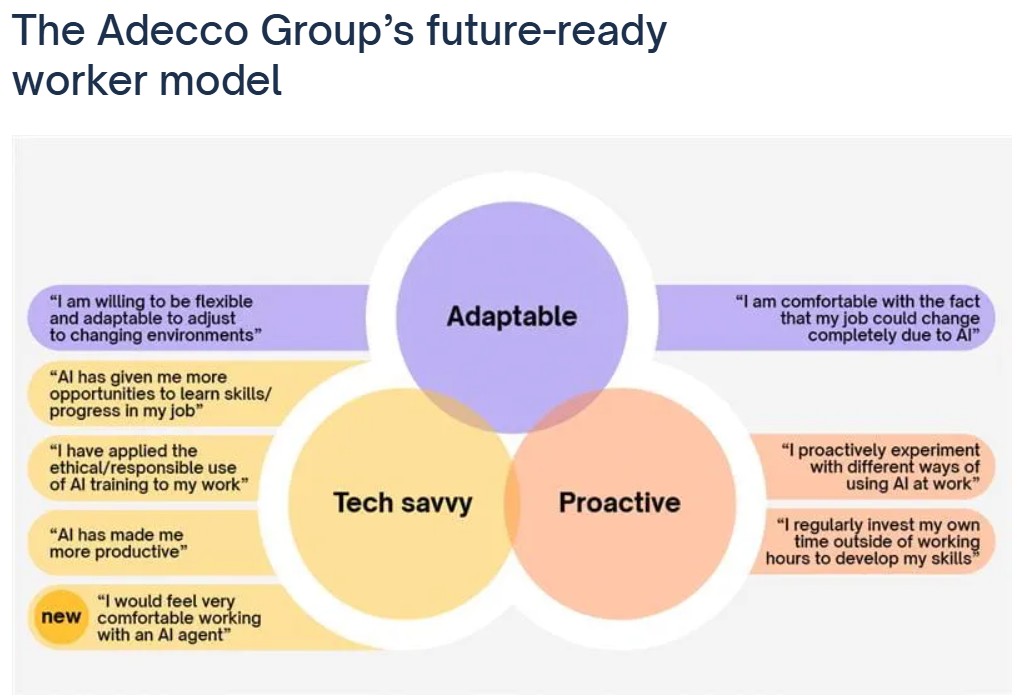
Amid all these pressures, less than 2 in 5 (37%) workers qualify as “future‑ready workers”, though that number is up from 11% in 2024, according to The Adecco Group’s Global Workforce of the Future 2025 research, which surveyed 37,500 workers across 31 countries and 21 industries.
Three in four employees see AI more as an opportunity than a threat. However, AI now sits at the forefront of workers’ concerns and expectations. Generative AI, general AI and AI agents occupy the top three spots among global “megatrends” influencing working life, ahead of economic uncertainty and flexible work. Around 76% of workers expect job redesign due to AI, while only 23% anticipate job displacement.
Nearly 8 in 10 (77%) workers say AI allows them to perform tasks they could not do previously, and about three‑quarters report that AI has already changed, or will change, both the activities they carry out at work and the skills required in their role. At the same time, only about one‑third say they can confidently measure the impact of their work, and a similar share admit they still spend AI‑freed time on the same or more mundane tasks.
The report links this lack of clarity to retention risk. It finds 99% of workers who feel a strong sense of purpose at work every day plan to stay with their employer over the next 12 months, compared with just 53% of those who never feel a strong sense of purpose. Workers say their purpose would be strengthened by a better understanding of company strategy, the impact of AI on their jobs and more professional growth opportunities.
Future‑ready workers
Ensuring that employees are future‑ready can bring a lot of positives to employers, especially as they continue to bring AI into their work processes, according to The Adecco Group’s report:
-
Future‑ready workers are far more likely (+12 percentage points) than mainstream workers to say they intend to take greater control over their skills development.
-
Over 2 in 5 (41%) of future‑ready workers are involved by their employers in the design of work being reshaped by AI, compared with 24% of mainstream workers.
-
A score of 6.6 out of 10 is the AI trust score for future‑ready workers, compared with a score of 3.3 out of 10 for mainstream workers.
Ramaswamy says there is “a tremendous amount of anxiety in the landscape because we often don’t know what we don’t know,” describing an environment with a “high degree of pressure” and ambiguity, and increasingly non‑linear career paths.
Under such stress, leaders tend to “resort to trying to control, trying to be the subject matter expert, trying to default to caution,” she says. Instead, they should focus on “harnessing psychological safety” by creating trusted spaces for dialogue.
She urges leaders to shift from telling to asking. “We talk about advocacy versus inquiry,” she says. Rather than directing, leaders should be asking: “What are we missing? What are you seeing? What assumptions are we holding [that] might not hold true anymore?”
Post‑COVID anxiety, restructures, redeployments and career transitions are intensifying pressure, she adds. To reduce fear, leaders should help employees reframe change: “Sometimes changes have opportunities for us too… some things are actually a growth area for us, there is an opportunity here,” she says.
What can HR leaders do?
Ramaswamy says HR and business leaders cannot shoulder all responsibility for navigating change. “HR can’t just do everything,” she says, arguing that employees must be empowered to “take charge of certain things” while organisations provide clear guidelines on engagement, retention and growth.
She also highlights a cultural reluctance in New Zealand and Australia to have “hard conversations”, not only about performance but about constructive challenge and disagreement. “People struggle to have a hard conversation,” she says. “It’s okay to disagree, it’s okay to constructively challenge,” provided the aim is collective growth.
Ramaswamy calls for more space for experimentation, including “role modelling growth mindset” and testing intelligent hypotheses about new ways of working, with explicit reflection on lessons learned whether initiatives succeed or fail.
Finally, she says leaders must prioritise career conversations over task check‑ins. Too often, meetings focus on “to‑do lists”, when employees also have “motivations” and “passions” and may have “alternative pathways” within the organisation that can be unlocked by AI‑enabled redesign of work.