Data governance choices carry weight for trust and partnership
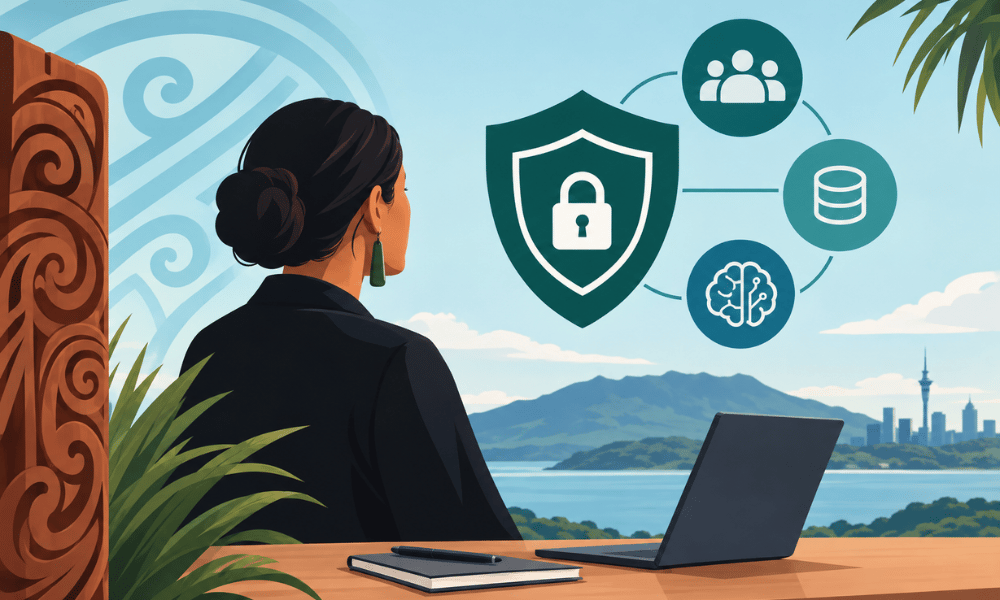
New Zealand's Office of the Privacy Commissioner recorded a 43 per cent rise in serious privacy breach notifications in its 2024/25 annual report, and found 62 per cent of people surveyed are concerned about organisations using AI to make decisions with their personal information.
For Gil Sewell, chief people and culture officer at Ember Korowai Takitini, a mental health, addictions and intellectual disability non-governmental organisation (NGO) based in Auckland, that concern is not abstract. It sits at the centre of how her people and culture team is approaching data sovereignty, and Māori data sovereignty in particular, as AI tools move into New Zealand workplaces.
Sewell, recognised as one of New Zealand's top HR leaders on HRD's Hot List, spoke with HRD alongside Peti Deed, Ember's Kaiwhakahaere Hononga ā-Iwi (general manager leading the organisation's bicultural team), about why data decisions carry cultural weight, why the organisation has deliberately kept AI note-takers out of some meetings, and where she believes other HR and people leaders are getting the balance wrong.
What Māori data sovereignty means for people and culture teams
Sewell opened by invoking a whakataukī, or Māori proverb: "He rei ngā niho, he paraoa ngā kauae," which she translated as meaning "you must have the right principles for important endeavours." She said collecting and storing personal information is exactly that kind of endeavour, and needs to sit within the principles of Te Tiriti o Waitangi (the Treaty of Waitangi) – partnership, participation and protection.
"For Māori, data is not just information," Sewell said. "It carries whakapapa, identity, and the stories of our people. Data sovereignty is ultimately about ensuring those stories remain held with the same care, respect, and rangatiratanga that we would expect for any taonga." She added that the question for organisations "is not simply who owns the data, but who carries the responsibility to protect it."
Ember has deliberately chosen not to use AI note-taking tools when staff meet with new referrals, because the act of note-taking is itself part of the therapeutic relationship.
Sewell said the decision reflects a wider principle guiding her team's approach to technology: "Be efficient with things, and effective with people." She said HR practitioners and people leaders "lose sight of and override the person at their peril" when they assume that faster is automatically better.
Deed framed the same choice in cultural terms, describing relationships as "the intervention" in te ao Māori (the Māori world). "Technology can support our work, but it should never displace the human presence, listening, and whakawhānaungatanga that create trust and healing," she said, adding that "the deepest human connections are built through 'presence' not efficiency."
Rebuilding trust after the historical misuse of data
Sewell said Māori are often reluctant to share personal data because of past instances where information was used to justify harmful state action, including the removal of children from their families.
She compared the scale of that repair work to her own experience growing up Welsh, noting that "the deep enmity between the Welsh and the English" has persisted for more than 700 years, to illustrate how long rebuilding trust can take.
Practically, she said Ember has started bringing its Māori team into major projects "at the very beginning," pointing to the organisation's leadership development framework, its organisation-wide competency framework, and a recent learning management system procurement as recent examples of early co-design rather than presenting Māori staff with a finished plan and "hoping for their buy-in."
Deed connected this directly to trust-building, saying communities are more willing to share data "when they see respect, genuine partnership, and benefits that flow back to the people, not just the institution."
She linked the point to research by Dr Carla Houkamau on collective decision-making, paraphrasing the idea that trust grows when people can see their own values reflected in the processes that affect them.
Deciding where AI belongs in HR
Some of Ember's team have enterprise-level, data-protected AI access, while others do not, and Sewell said the split comes back to distinguishing efficiency from effectiveness. She described hearing AI compared to "a new graduate": worth giving interesting work to, but not worth trusting without oversight. "The humans need to be checking what AI produces," she said.
Asked what HR leaders in New Zealand and elsewhere most often get wrong, Sewell pointed to a rush to adopt new tools "without really understanding their long-term impacts or implications," including automating entry-level tasks in ways that could narrow future employment pathways.
Her test for the organisation is a set of questions she credited to Ember's chief executive: does a given use of AI strengthen or weaken human connection, support or undermine critical thinking, and increase people's agency or create dependency.
"Human relationships remain the primary driver of wellbeing," she said. "AI may support human work, but it is not a substitute for human connection, lived experience, empathy, judgement, care or cultural understanding."
Deed referenced a warning often attributed to Microsoft co-founder Bill Gates, that AI could become either society's "greatest equaliser" or its "greatest source of injustice".
Her own advice to HR leaders was to "place human dignity, whakapapa, whānau, and rangatiratanga at the centre of AI governance, ensuring technology strengthens rather than replaces human judgment and connection."
As she put it: "The question is not whether AI can do the work. The question is whether, in doing so, we risk losing the very human, cultural, and relational elements that give the work meaning."