New proposal wants a sign-on payment and a completion bonus

The New Zealand government is being urged to "re-purpose" the incentive it offers employers who take on apprentices as part of a broader effort to overhaul the country's apprenticeship model.
The Skills Group, in a recent white paper, said the government should "re-purpose" the Apprenticeship Boost, which is currently a flat monthly $500 wage subsidy aimed at offsetting the costs of taking on and retaining apprentices in critical industries.
"The same funding could be applied as a book-ended set of incentives, to engage more employers to participate in the system and support apprentices to complete their training," the group's paper read.
The set of incentives that it proposes includes a sign-on payment that would reward employers for taking on an apprentice, as well as a completion bonus for employers that is staged against progress milestones.
"So that public funding rewards employers for signing up and seeing apprentices through, rather than simply for time enrolled," the paper added.
Why redesign employer incentives?
The Skills Group called for a redesign of the incentive programme for employers after data showed that the completion rate of apprentices dipped following strong enrolment.
In the report, it noted that only 54% of apprentices who started their apprenticeship in 2016 completed within five years. Among those who started in 2021, only 40% of apprentices finished the programme.
"Weighting incentives towards progress and completion rewards the effort of seeing apprentices through and helps counter the boom-and-bust instinct that sees training stop when times are tight," the paper read.
"This is a redesign of money the system already spends, not a call for new funding."
Proposed overhaul to apprenticeship model
The redesign of the employer incentives is just one of the many reforms proposed by The Skills Group amid declining apprentice numbers.
Data from the organisation showed that the headcount of apprentices peaked in 2022 before eventually declining, similar to the share of apprentices employed.
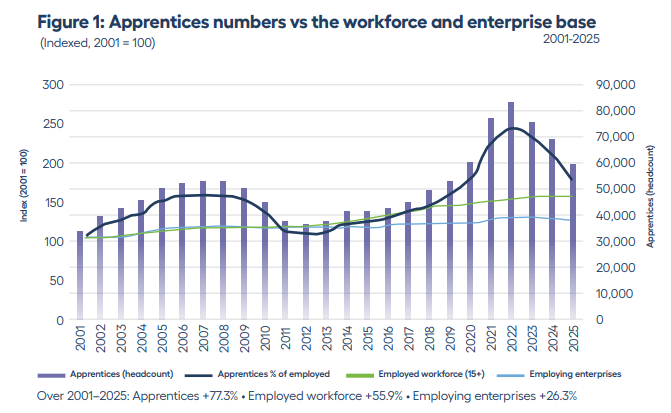
To address the issue, The Skills Group is also calling for advanced apprenticeships and degree-level apprenticeships. It also suggested giving apprentices and other work-based learners access to student loans and allowances that are available to other tertiary students.
"We have spent much of the past seven years restructuring vocational education, but changing who runs the system does not necessarily change the experience of the apprentice or the employer," said The Skills Group chief executive Rosanne Graham.
"The next step needs to be about the apprenticeship itself – making it easier to enter, recognising the skills people already bring, creating opportunities to progress and better supporting the employers who train them."