New data shows fewer organisations believe their workforce is ready for AI adoption

As investments in artificial intelligence tools surge, a new report has found that fewer business leaders believe that their workforce is ready to successfully leverage the technology.
Worldwide spending on AI is forecast to total $2.52 trillion in 2026, an increase of 44% year-on-year, according to Gartner's latest insights.
But a new report from Kyndryl shows that only 23% of senior business and technology leaders believe that their workforce is ready for AI, down six points from 2025.
Just a quarter of Kyndryl's 1,100 global respondents also believe that their organisational culture is ready for AI adoption.
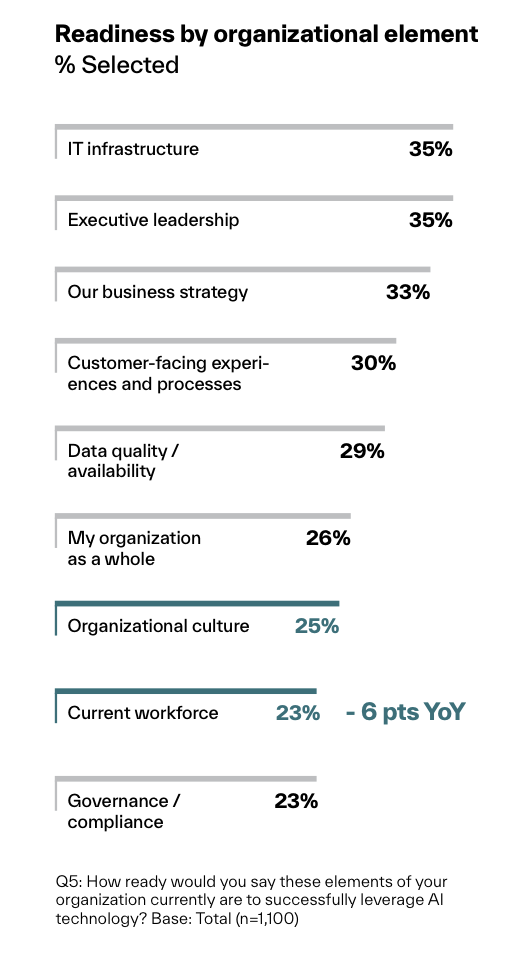
"The readiness gap is widest where it is least technical," the report read. "Organisations are far more confident in their tech than in the structures that support their people."
Most leaders also aren't confident that human aspects will be ready any time soon, with only around a third saying their workforce skills and role structures (36%) and organisational culture and change capacity (33%) will be ready within the year.
Despite these gaps, the report found that few organisations are investing in workforce planning measures to manage AI transformation effectively.
Just around a third of leaders have an accurate inventory of employee skills (34%) and have implemented a formal budget and proactive upskilling strategy (31%).
Only around a quarter of leaders also said they implemented enterprise-wide workforce resourcing plans (28%) and career transition pathways for employees impacted by AI (25%).
Importance of workforce readiness
Workforce readiness is one of the distinct behaviours displayed by organisations that are successfully getting strong gains from AI adoption.
These firms, dubbed as the "Pacesetters," are 1.5 times more likely to achieve AI-related revenue growth and 1.6 times more likely to report better innovation for products and services.
Their other distinct behaviours that make them pull ahead include redesigning roles around AI, as well as implementing change management so the workforce understands the new operating model and has guardrails in place.
"The data shows that the organisations investing in people – whether it's rethinking roles and workflows, dedicating resources for upskilling and retraining, or guiding employees through change – are experiencing positive outcomes at a much higher rate," said Kim Basile, CIO at Kyndryl.
The report further underscored that Pacesetters do not stand out for pursuing different goals from others firms.
"What distinguishes them is not more advanced technology, but how they prepare their people, redesign work, and build trust," it said.