New report reveals impact of promoting individuals without leadership skills

Organisations may be missing out on crucial talent development as many "accidental managers" fall short on leadership skills, a new report has warned, highlighting the importance of first-time manager readiness in the workplace.
Global findings from the latest American Management Association (AMA) report revealed a paradox where employees are actively seeking growth, but lack the professional development opportunities.
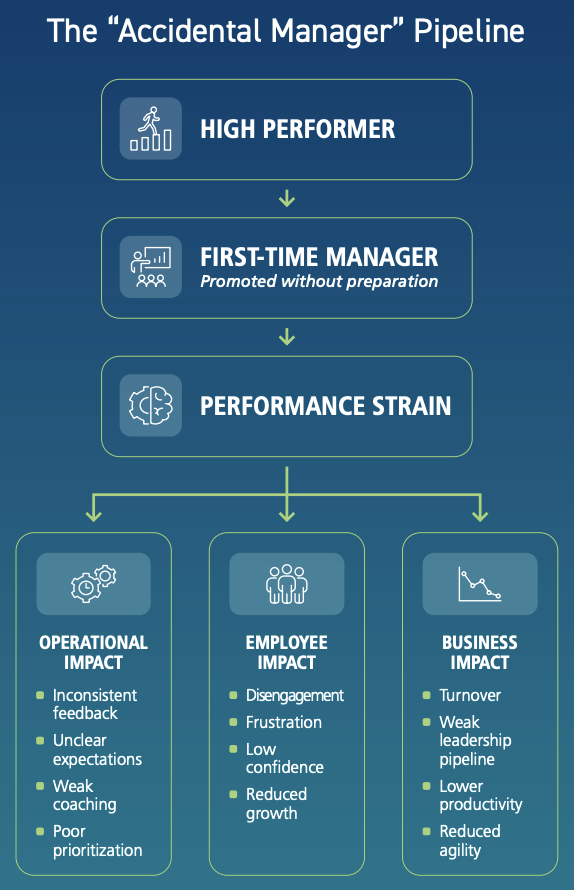
The report attributed this gap to "accidental managers," or individuals who are promoted into people leadership roles without formal leadership or management training.
"Organisations have a valuable asset right in front of them: employees who are ready and motivated to grow," said Manny Avramidis, president and CEO at AMA.
"The risk is that many managers have not been given the tools or support to turn that motivation into performance. Talent development can't sit outside the daily work experience. It needs to be reinforced by managers through communication and practical application."
Rise of 'accidental managers'
The findings come in the wake of the growing role of managers in workplaces, who are now expected to do more than supervise tasks or manage operations. According to the report, they are also expected to be:
- Coaches and mentors
- Communicators and translators of organisational priorities
- Performance facilitators
- Capability builders
- Change navigators
- Culture influencers
However, the report found that 51% of respondents reported being promoted into people management roles without formal leadership training.
"This creates what many organisations experience as the 'accidental manager' phenomenon - individuals who possess technical expertise or strong individual performance, but who may lack the leadership, coaching, communication, and performance management capabilities required to lead teams effectively," the report read.
This puts organisations at significant risk, including inconsistent employee experiences, reduced team performance, poor communication and feedback practices, lower employee engagement, increased turnover among high-potential talent, weak succession pipelines, and organisational agility.
"Organisations that fail to invest in first-time manager readiness often unintentionally create downstream performance and engagement challenges throughout the organisation," the report warned.
What can HR leaders do?
The report underscored the need to invest more intentionally in managers in order to strengthen leadership capability in workplaces.
It recommended the establishment of "more intentional pathways for leadership readiness" before managers can assume management responsibilities.
These pathways may include leadership readiness programmes, transition-to-management onboarding, mentorship and peer support, leadership simulations and experiential learning, as well as ongoing reinforcement and coaching.
The report further advised organisations to help managers understand that people development is not separate from performance, but rather is central to it.
"Managers are often the link between employee potential and organisational performance," said Avramidis.
"When organisations prepare managers to develop people effectively, they strengthen both individual growth and business outcomes. That is when talent becomes a strategic advantage."