Experts urge HR leaders to rethink “AI skills” hiring and redesign work so adaptable MacGyvers – not just gadget-loving Qs – can unlock real value
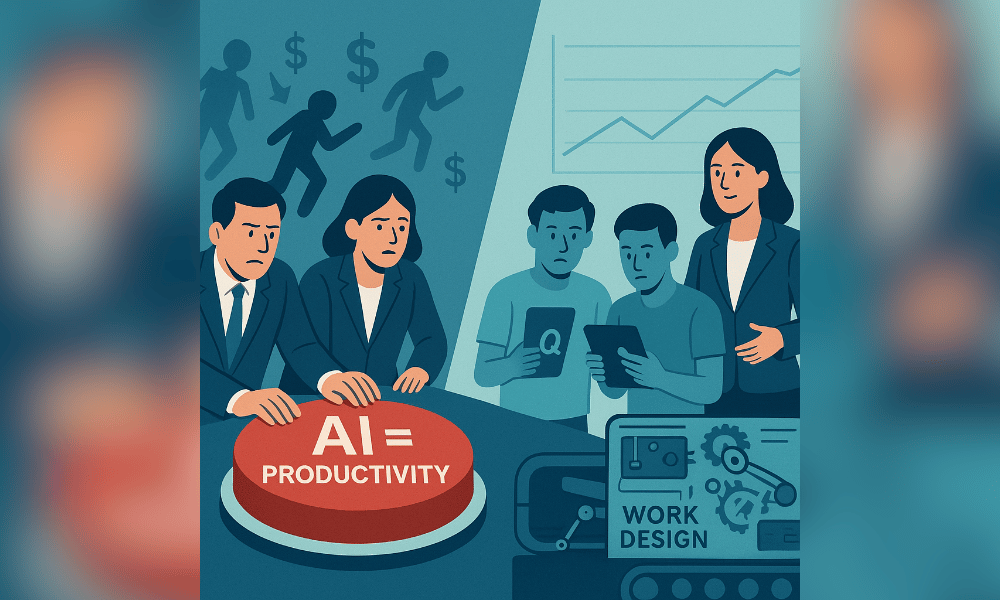
Employers racing to roll out AI risk over-promising productivity gains, cutting headcount prematurely and hiring for the wrong skills.
In conversation with HRD, Emily Rose McRae, senior director analyst in the Gartner HR practice said many organisations are acting on the assumption that AI will “magically” transform productivity, despite little evidence so far that broad, enterprise-wide deployments are delivering meaningful financial returns.
One of the biggest issues she sees is what she calls “risks before reality” – leaders acting on the idea of AI-driven productivity rather than the current reality on the ground.
“There’s this general perception that AI should somehow make us more productive. Of course, it’s not that simple,” McRae said.
“It might assist with things. A lot of times it’s assisting with things we weren’t doing before… our work has more thoroughness to it. But it’s not actually necessarily saving us time and that’s pretty stressful.”
The stakes rise when CEOs layer cost-cutting expectations on top of that hype.
“When you add in a CEO expectation of cutting headcount, suddenly we run into this issue where we’re either cutting headcount in advance or in anticipation of AI somehow creating more productivity, or simply because others have done it and they’re rewarded financially in the stock market for doing so,” McRae said.
“That puts HR leaders in a really challenging position… some functions just aren’t going to see those kinds of savings, no matter how much you invest in AI and redesign processes. It’s just not how it’s going to work – and that’s a problem.”
Why ‘AI skills’ hiring is the wrong target
McRae also challenged the growing trend of organisations trying to recruit for generic “AI skills” without first redefining roles or workflows.
Corporate instances of tools like ChatGPT, which sit behind strict firewalls and controls, can be dramatically different from the consumer versions many candidates use at home. McRae said some employees are even stepping outside corporate systems to get work done.
Instead, she argued, employers should stop fixating on whether someone can “write prompts” and focus on deeper capabilities.
“What we actually need is people who can understand how the process works, regardless of what technology is doing – not just what are the steps, but why are those steps,” she said. “Finding out that people think about iteration and validation of their outcomes – that’s helpful.”
McRae urged HR leaders to not just hire “Qs” as you need “MacGyvers” too.
“The comparison I’ve been using is the difference between hiring a bunch of Qs from the James Bond film and book series, and hiring a bunch of MacGyvers,” she said.
Q, the gadget genius, represents highly specialised tool experts: “Expert with the gadgets… can build all sorts of amazing things. Probably not great in stress situations in the field.”
MacGyver, by contrast, symbolises adaptable problem-solvers: “People who can use whatever the tools are at hand to get the job done because they understand the basic tenets of how things work… openness to using those tools if those are useful, and [the] ability to use duct tape and a glue gun if they’re not useful or they’re not available.”
She noted that leaders tend to hire a lot of Qs while neglecting the MacGyvers. This can cause issues when running into unintended problems that require adaptability and quick thinking.
"We don’t know what six months looks like": Why AI is forcing a new kind of talent strategy
To add some further context on what’s happening on the front lines, Liz Levick, Securian Canada’s talent acquisition manager noted that AI isn’t just a new skillset to recruit for – it’s fundamentally reshaping how organisations think about strategy, internal mobility and the very idea of “capabilities”.
For years, HR leaders have talked about operating in a “VUCA” world – volatile, uncertain, complex, ambiguous. But Levick says that framework no longer fully captures the pace and nature of change AI is driving.
This is why leaders are now adopting the “BANI” model: brittle, anxious, non-linear and often incomprehensible.
“The world of work, the global economy, is changing so rapidly, a lot of that driven by developments in AI, that it’s really hard,” Levick explained. “It’s become very difficult to predict what’s coming and to prepare for things.”
Under the old VUCA assumptions, organisations could still plan two or three years out with some level of confidence. That’s no longer the case.
“At the moment, globally, we’re kind of facing this challenge of like, we don’t even know what things are going to look like in six months from now,” she said.
For talent leaders, that uncertainty puts pressure on the old model of highly prescriptive, multi-year talent roadmaps.
Levick understands that long-term ambitions still matter, but they have to be built on a far more flexible foundation.
AI as catalyst for a skills-based, internal-first mindset
AI is also accelerating a major philosophical shift in how organisations think about talent itself. Rather than focusing on job titles, Levick says the most resilient employers will organise around skills and capabilities – especially when it comes to emerging technologies.
“We still tend to think about talent like our talent strategy is based on roles, rather than skills and capabilities,” she said.
“Skills and capabilities will give organisations more flexibility to think differently about where they use people.”
That skills lens becomes critical when AI tools and use-cases evolve faster than traditional workforce planning cycles. Instead of hiring narrowly defined “AI experts”, Levick believes companies should map adjacent skills and deliberately grow capability from within.
She links this directly to the idea of an “internal talent marketplace” – a system where organisations can see, move and develop people based on their skills, not just their current job.
Tools without redesign: why AI experiments stall
McRae continued and issued a word of caution over investing in AI capabilities faster than redesigning work.
“Most companies aren’t investing that heavily in redesigning roles and workflows,” she said. “They’re hoping that generative AI tools will magically change everything. And what we’re hearing time and time again from clients is, so far, not so much. And they’re very expensive.”
Across core systems such as CRM platforms and HR systems, she sees a familiar pattern: AI features are switched on, but use is optional and outcomes are vague.
“It’s not enough to add AI if we also haven’t given people – and asked people – to experiment when we haven’t taken anything away from their workloads,” she said.
With eight of the nine top workplace risks Gartner has identified now tied to AI, it’s no surprise employers feel compelled to act. Many are driven less by a clear business case and more by anxiety.
Despite the density of media coverage and vendor marketing, she stressed that the technology is still in its infancy as an enterprise tool.
Far from being punished, many of the organisations taking a slower, more selective approach are actually benefiting.
By contrast, those racing ahead without foundations like strong data quality and clear use cases are more likely to be disappointed.
While much of the public conversation remains overwhelmingly optimistic, McRae said a more sober, evidence-based stance is overdue.
In her view, AI will only deliver on its promise if leaders move beyond buzzwords, metrics in isolation and faith in “magic productivity”.
That means resisting the urge to slash headcount on speculative productivity gains, hiring adaptable “MacGyvers” rather than tool-specific “Qs”, and doing the difficult work of redesigning processes so AI is embedded into how work actually gets done.
“There will be value from it,” McRae said. “But it’s not going to come from just buying the tools and hoping for the best.”