Geopolitics, AI, climate shocks and deepening inequality are all converging on the workplace
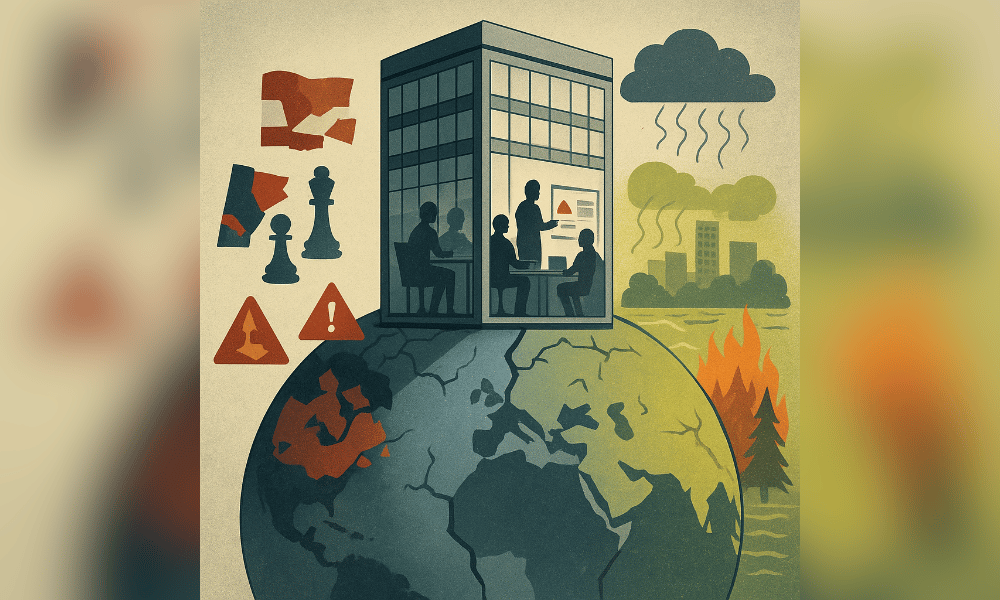
The coming decade will test HR like few periods before it, with the World Economic Forum’s Global Risks Report 2026 warning that work is entering a far more contested and unstable era.
Based on input from more than 1,300 experts across business, government, academia and civil society, the report argues that 2026 “marks an age of competition” in which geopolitical rivalry, economic stress, social fragmentation and rapid technological change collide to reshape jobs, workplaces and careers.
For people leaders, the analysis reads less like a distant macro‑economic forecast and more like an immediate playbook on talent risk, culture, wellbeing and workforce resilience.
A workforce on edge in an unsettled world
The outlook is strikingly pessimistic. Around half of respondents expect the next two years to be “turbulent” or “stormy”, and that share climbs to 57% when they look out over the next decade. Only 1% foresee a calm environment in either timeframe.
The near term has experts heavily concerned about geopolitical risks, as continued global evens continue to impact the workforce.
Over the next two years, the top five global risks ranked by respondents are:
- Geoeconomic confrontation
- Misinformation and disinformation
- Societal polarisation
- Extreme weather events
- State based armed conflict
Looking to the long term, respondents were far more concerned with the environment and the risks this will bring.
Over the next decade, the top five global risks were:
- Extreme weather events
- Biodiversity loss and ecosystem collapse
- Critical change to Earth systems
- Misinformation and disinformation
- Adverse outcomes of AI technologies
For HR, this is not just background context. Persistent instability tends to surface as rising anxiety and mental strain among employees, intensified expectations that employers will offer support and higher chances of burnout, disengagement and turnover where organisations fail to adapt
Many HR leaders already report that staff are bringing fears about war, the cost of living and job security directly into performance reviews, check‑ins and engagement surveys.
The new risk outlook suggests these concerns will become a built‑in feature of working life rather than a temporary spike.
Confidence in the multilateral system is described as “under pressure”, as protectionist policies, sanctions regimes and declining trust in the rule of law rearrange long‑standing trade and investment patterns.
Inside multinational organisations, HR teams are already feeling the knock‑on effects through more frequent geopolitical shocks affecting global mobility programs, remote hubs and expatriate postings, headcount and footprint changes driven by sanctions, export controls or regional instability and a rising need for scenario planning and agile workforce models so activities can be shifted between regions at short notice
The cultural impact is equally challenging. Highly polarised public debates on wars, trade, national security and human rights do not stop at the office door. They are surfacing on internal collaboration channels, in team disputes and even in formal ER and grievance cases.
HR leaders are increasingly tasked with maintaining psychological safety and respectful dialogue while preventing the workplace from becoming another arena for culture‑war battles.
Polarisation, inequality and the ‘fairness’ stress test
Beyond geopolitics, the report identifies social and political polarisation as a defining risk for democracies, with extremist movements eroding institutional resilience and public trust.
Economic inequality stands out as the most interconnected global risk for the second consecutive year. With wealth concentration rising and the cost of living still biting in many regions, the authors warn of “permanently K‑shaped economies” and a social contract under heavy strain.
Within organisations, this is likely to show up in three main ways:
- Intense focus on pay and benefits: Employees and unions are expected to keep pushing for living wages, robust pay transparency and demonstrable progress on gender and racial pay gaps.
- Fragile trust in corporate commitments: Bold statements on ESG, diversity or wellbeing will increasingly be judged against day‑to‑day experience, with scepticism growing where there is a gap between words and reality.
- Deeper polarisation within teams: Conflicts over politics, identity and social issues may spill into working relationships, making it critical to have strong frameworks for dialogue, clear boundaries and escalation routes that don’t simply shut down difficult conversations.
In this environment, reward strategy, internal communications and inclusion practices are no longer “nice to have” initiatives – they function as core controls in the organisation’s overall risk management system.
Technology, AI and a new generation of people risks
Rapid technological change – and AI in particular – is framed in the report as both a major opportunity and a fast‑emerging source of risk.
The report argues that AI and related tools are reshaping labour markets, the information ecosystem and even weapons systems – all of which have profound consequences for how employers hire, manage and support their people.
HR increasingly must consider how AI will transform roles, skills requirements and career paths over the next five to ten years, and what does that demand from workforce planning and learning strategies?
What guardrails are in place must also be considered to prevent discrimination or bias in AI‑enabled recruitment, promotion, performance management or monitoring tools.
HR leaders will also need to consider how redeployment, reskilling and redundancy will be handled in ways that preserve trust and minimise harm.
Information integrity is another people‑centric concern. Within companies, false or misleading narratives about strategic decisions, policy changes or even basic health guidance can spread quickly, especially on internal channels.
Climate risk: less visible short term, dominant long term
One of the more striking shifts in this year’s report is down the short‑term priority list, even as climate threats become more daunting over the long term.
Over the next two years, “extreme weather events” has fallen in the severity rankings, and “pollution” also drops. Overall, respondents rate environmental risks as less acute in the near term than they did a year ago.
Stretch the horizon to a decade, however, and climate and nature‑related risks dominate. Environmental threats are seen “with the most pessimism” of any category, with nearly three quarters of respondents expecting a turbulent or stormy outlook.
For HR, the message is that even if boardroom conversations temporarily pivot to geopolitics or economic headwinds, climate pressures will continue to shape employees’ lives and expectations.
Climate‑related disasters will disrupt operations, commuting, supply chains and communities, directly affecting both physical safety and mental health.
Environmental factors such as heat stress and air quality will become central occupational health and safety issues.
And many employees – especially younger cohorts – will assess employers based on tangible climate action, adaptation measures and credible transition plans, rather than on high‑level net‑zero slogans.
The leadership challenge: resilience, wellbeing and trust
Viewed as a whole, the report portrays a decade in which environmental, societal, technological, economic and geopolitical risks all intensify rather than recede.
If organisations regard these forces as distant, external concerns, the likely human outcomes are chronic anxiety, burnout and disengagement. If they respond thoughtfully, HR leaders suggest, workplaces can instead become anchors of stability, meaning and fair treatment in an unpredictable world.
Over the coming years, WEF expects senior people leaders to concentrate on:
- Building organisational resilience through scenario‑based workforce planning, cross‑skilling, flexible work design and stronger succession pipelines
- Treating mental health and psychosocial safety as strategic priorities, recognising global instability as an ongoing stressor rather than a one‑off crisis
- Rebuilding and protecting internal trust by being radically transparent about pay decisions, restructures, AI deployment and climate strategy
- Giving managers the skills to navigate polarisation and conflict within teams, balancing inclusion and free expression with clear protections against harassment and harm
The report closes with the observation that “the future is not a single, fixed path but a range of possible trajectories, each dependent on the decisions we make today as a global community.”
For HR, those decisions now sit at the centre of strategy – from how AI is rolled out, to which employees are protected and supported in a crisis, to whether the workplace deepens societal divides or becomes one of the few remaining spaces for constructive dialogue and shared purpose.