Are you sure your employees are using AI after training?
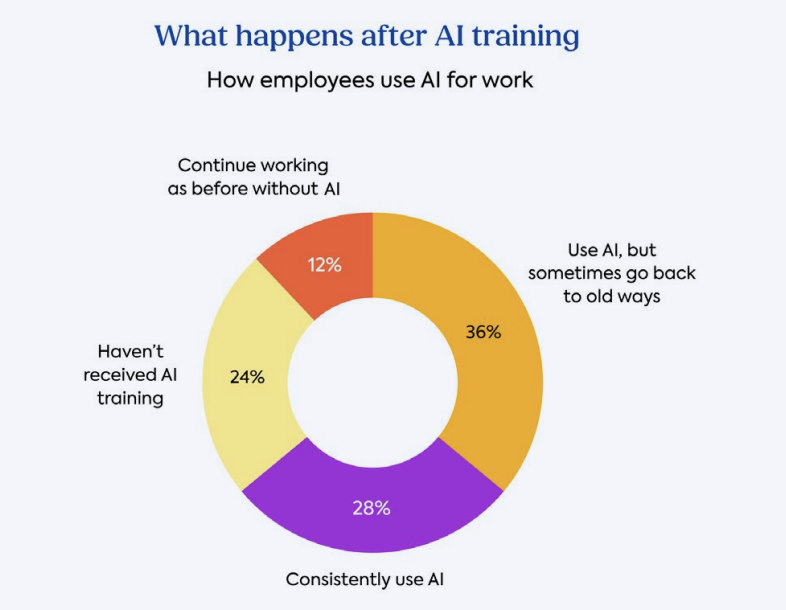
Training employees to use AI does not guarantee they will keep using it, according to new research from TalentLMS, which found that only 28% of workers consistently use AI after being trained on it.
The employee training platform's report, Habit hugging: When old habits block new ways of working, surveyed 1,500 full-time employees in the United States. All had received training on a new tool, technology, process or way of working within the previous 12 months.
The survey found that 36% of respondents use AI but sometimes go back to their old ways of working, while 12% have been trained but continue to work without it. Another 24% said they had not been trained to use AI for work tasks at all.
Among those who do not consistently use AI after training, the most common reason was a lack of trust in AI for high-stakes tasks (32%). The other most common reasons are:
- Spending too much time checking or reworking its output (25%)
- Unsure when AI use was acceptable (15%)
- Forgetting to use AI (15%)
"AI is fundamentally changing how work gets done, but AI training alone isn't enough to make new ways of working stick," said Dimitris Tsingos, CEO of Epignosis, the parent company of TalentLMS. "Organisations need to move beyond training completion and help employees put what they've learned into practice."
The rise of 'habit hugging'
TalentLMS described the broader pattern as "habit hugging." It defined this as holding onto familiar ways of working while jobs change, expectations rise and AI reshapes how work is done.
Across all new ways of working, only 41% of employees said they consistently use the new approach after training. More than half (52%) follow it but sometimes fall back on old habits, and eight per cent do not adopt it at all.
Sixty-five per cent said letting go of an old habit is harder than learning a new one. Forty-two per cent said they still use tools or processes their manager thinks have been replaced.
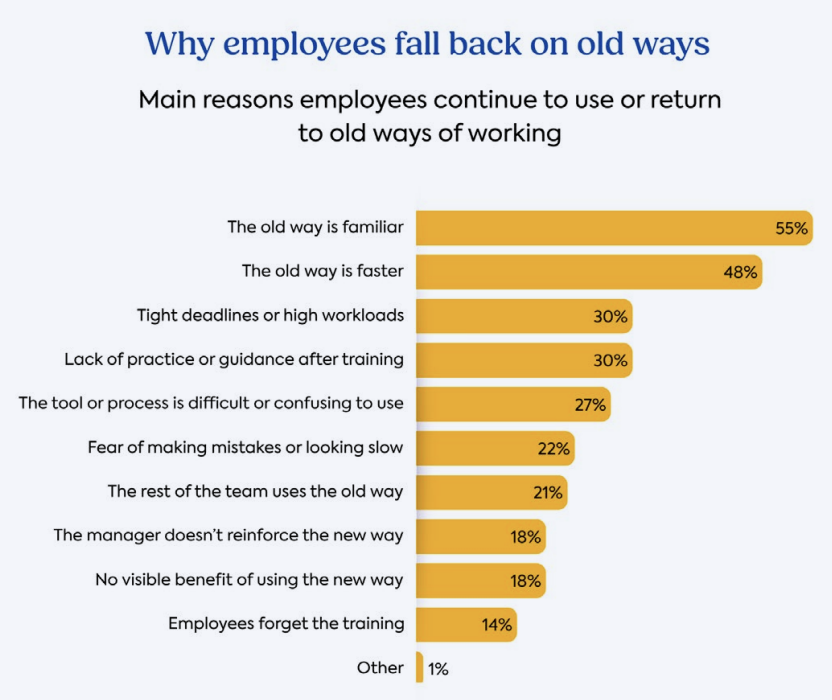
Among employees who keep using or return to old ways of working, 55% said the old way feels more familiar and 48% said it is faster.
Workplace pressures may also play a part. Six in 10 respondents said that at their company, getting results matters more than using the new way of working.
Another 48% said they feel rushed to adopt new ways of working, and only 41% said they are given room to be less productive while learning.
Tracking beyond completion
The research also pointed to gaps in how employers follow up after training.
Only 41% employees said their company tracks training completion. Fewer said it checks whether they are using what they learned (36%) or assesses whether they understood it (34%).
Another 10% said their company does none of the post-training follow-up activities included in the survey.
Asked what would help them use new tools or processes more consistently, half of employees said making the new way part of their everyday workflow.
Nearly half (49%) of employees cited more opportunities to practise, and 47% said seeing how the new way improves their work.
How managers can make a difference
Meanwhile, the report further found that consistent use of new ways of working was more than twice as common among employees whose managers also used them (49%) as among those whose managers did not (22%).
Carolina Caro, CEO of Conscious Leadership Partners, said in the report that managers can influence what she called "identity inertia."
"When people return to old ways of working, I call this Identity Inertia: the pull toward what is familiar, even when we've learned something new," Caro said in the report.
Managers can break this by modelling new behaviour themselves and making their own moments of reversion visible.
"They can ask themselves, 'When did I use the new behaviour, and where did I revert to the old way?'" Caro said.
"That way, they pay attention not only to what they did, but to the beliefs, embodied reactions, and narratives that continue to perpetuate the default behaviour. When we learn what's getting in the way, we can unlearn what no longer serves us, create space for what's next, and open up different possibilities and outcomes."