Employers cite company performance as top factor influencing bonuses

Company performance has emerged as the top factor influencing bonus payouts, outweighing employees' individual performance and expectations, according to a new report from Robert Half.
Its latest poll found that 72% of employers use company performance as the metric when considering bonus amounts, followed by individual performance (69%) and available budget (62%).
Only around a third of employers consider employee expectations (37%) and industry trends (30%) when deciding bonus payouts, according to the report, while just 27% cite competitor benchmarking.
The findings challenge traditional expectations that bonuses are based on employee performance and achievements in the workplace.
"Amid the current economic landscape, bonuses are functioning as a barometer of organisational performance rather than purely individual achievement," said Nicole Gorton, director at Robert Half.
"While personal contribution remains critical, employers are embedding bonus decisions within broader commercial realities, signalling a more integrated and financially disciplined approach to reward strategy."
Bonuses remain steady
The findings come amid the stability of bonus payouts in recent years despite ongoing economic pressures, according to the Robert Half report. In the most recent bonus cycle, 43% of firms reported higher bonus payouts, while about 51% said bonuses remained at similar levels.
Performance bonuses remained the most common incentive across nearly all employee levels, but eligibility and structure vary widely.
For people managers, the report found that 50% are offered performance bonuses. They are also granted project completion bonuses (42%), holiday (39%), referral (37%), profit-sharing (36%), retention (34%), and then sign-on bonuses (28%).
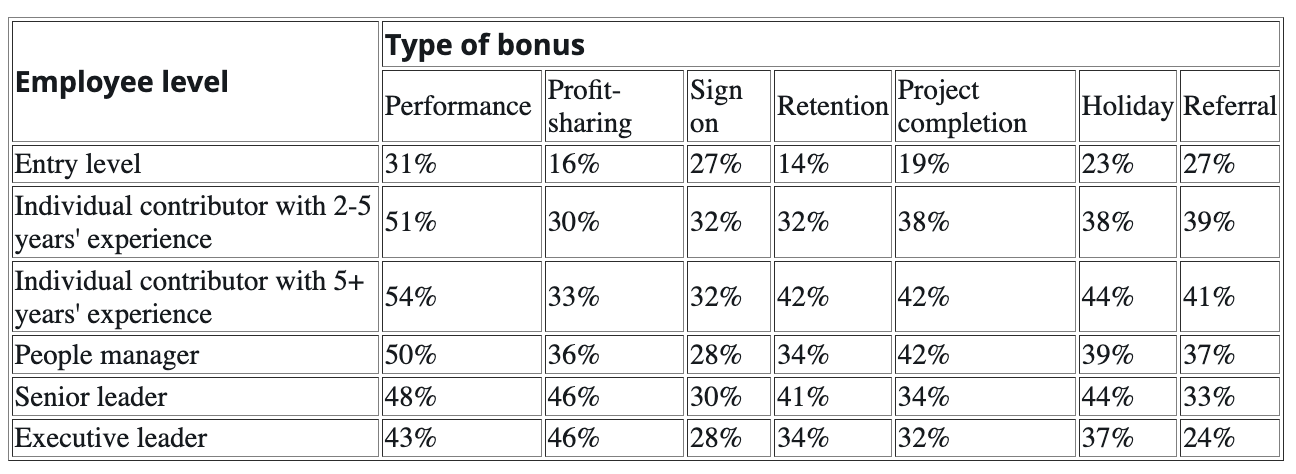
According to the report, the variations in bonuses offered reflect how employers align rewards with responsibility, tenure, and impact on overall business performance.
"Executives are more closely tied to profit-sharing because their influence sits at the enterprise level, whereas performance-based bonuses dominate at earlier career stages where contribution is measured more individually," Gorton said.
"The modern remuneration strategy is strategically engineered to mirror accountability, influence, and business outcomes."